POSCO International Builds Consortium to Expand Electronic Bills of Lading
- Input
- 2026-08-26 16:59:28
- Updated
- 2026-08-26 16:59:28
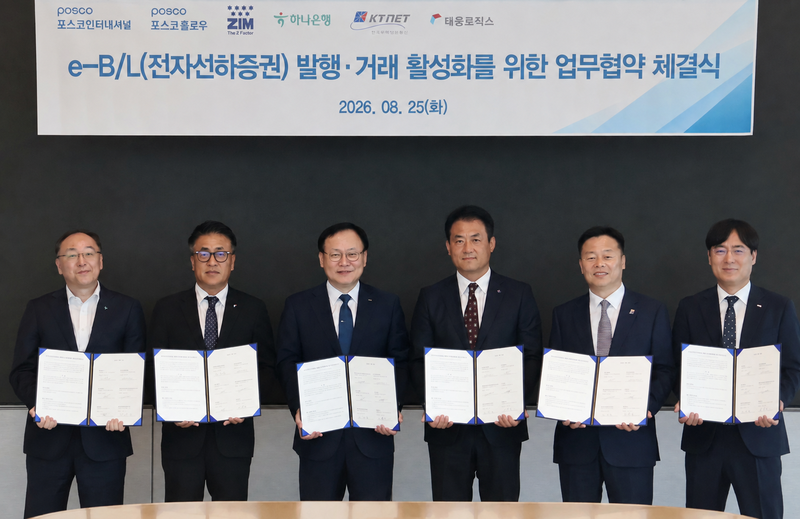
The previous day, POSCO International signed a memorandum of understanding for the activation of electronic bills of lading (e-B/L) with POSCO FLOW, global shipping company ZIM Integrated Shipping Services, Hana Bank, Korea Trade Network, and Taewoong Logistics Co., Ltd. at POSCO Center in Gangnam-gu, Seoul, and officially launched the e-B/L consortium. The participating companies plan to jointly build infrastructure for issuing and trading e-B/Ls, expand use by shippers and financial institutions, and cooperate on related regulatory improvements and legislation.
A bill of lading is a key trade document that serves as proof of cargo ownership and payment settlement. At present, most are issued as paper originals and typically take five to 10 days to move through exporters, importers, shipping lines, and banks. During that process, international courier costs are incurred, and there are also risks of delivery delays, loss, forgery, and tampering. An e-B/L replaces the paper original with a digital document and handles issuance and transactions online.
POSCO International expects that wider adoption of e-B/Ls could cut the circulation time for trade documents from the current five to 10 days to within a few hours. It also expects international courier and document processing costs to fall by as much as 80%. With fewer paper documents and less international shipping, the move is also expected to help reduce carbon emissions. As the consortium's lead company, POSCO International plans to oversee the spread of e-B/Ls and drive the digitalization of trade finance. Jeong Kyung-jin, head of POSCO International, said, "This consortium will set a new standard for Korea's e-B/L ecosystem by combining decades of trade expertise accumulated as a general trading company with top-tier domestic e-trade and financial partners." He added, "Beyond simply digitizing documents, we will accelerate the digital transformation of the entire trade process and contribute to strengthening the country's logistics competitiveness."
[email protected] Cho Eun-hyo Reporter