86.4% of Jeju 4.3 compensation reviews completed, but only 24.3% of family-record corrections
- Input
- 2026-08-26 16:42:01
- Updated
- 2026-08-26 16:42:01
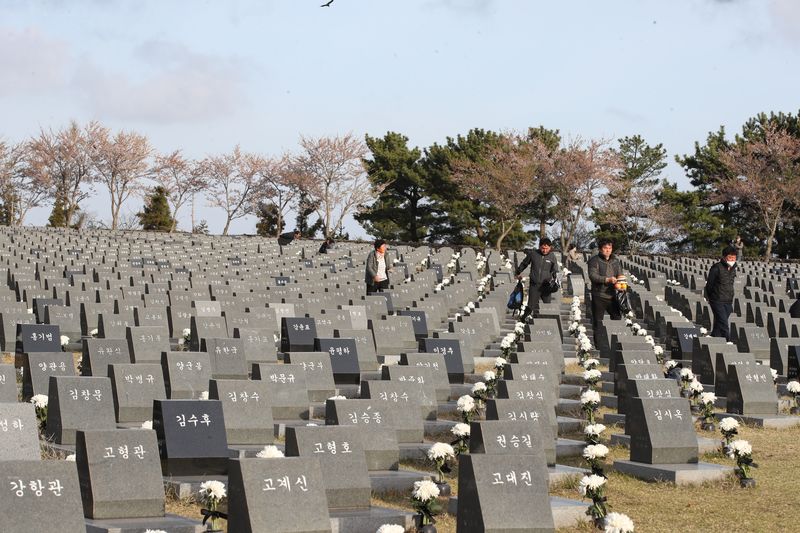
[Financial News, Jeju = Reporter Jung Yong-bok] The administrative review for compensation payments for victims of the Jeju uprising has been completed for 86.4% of all applicants, while reviews to correct family relations distorted by the uprising have reached only 24.3%. As monetary compensation has advanced substantially, the work of aligning actual family ties with legal records is emerging as another major task in restoring rights for victims and their families.
According to Jeju Special Self-Governing Province on the 26th, the 248th meeting of the Jeju 4.3 Working Committee was held at Halla Hall in the Jeju Provincial Government Office, where it reviewed compensation payments for 287 victims and eight requests to amend family-register records.
With this review, the Jeju 4.3 Working Committee has completed its examination of 11,092 of the 12,835 victims who applied for compensation. That accounts for 86.4% of the total.
Among them, 10,502 victims have completed the final deliberation and approval process by the Jeju 4.3 Truth Investigation and Victims’ Honor Restoration Committee.
So far, compensation totaling 742.4 billion won has been paid to 101,160 claimants related to 9,563 victims. Among claimants living overseas, 2,377 people have received 17 billion won in compensation.
Unlike the relatively advanced compensation process, family-record corrections still have a long way to go. Excluding 76 withdrawn cases, 544 applications remain to correct cases in which actual family relations and legal records were left inconsistent because of deaths, disappearances, and the interruption of marriage and birth registrations during the Jeju uprising.
By category, the largest number involves confirmation of a biological parent-child relationship between a victim and a de facto child, with 242 cases. That is followed by 193 cases of de facto adoptive-parent relationships, 50 cases of death-record entries or corrections, 48 cases to create family-register records for victims without a family registry, and 11 cases of de facto marital relationships.
Of these, the Jeju 4.3 Working Committee has completed reviews of 132 cases, or 24.3% of the total. It has asked the Jeju 4.3 Committee to deliberate and decide on 114 cases, while 18 cases were rejected or closed.
Of the 114 cases submitted to the central Jeju 4.3 Committee, 65 have been recognized so far. These include 35 cases confirming a biological parent-child relationship between a victim and a de facto child, 27 cases involving death-record entries or corrections, and three cases to create family-register records for victims without a family registry. Four cases were not recognized or were closed, and 45 remain under review.
Since the Jeju 4.3 Committee first recognized a biological parent-child relationship between a victim and a de facto child in February, Jeju Special Self-Governing Province has been accelerating related fact-finding and reviews.
The missing-person declaration process, which is intended to settle the legal status of missing victims, has moved relatively quickly. Excluding 64 withdrawn cases, there were 244 applications for missing-person declarations, and 236 of them have completed review by the Jeju 4.3 Working Committee. The Jeju 4.3 Committee has also reviewed all 236 cases, recognizing 232, rejecting one, and leaving three pending.
A missing-person declaration is a procedure that corrects the legal problem of victims who disappeared during the Jeju uprising but are still legally listed as alive. It provides the legal basis needed to align family records with reality.
The eight family-register correction cases reviewed by the working committee on this day are also part of that broader rights-restoration process. They included seven cases to confirm biological parent-child relationships between victims and de facto children, as well as one request for a missing-person declaration for a victim who disappeared.
Cases that pass this review will undergo additional fact-finding before being submitted to the Jeju 4.3 Committee for final deliberation and decision.
Byun Young-geun, director of the Special Self-Governing Administration Bureau of Jeju Special Self-Governing Province, said, "We have completed administrative reviews for more than 86% of the victims who applied for compensation," adding, "We will push ahead without disruption with the remaining compensation and family-record correction reviews to accelerate the restoration of rights for victims and bereaved families."
[email protected] Jung Yong-bok Reporter