Will education subsidy grants be cut by 20 trillion won next year? Jeju Superintendent Ko Eui-sook says, "The foundation for future education must not be shaken"
- Input
- 2026-08-26 16:24:23
- Updated
- 2026-08-26 16:24:23
[Financial News Jeju = Jung Yong-bok] The formula used to calculate Local Education Subsidy Grants, which has served as the backbone of elementary and secondary education finance for more than half a century, is set for a major overhaul, and resistance from the education sector is intensifying. The Jeju Special Self-Governing Provincial Office of Education has joined a joint response with education offices across the country, calling on the government to withdraw the reform plan and reopen discussions with education stakeholders.
According to the Jeju Provincial Office of Education and the Ministry of Education on the 26th, the government announced a reform plan at the first Fiscal Management Strategy Council on the 21st. The plan would abolish the current system that automatically links Local Education Subsidy Grants to 20.79% of national tax revenue and introduce a new formula that reflects economic growth and changes in the school-age population.
Under the new formula, next year’s grant amount would be determined by applying part of the average nominal growth rate over the past three years and the rate of change in the school-age population to the previous year’s education subsidy grants.
The government estimates that next year’s education subsidy grants under the new formula would amount to 80.3 trillion won. That is a 5.1% increase from this year’s 76.4 trillion won, but it is nearly 20 trillion won less than the roughly 100 trillion won expected if the current tax-linked system is maintained.
This is the point of contention for the education sector. Provincial and metropolitan offices of education argue that even if the school-age population declines, investment per student is actually rising in areas such as school facility improvements, education welfare, digital and artificial intelligence education, special education, and basic academic support. They warn that removing a stable, tax-linked funding base could reduce the predictability of medium- to long-term education plans.
The government has a different explanation. It says the current structure, under which elementary and secondary education grants automatically rise when national tax revenue increases even if the number of students falls, needs to be adjusted. It also wants to expand the scope of education investment to include early childhood, higher and lifelong education, and talent development.
The government plans to use the funds generated between the current system and the new formula for lifelong education through the education and talent account of the newly created Future Response Fund.
It has also proposed safeguards to prevent a sharp decline in elementary and secondary education finance. If the amount calculated under the new formula is lower than the previous year, the state would cover the difference, and the relevant law would explicitly state that the total grant amount cannot fall below the previous year’s level.
However, provincial and metropolitan superintendents say that guaranteeing only the previous year’s amount is not enough to ensure fiscal stability or respond to future needs.
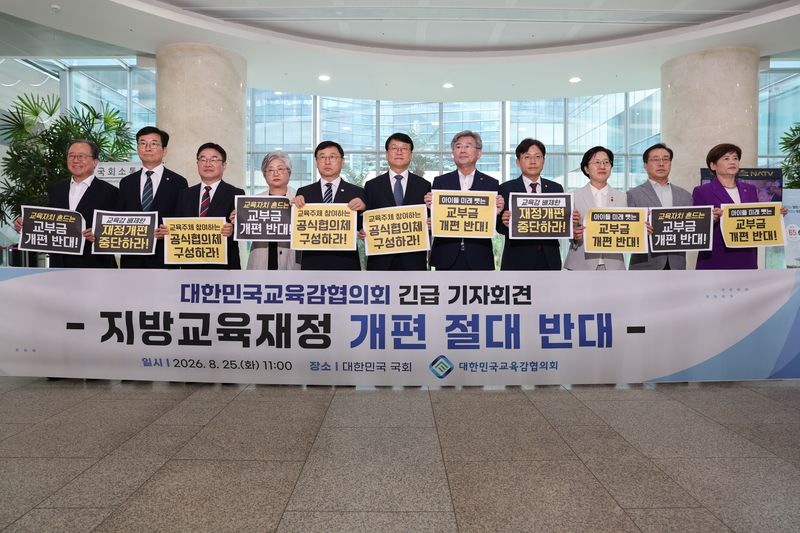
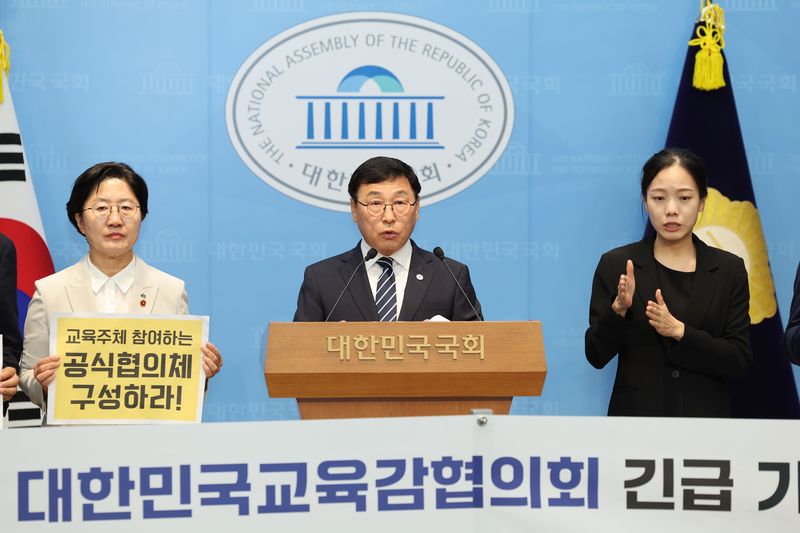
The Korean Council of Superintendents of Education held an emergency press conference at the National Assembly on the 25th and said it was speaking for all 16 provincial and metropolitan superintendents in opposing the reform of local education finance.
The superintendents argued that the reform would do more than change the grant calculation method. They said it would alter the basic framework of local education finance that has been in place for the past half-century. They also criticized the government for designing the system around ministries without sufficient consultation with the superintendents who actually manage local education finance.
The council demanded the creation of a formal consultative body with the participation of provincial and metropolitan superintendents. It said the body should revisit, from the ground up, not only the grant calculation method but also the appropriate scale and stability of local education finance and future education demand.
The government began the reform process on the 24th by issuing advance notice of a partial revision to the Local Education Grant Act. In the coming National Assembly deliberations, a back-and-forth between the government and the education sector over funding levels and calculation methods is expected to continue.
The Jeju Provincial Office of Education is also joining the joint response. It believes that if the predictability of education finance declines, it may become difficult to steadily improve Jeju’s education environment and carry out future education projects.
In particular, Jeju’s island geography and the large number of small schools mean that education spending needs cannot be judged by student numbers alone, a point that should be addressed in future discussions.
Jeju Special Self-Governing Province Superintendent of Education Ko Eui-sook said, "The stability of local education finance is the foundation for protecting children’s right to education and the sustainability of future education." She added, "We will respond actively with other provincial and metropolitan offices of education so that Jeju’s stable fiscal base and investment in future education are not weakened."
[email protected] Jung Yong-bok Reporter