Science Knowledge Alone Is Not Enough... 32 Jeju Youth Teams Compete in Digital Convergence Challenge
- Input
- 2026-08-26 16:12:03
- Updated
- 2026-08-26 16:12:03
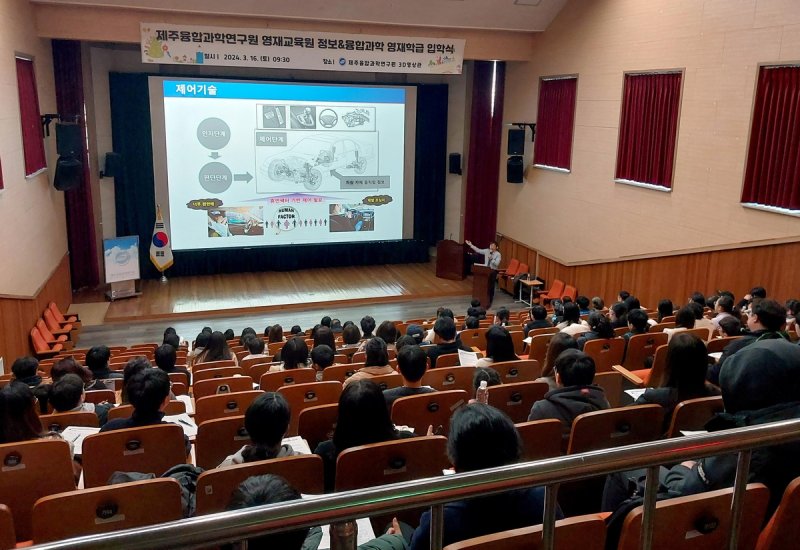
[Financial News, Jeju = Reporter Jeong Yong-bok] A competition will be held in Jeju to test students' convergence skills, not by how many correct answers they know, but by how well they can analyze a given science problem and turn it into a new result using digital tools.
According to the Jeju Convergence Science Research Institute on the 26th, the convergence science category of the 2026 Jeju Youth Science Exploration Competition will be held at the institute on the 29th.
A total of 32 teams will compete, including 26 middle school teams and 6 high school teams from the Jeju area. Students will need to combine scientific inquiry with digital skills to solve a task that will be revealed on the day of the event.
The competition will assess the entire process, from receiving the problem to producing the final result. After checking the topic and detailed tasks on site, participants will gather the necessary materials and divide roles among team members. They will then write a project proposal outlining their approach and use digital tools to create the final output and an explanation of their work.
The contest does not end with completing the output. Students must explain what problem they identified and how they combined scientific principles and ideas. They must also answer questions from the judges.
This is what sets the competition apart from a conventional science knowledge contest. Rather than simply reproducing fixed knowledge, it connects inquiry, collaboration, planning, digital production and presentation into a single problem-solving process.
The 2022 Revised Science Curriculum also emphasizes inquiry using a range of digital technologies and tools, including data, artificial intelligence and virtual experiments. The goal is not only to understand scientific principles, but also to apply them to real-world problem-solving and build integrated scientific literacy.
Judging will take into account not only the quality of the final output, but also digital proficiency, the systematic nature of the convergence process, the creativity of the planning and the clarity of the presentation.
The two top teams in the middle school and high school divisions will represent Jeju at the 44th National Youth Science Exploration Competition.
Song Jae-chung, head of the Jeju Convergence Science Research Institute, said, "I hope that the experience of solving problems using digital tools based on scientific inquiry and cooperating with friends will become an opportunity to build the skills needed in the future society." He added, "We will expand inquiry opportunities so that students can develop scientific imagination and convergence thinking."
[email protected] Jeong Yong-bok Reporter