Bitcoin Breaks Above $80,000 on U.S. Treasury Buybacks and Easing Regulation [Crypto Briefing]
- Input
- 2026-08-26 15:57:32
- Updated
- 2026-08-26 15:57:32
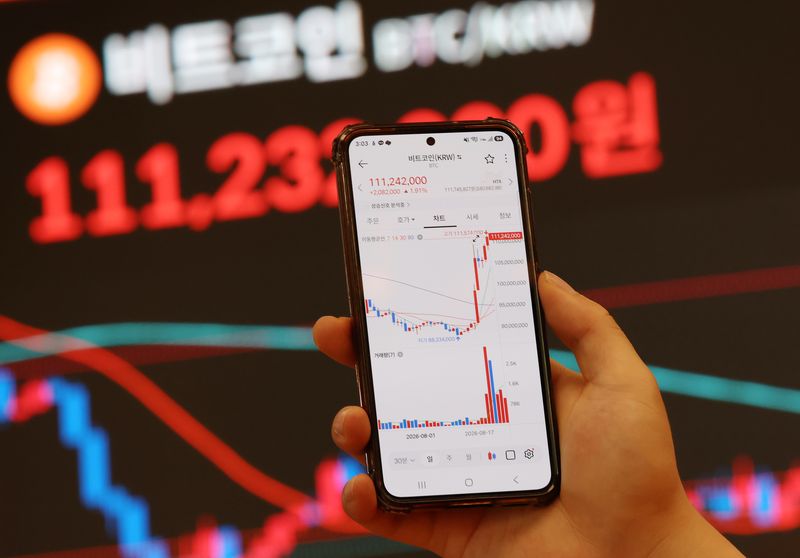
[Financial News] Bitcoin surged more than 20% over the past week and broke above $80,000, supported by the U.S. Department of the Treasury's expanded long-term Treasury bond buyback program and expectations that regulatory uncertainty around virtual assets will ease. Analysts said the rebound was also fueled by renewed inflows into spot exchange-traded funds (ETFs) and the unwinding of short positions that had built up in the futures market.
According to Investing.com on the 26th, Bitcoin climbed as high as $81,200 intraday the previous day before trading around the $79,000 level on the day. That is more than 22% higher than $64,700 on the 18th.
A key catalyst for the rebound was the Treasury's expanded buyback program for long-term bonds. The department recently said it would more than double the cap for each liquidity-support buyback of 10- to 30-year Treasury bonds, raising it from $2 billion to at least $4 billion.
Markets also focused on concerns over the U.S. fiscal burden and the dollar's value, alongside hopes for improved supply-demand conditions in longer-dated bonds. iM Securities said that after the Treasury's announcement, the dollar weakened while gold, silver and Bitcoin all rose, suggesting that the Debasement Trade — buying scarce assets to hedge against currency dilution — has spread into the virtual asset market.
Expectations for easing regulatory uncertainty also lent support. The United States Securities and Exchange Commission (SEC) has begun drafting separate rules for the issuance and fundraising of investment contracts linked to virtual assets. The proposal includes registration exemptions for early-stage project fundraising and a conditional safe harbor that would allow projects to escape investment contract regulations if certain requirements are met.
U.S. President Donald Trump also urged Congress to pass the Digital Asset Market Clarity Act during a recent meeting at The White House. The Commodity Futures Trading Commission (CFTC) said it would also move to improve the virtual asset regulatory framework by using its existing authority, separate from legislation.
Signs of improving institutional demand also emerged. Spot Bitcoin ETFs returned to net inflows in mid-month, while the discount in the Coinbase premium — a gauge of relative buying strength in the U.S. spot market — also narrowed.
A short squeeze in the virtual asset futures market was also cited as a factor behind the gains. As bearish short positions accumulated during the recent downturn, the rapid rebound in prices triggered forced liquidations and buybacks.
However, some observers noted that short covering is a one-off supply-demand factor rather than sustained buying demand. Unlike gold, which has long-term buyers such as central banks in major economies, Bitcoin relies more heavily on ETFs, Digital Asset Treasury (DAT) companies, and the risk appetite of retail and institutional investors.
Future prices are expected to be influenced by continued spot ETF inflows, U.S. regulatory policy, and broader macroeconomic conditions such as inflation and monetary policy.
Yang Hyun-kyung, a researcher at iM Securities, said, "For Bitcoin to establish itself as a debasement asset over the medium to long term, it is important how much the pool of long-term buyers that are less sensitive to market cycles expands."
[email protected] Kim Mi-hee Reporter