South Korea Pushes Ahead with a Fast-Track Delisting Drive... How It Differs from the U.S. and Japan [Delisting Storm 3]
- Input
- 2026-08-27 07:00:00
- Updated
- 2026-08-27 07:00:00
[Financial News] Under the delisting reform plan announced by the Government in February this year, the Financial Services Commission (FSC) began fully enforcing a system from the first day of last month that designates penny stocks and listed companies that fail to meet market capitalization requirements as monitored firms, while also sharply tightening the conditions for exiting that status.
The goal is to support the listing of innovative companies while quickly removing weak firms to address the "South Korea Is Becoming Uninvestable, Too" discount. But small-business groups are pushing back, calling for looser requirements and a one-year delay in implementation.
As the reform raises quantitative thresholds and shortens the recovery period, market confusion is growing. That raises the question of how similar South Korea's approach is to the systems used in the U.S. and Japan, which have comparable market structures.
Similar rules, but not the same... How do the U.S. and Japan do it?
The New York Stock Exchange (NYSE) and NASDAQ notify a company that it has fallen below the standard if its average closing price stays under $1 for 30 consecutive trading days. NYSE then gives a six-month grace period, while NASDAQ allows 180 days. If certain conditions are met, both can grant an additional 180 days.
One important point is the exception clause. On NASDAQ, companies that have carried out a reverse stock split within the past year, or that have had cumulative reverse splits of at least 250-for-1 over the past two years, cannot receive the regular grace period if they again fail to meet the minimum share price requirement.
NYSE has a similar rule. If a company has done a reverse stock split within the past year, or has had cumulative reverse splits of at least 200-for-1 over the past two years, and still fails to meet the price standard, the usual grace period is waived and suspension and delisting procedures begin immediately. The $1 threshold remains in place, but companies that have repeatedly tried to bypass it through reverse stock splits are given fewer chances to recover.
Japan is raising the bar in a different way.
After the Tokyo Stock Exchange (TSE) reorganized its market structure into Prime, Standard and the TSE Growth Market in 2022, it revised the continued-listing standards for the Growth Market. According to Japan Exchange Group (JPX), companies listed for more than 10 years must now have a market capitalization of at least 4 billion yen.
Starting with fiscal years ending after March 2030, however, the standard will be tightened so that companies must reach a market capitalization of at least 10 billion yen once they have been listed for five years. In other words, the application date is moved up by five years, while the required market capitalization is raised 2.5 times.
That does not mean companies are immediately removed the moment they fall short. Once the new standard takes effect, companies are generally given a one-year grace period. This period is not assigned selectively based on each company's growth potential; it applies uniformly to all firms that miss the standard. If they still fail to meet the requirement during that time, they go through procedures such as designation as monitored firms and a delisting auction before being delisted.
In a report published in June titled "The Meaning and Tasks of Revising Listing Rules to Implement the Delisting Reform Plan," Senior Research Fellow Jeong Ji-su of the Korea Capital Market Institute said that "the U.S. and Japan manage continued-listing eligibility for companies that fail to meet delisting standards through improvement procedures, reviews and internal system reforms." She added that "South Korea's revised plan is differentiated from major overseas markets in that it clearly defines key delisting requirements around quantitative standards and review and recovery procedures."
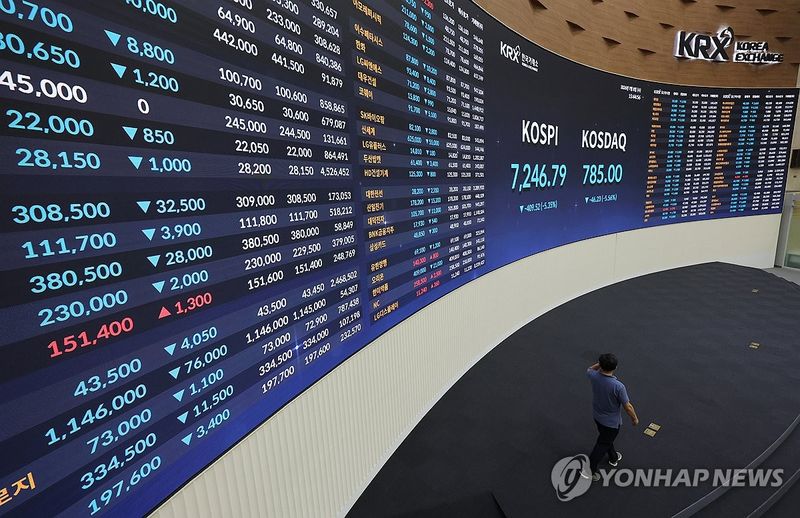
South Korea raises the bar and shortens the recovery period
In South Korea's latest delisting overhaul, quantitative standards were significantly tightened, and loopholes through reverse stock splits or capital reductions were blocked. Just as NASDAQ and NYSE do not grant a regular grace period to companies with repeated split histories over the past one to two years, South Korea is also effectively blocking recovery procedures for firms that have merely met the standards on paper through splits or capital cuts.
The grace period for substantive delisting reviews has also been shortened. The maximum KOSDAQ review grace period, which had been two years, was cut to 18 months in February 2025 and then shortened again to one year after a subsequent rule revision. That still leaves open the question of how far quantitative continued-listing requirements can truly capture a company's substance. This is especially relevant on KOSDAQ, where innovative and high-quality firms with heavy R&D intensity coexist with companies that have weak profitability and fragile financial health.
In a report released the same month titled "Heterogeneity in the Distribution of KOSDAQ-Listed Companies and Future Tasks," Senior Research Fellow Kang So-hyun of the Korea Capital Market Institute pointed out that "compared with the past, the growth potential of mid-sized companies has weakened, while the group of top R&D-intensive firms and the group of low-profitability firms at the bottom have both expanded, strengthening heterogeneity within the market."
That is why questions are being raised about whether it is appropriate to keep increasing the weight of the same yardsticks, price and market capitalization, in the KOSDAQ market. A market price alone does not reveal everything about a company's profitability, cash flow, financial soundness or growth potential.

What should be fixed, and how?
Concerns about the side effects of quantitative standards have also surfaced in politics. Democratic Party of Korea lawmaker Kim Hyun-jung raised the need to supplement the KOSDAQ delisting market capitalization standard during a full session of the National Policy Committee on the 24th.
Kim said, "As of the end of July, there were 149 companies with market capitalizations below 20 billion won, and 45 of them were profitable companies." She added, "If they are pushed toward delisting based on market capitalization alone, the market is raising concerns about the problems that could create."
In response, FSC Chair Lee Eok-won said, "Given policy credibility, a sweeping policy change is not easy," but added, "We will look into whether there are areas that can be fine-tuned."
He also emphasized the existing principle that "weak firms must be cleared out first for KOSDAQ to normalize."
Preventing weak firms from lingering for too long is necessary to normalize the listed market. But removing companies with very different characteristics at the same pace based on a single signal, market price, can also weaken the market's ability to distinguish between them. What South Korea needs now is not a slower exit process, but the precision to decide who that speed should apply to.
[email protected] Kim Hee-sun, Seo Yoon-kyung Reporter