KFTA Calls Government Formula a "Desk-Bound Calculation That Ignores Reality," Demands Full Withdrawal of Plan to Scrap Tax-Linkage for Education Grants
- Input
- 2026-08-26 15:26:51
- Updated
- 2026-08-26 15:26:51
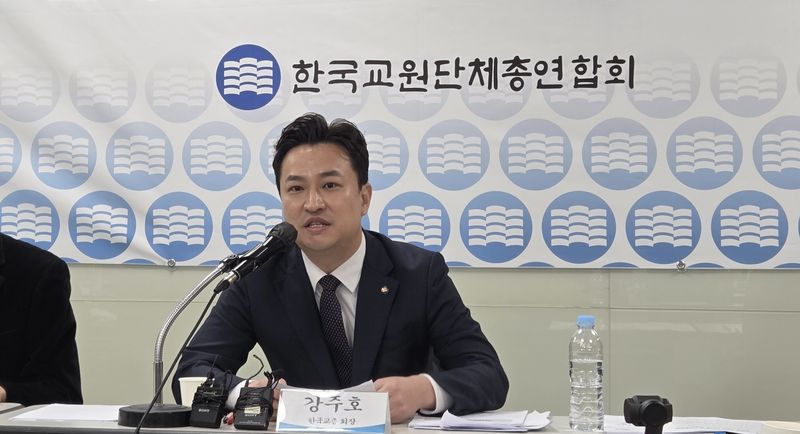
[Financial News] As the government moves to abolish the tax-linked system for Local Education Subsidy Grants, which has been in place for more than half a century, the education sector is pushing back strongly, calling it an attempt to undermine the foundation of education investment with an unrealistic formula.
The Korean Federation of Teachers' Associations (KFTA) said on the 26th that it had submitted an official objection to the Ministry of Education, demanding a full withdrawal of the proposed revision to the Local Education Subsidy Act.
KFTA President Kang Ju-ho said, "Local education finance is the lifeline of Korea's future education," and urged the government to "immediately stop pushing the bill unilaterally and, on the premise of keeping the tax-linkage principle, form a social consultative body with the education sector and reconsider the matter from scratch."
KFTA said the government's new grant calculation method seriously distorts the actual structure of education spending. The government assumed that the share of spending excluding fixed costs such as labor expenses would be around 60 percent and set the coefficient reflecting changes in the school-age population at 35 to 40 percent, but KFTA said those figures are far removed from reality.
According to KFTA, labor costs accounted for an average of 75.4 percent of provincial and metropolitan offices of education budgets nationwide over the past four years, rising to 82.9 percent in 2024.
KFTA criticized the government, saying, "If its logic is applied to actual spending patterns, the coefficient reflecting changes in the school-age population should be lowered to around 20 percent, not 35 to 40 percent," and added, "From the very starting point of the formula, it is distorting reality in order to reduce future education finance." It also pointed out that the bill failed to provide clear grounds for the "initial base amount," including whether it is based on the main budget or a supplementary budget, and how tax revenue forecasts and settlement amounts were reflected.
Concerns were also raised that the removal of safeguards for schools would lead to weaker school operations and reduced student learning activities. That is because the revision bill completely deletes the current legal mechanism that adjusts the grant rate when labor costs surge, such as when the number of teachers changes.
KFTA stressed, "Even if more staff are needed because of growth in special education or multicultural students, if the grant does not support it, schools will ultimately have to cover the gap by cutting classroom activity funds and school operating expenses," adding, "The new formula does not reflect at all the real educational demand that does not simply decline with the number of students, such as digital education, aging facility improvements, and maintaining class sizes."
Earlier, on the 24th, the Ministry of Education announced a revision bill that would abolish the current system of distributing grants by uniformly allocating 20.79 percent of total domestic tax revenue, and instead calculate the grants by reflecting nominal growth and changes in the school-age population. It also said additional funds would be transferred to the Future Response Fund and used for early childhood, higher, and lifelong education.
KFTA also strongly condemned the procedural issue of setting the public comment period at just five days while pushing ahead with a major overhaul of the fiscal structure.
[email protected] Kim Man-ki Reporter