Kim Min-seok Pushes Police Reform, Clashes With RKP... 'His True Colors Are Showing'
- Input
- 2026-08-26 15:06:55
- Updated
- 2026-08-26 15:06:55
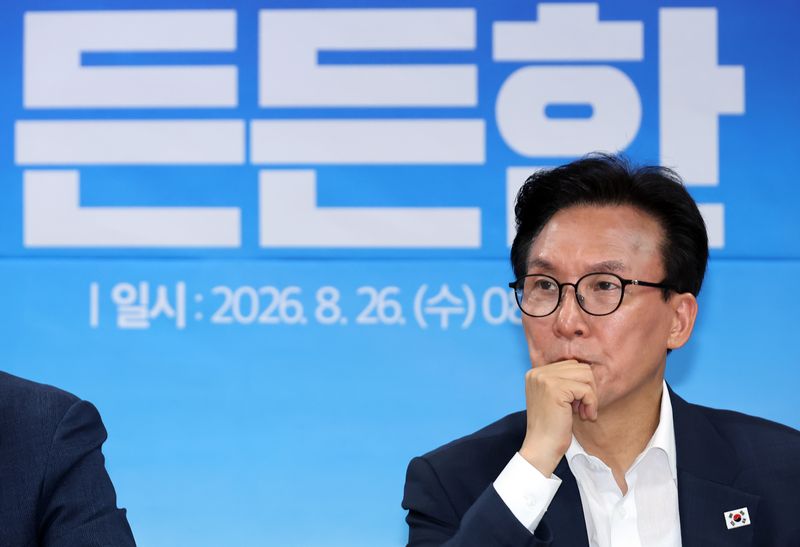
[Financial News] Kim Min-seok, leader of the Democratic Party of Korea, is being seen as revealing his true colors. He has accelerated police reform in the wake of the false closure of a missing-person case in Jeju, while also clashing with the Rebuilding Korea Party (RKP) over a possible merger.
The Lee Jae Myung administration and pro-Lee lawmakers had initially worried that abolishing prosecutors' supplementary investigation rights would give police too much power. They were also reluctant about a merger with the RKP. But during the party convention, they shifted course, agreeing to abolish the supplementary investigation rights and to support a merger with the RKP in order to counter former leader Jung Cheong-rae's bold reform slogans. Now that Kim has taken control of the party, he is gradually signaling his original stance.
At a field Supreme Council meeting in Andong on the 26th, Kim said he would "push ahead with police reform," referring to the uproar over the alleged cover-up of the disappearance case of the late Jang Mi-ran. He outlined six major abuses, including protecting one's own, burying cases, unauthorized case closure, evidence concealment and manipulation, leakage of investigative information, and privacy violations. He also proposed reform measures such as expanding external audits, strengthening legal accountability for improper investigations, and tightening grounds for recusal from investigations.
The Democratic Party of Korea has formed an internal Police Reform Task Force to speed up the reform drive. Rep. Kim Nam-hee, who heads the task force, had previously argued during the debate over abolishing supplementary investigation rights that safeguards were needed, warning that weak investigations into cases involving vulnerable people could become a problem.
Kim launched the party's Grand Unification Task Force in line with a party convention pledge, but defined its goal as bringing together not only progressive forces such as the RKP, but also centrists and conservatives. RKP leader Shin Jang-sik pushed back, saying, "I am worried about how far they want to expand. I wonder if they are thinking of creating a Japanese LDP-style 1.5-party system and a mixed coalition that treats opposition parties as 0.5. If that is the Democratic Party's direction, we have no intention of joining."
Kim also directly challenged the RKP. During a visit to Shin, he pointed out that if a merger was being considered, then the RKP's demand to ease the National Assembly floor caucus requirement was contradictory. The RKP wants the current threshold of 20 seats lowered to 10, which would allow it to emerge as a third floor caucus alongside the Democratic Party of Korea and the People Power Party. Kim's remarks were essentially, 'If they are going to merge anyway, what is the point?' In response, the RKP said, "It is highly inappropriate to describe political reform as if it were a matter of bargaining. Trust between the two parties has been dealt another blow. We express regret."
[email protected] Kim Yun-ho Reporter