Foreign Shoppers Open Their Wallets, and Seoul Retail Districts Shift: Myeong-dong Revives, Seongsu Repositions as a Flagship Hub [Financial News]
- Input
- 2026-08-26 15:14:34
- Updated
- 2026-08-26 15:14:34
[Financial News] Seoul's core retail districts are being rapidly reshaped as foreign tourists return. While Myeong-dong is filling vacancies on the back of recovering foreign spending, Seongsu is undergoing a major spatial shift, with large flagship stores replacing short-term pop-up shops.
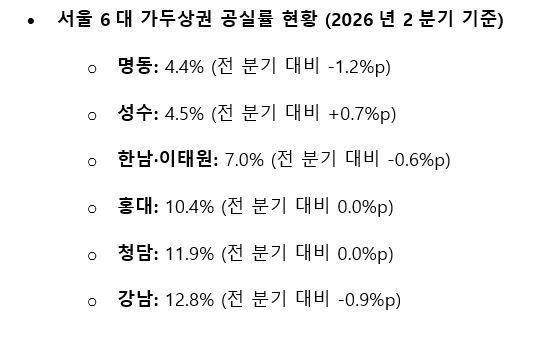
According to Cushman & Wakefield Korea's "Seoul Retail MarketBeat for the second quarter of 2026," the average vacancy rate across Seoul's six major street retail districts stood at 8.5%. That was down 0.3 percentage point from the previous quarter and 1.9 percentage points from a year earlier.
Foreign spending is the key driver behind the recovery. In the first half of this year, the number of inbound foreign tourists reached 10.71 million, the highest ever for a half-year period. Foreign credit card spending also surged 50.8% from a year earlier.
In particular, spending has shifted away from the old duty-free and group-shopping model toward experience-based consumption centered on individual travelers, including beauty, fashion, medical services, and wellness. Street retail districts are benefiting directly from that change. Myeong-dong has recovered the fastest. Its vacancy rate in the second quarter fell to 4.4%, down 1.2 percentage points from the previous quarter. Large pharmacies and beauty brands offering multilingual services and tax refunds are once again filling prime locations.
Gangnam, which had long underperformed, still posted a relatively high vacancy rate of 12.8%, but that was an improvement of 6.1 percentage points from a year earlier. Hannam-dong and Iteawon also kept vacancy rates in the single digits at 7.0%.
Seongsu is undergoing a different kind of change. Its vacancy rate rose 0.7 percentage point from the previous quarter to 4.5%, but the market sees this less as a downturn and more as a process of "space replacement." The district is moving away from a pop-up-driven model, where brands once tested consumer response, and toward a cluster of large flagship stores designed for long-term operations. As a result, tenant demand is being reorganized around scale and location.
New openings by global brands are also expected to continue in Hannam-dong and Cheongdam, following Laneige and Uniqlo in Myeong-dong, Decathlon in Gangnam, and OLIVE YOUNG Beauty Mansion in Seongsu-dong.
Competition in Seoul's retail market is increasingly shifting from simply filling vacancies to securing the most important spaces. As foreign spending and experience-based consumption both grow, brand rivalry for large, high-quality sites in major districts is expected to intensify further.
Yoon Hwa-seop, Managing Director in charge of retail leasing at Cushman & Wakefield Korea, said, "The shift toward individual traveler spending, combined with the strong won, has significantly boosted foreign consumers' purchasing power." He added, "Brands will focus on large flagship strategies that secure key landmark assets and maximize brand experience."
A retail industry source said, "For core retail districts, the key issue is no longer how much vacancy has been filled, but which brands stay and for how long." The source added, "Myeong-dong's normalization and the flagship competition in Seongsu, Hannam-dong, and Cheongdam are likely to unfold at the same time."
[email protected] Kim Kyung-a Reporter