Min Hyung-bae: "City administration will focus on strengthening civic sovereignty and leading the national agenda"
- Input
- 2026-08-26 15:17:54
- Updated
- 2026-08-26 15:17:54
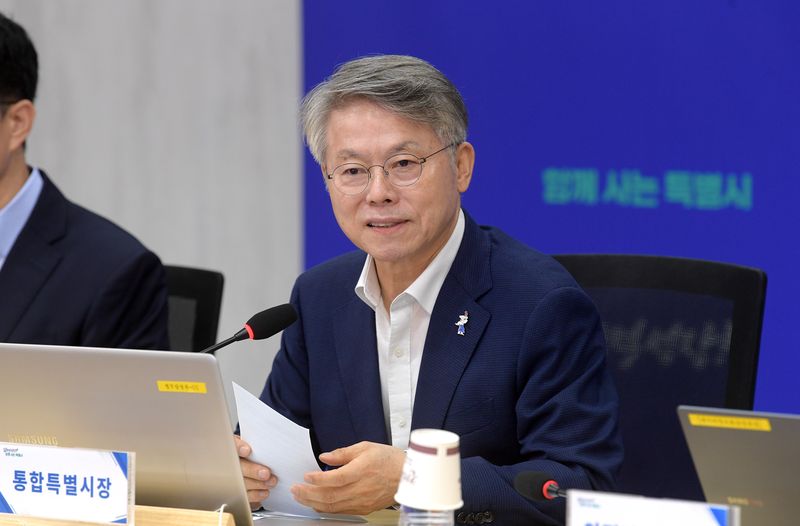
【Financial News Jeonnam-Gwangju = Reporter Hwang Tae-jong】 Min Hyung-bae, mayor of Jeonnam-Gwangju Integrated Metropolitan City, called for the city administration to focus its capabilities on strengthening civic sovereignty and leading the national agenda by advancing large-scale high-tech future industries and ensuring fairness across city administration.
According to Jeonnam-Gwangju Integrated Metropolitan City (Gwangju Metropolitan City) on the 26th, Mayor Min presided over an expanded executive meeting at a conference room in Gwangju City Hall with bureau chiefs, heads of affiliated agencies and others in attendance. He urged swift city administration in line with large-scale future investment attraction, along with greater fairness across city operations and the establishment of civic sovereignty.
In his opening remarks, Min said, "Jeonnam-Gwangju is at the center of an unprecedented transformation, including a semiconductor cluster worth 896 trillion won, 100 trillion won in investment by major conglomerates in the eastern region, Samsung Electronics' first new production line in 37 years, and the second relocation of public institutions." He added, "All of these are connected. We must move every front at the same time."
He also said, "Civic sovereignty means citizens take part in the process of making and evaluating policies, and share in the results and benefits," adding, "In the end, the key is to build the region's own capacity to grow."
Regarding the city’s first organizational restructuring plan, which was recently announced for legislation, Min said, "The plan contains the key directions of city administration that will unfold going forward." He added, "As soon as the new system launches, each department must thoroughly review its work and make full preparations so that results can be delivered without any gaps."
At the main discussion on current issues, participants focused on ways to secure fairness in city administration as a foundation for governance. In particular, they discussed the current state of corruption-prone areas in the public sector, response measures, and ways to strengthen fair contract management, joining forces to root out entrenched irregularities.
Citing recent remarks by the president at the anti-corruption policy council, Min said, "There can be no such thing as ruling party or opposition, or 'my side' and 'your side,' when it comes to eradicating corruption. It must be handled fairly and strictly, without exception." He added, "All public officials should set aside private interests, arm themselves with a firm sense of public duty, and work to foster emotional unity in Jeonnam-Gwangju."
Min also said he is determined to complete Urban Rail Line 2 as quickly as possible in order to ease inconvenience for residents and finish the project sooner.
Among the items requiring cooperation, the meeting discussed ways to ensure the success of the "2026 Yeosu World Island Exhibition" and the "The 16th Gwangju Biennale," both of which will open next week and be held as international events.
Min said, "These two mega-events are the first test of how Jeonnam-Gwangju can showcase its culture and capabilities to the world under the name of an Integrated Special City." He added, "We need to link the island exhibition and the Biennale organically to maximize synergy, and promote them with SNS-driven killer content."
On next year's government budget proposal, Min said, "We must secure national funding for key pending projects and also leave no gaps in efforts to obtain fiscal support of up to 20 trillion won." He added, "The party leadership and local lawmakers should work closely with the National Assembly and the South Korean government."
He continued, "The semiconductor cluster, the relocation of the military airport, and the national medical school are all key state tasks." He added, "We should not remain confined to a regional perspective, but look more broadly at Jeonnam-Gwangju's role within the overall growth strategy of South Korea."
Min stressed in particular, "Jeonnam-Gwangju must directly lead major national agendas in South Korea." He urged officials to anticipate the moves of central ministries and prepare in advance so they can respond immediately when the government and the National Assembly begin to act.
[email protected] Hwang Tae-jong Reporter