Housing Supply Bill Delayed by Party Workshops as Only Non-Controversial Bills, Including NDC Range Rule, Pass
- Input
- 2026-08-26 15:23:47
- Updated
- 2026-08-26 15:23:47
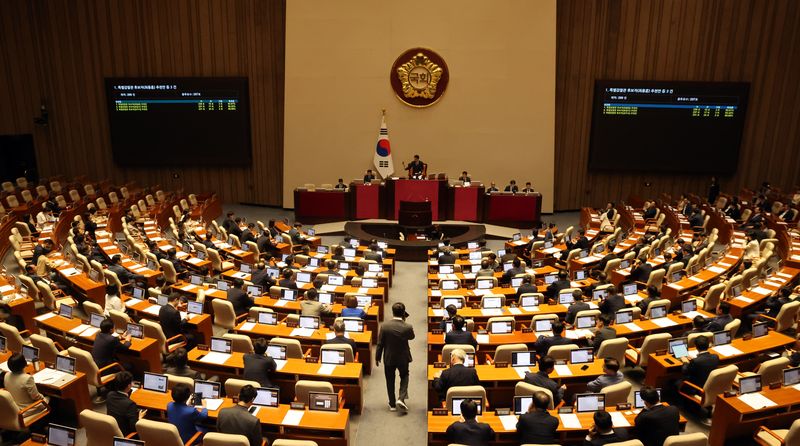
[Financial News] The National Assembly plenary vote on bills aimed at expanding housing supply has been delayed once again. Publicly, the reason is said to be coordination among the ruling and opposition parties and the government on supply measures, but in practice, the delay is believed to have taken into account the party workshops scheduled for the 27th and 28th.
The housing supply-related bills that failed to clear the plenary session include the special act on Yongsan Park development, the Act on the Improvement of Urban Areas and Residential Environments, and revisions to the Act on the Promotion of Urban Renewal. They had originally been scheduled for the plenary session on the 20th, but were pushed back after the ruling and opposition parties clashed with the government over public housing supply on the Yongsan Park site. Even though the dispute had eased by the 26th after the Yongsan Park site was removed, the bills still were not put to a vote.
The official explanation is that the parties and the government, including the Seoul Metropolitan Government and other local governments, will first review measures for housing supply in the Seoul metropolitan area and then process the necessary bills all at once. That is because consultations are still under way, including another meeting on the day between Seoul Metropolitan City Mayor Oh Se-hoon and Kim Yun-duk, Minister of Land, Infrastructure and Transport.
In reality, however, the bills already submitted to the plenary session are separate from the detailed supply measures, as they focus on easing regulations on redevelopment and reconstruction. They include a temporary relaxation of the floor area ratio cap for public redevelopment projects and a shorter procedure by allowing the master plan, redevelopment zone designation, and redevelopment plan decision to proceed at the same time. The Yongsan Park bill is also not about securing large tracts of land, which is the main point of contention, but about easing green-space standards in some areas such as Camp Kim.
In effect, the delay reflects the two-day party workshops that the Democratic Party of Korea and the People Power Party will each hold on the 27th and 28th. The People Power Party has some disagreements over the housing supply bills and would need to launch a filibuster, a legal form of unlimited debate used to obstruct proceedings under the National Assembly Act. That would disrupt the workshops for both parties. The plan is for each party to finish its workshop first and then decide which bills to process based on the consultations already held between the government and the Seoul Metropolitan Government.
As a result, the parties processed only 35 bills with no contentious issues at the plenary session that day, including revisions to the Framework Act on Carbon Neutrality and Green Growth.
The carbon neutrality law sets the country's medium- and long-term greenhouse gas reduction targets for 2035 to 2045 as a range rather than a single figure. Based on 2018 net greenhouse gas emissions, the reduction target for 2035 will be set by presidential decree at 53% to 61%, 69% to 80% for 2040, and 84% to 90% for 2045. The lower end follows the People Power Party's argument for a linear reduction path that steadily cuts emissions until carbon neutrality is reached in 2050, while the upper end follows the reduction path under the Paris Agreement, which the Democratic Party of Korea has emphasized as limiting the rise in the global average temperature to within 1.5 degrees Celsius.
A bill to enact the Climate Crisis Adaptation Act was also approved. The law is designed to encourage the government and local governments to develop and operate climate insurance to prepare for disasters and damage caused by the climate crisis. It also provides a legal basis for support projects for vulnerable groups such as the elderly, outdoor workers, and people engaged in farming and fishing, while requiring the establishment of a climate crisis adaptation information management system to assess climate change impacts in advance and minimize damage.
Revisions to the National Assembly Act and the Personnel Hearing Act were also passed. They introduce National Assembly confirmation hearings for the head of the Serious Crime Investigation Agency, which is scheduled to be launched after the prosecution is abolished on Oct. 2.
In addition to the bills, the Assembly approved a motion to hold the regular session for the 2026 Parliamentary Inspection of the Administration during the inspection period. It also passed a resolution, backed by the broader ruling bloc, calling for the expulsion of People Power Party lawmaker Lee Jin-sook. Lee drew criticism after holding a forum with a civic group that has been accused of disparaging the Gwangju Democratization Movement.
[email protected] Kim Yun-ho Reporter