From Jeju, which has welcomed refugees, to archipelagos and hybridity: 'Kkumda Humanities' expands its research scope
- Input
- 2026-08-26 14:44:20
- Updated
- 2026-08-26 14:44:20
[Financial News, Jeju = Reporter Jung Yong-bok] 'Kkumda Humanities,' which has studied the history of Jeju Province and refugees, is moving into a new research phase. Building on six years of work, it is broadening its scope to include archipelagos, migration, cultural hybridity, and coexistence.
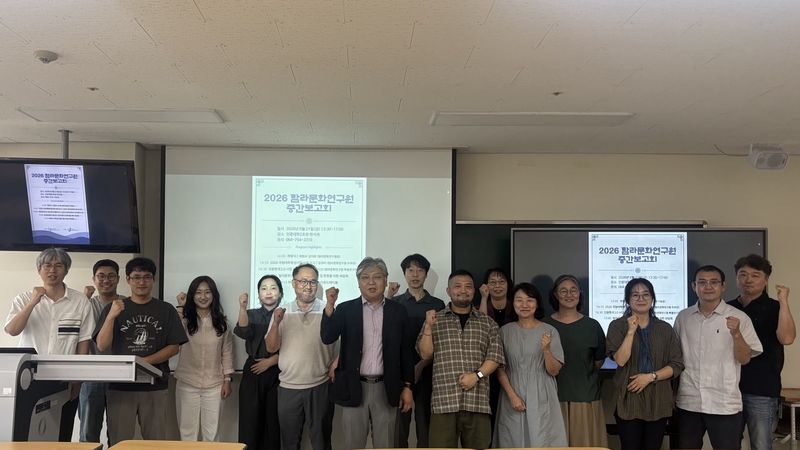
According to the Tamla Culture Research Institute at Jeju National University on the 26th, the institute held the '2026 Tamla Culture Research Institute Midterm Report' on the 21st at Building No. 2 of the College of Humanities at JNU. It reviewed the achievements of its research and projects in the first half of the year, as well as its research direction for the second half.
The meeting was organized to share this year's research results, centered on JNU's National University Promotion Project, and to discuss links between individual research tasks and the institute's mid- to long-term development strategy.
Kim Jin-cheol, a special researcher at the institute, explained the progress and results of the project to strengthen Tamla cultural research capabilities. He also shared plans for research and projects in the second half of the year.
The next major research axis for the institute was presented as an expansion of 'Kkumda Humanities.' Special researcher Kim Jin-seon introduced the research agenda and direction submitted to the National Research Foundation of Korea's 2026 Humanities Korea 3.0 support program. The institute proposed the agenda, 'Kkumda Humanities in an Age of Global Anomie: Through the Lives of Archipelagos and the Knowledge of Hybridity.'
Anomie refers to a state in which social norms and order weaken, leading to greater anxiety and confusion. The institute is focusing on the relationships and forms of coexistence that emerge on islands and in archipelagos in an era when overlapping crises such as climate change, war, migration, and refugees have become part of everyday life.
The new agenda follows the six-year Humanities and Social Sciences Research Institute support project, 'The History of Jeju Island and Refugees Explained through Kkumda,' which began in 2019.
While the previous research centered on the history of Jeju Province, refugees, migration, and the issue of the other, the new project aims to broaden the scope to include how islands and knowledge are formed, as well as migration, refugees, cultural hybridity, and coexistence.
In particular, the institute plans to examine how life and knowledge are formed from the perspective of an 'archipelago,' where multiple islands and regions are connected through movement and exchange, rather than viewing Jeju as an isolated island. It also intends to expand the domestic and international research network it has built so far by linking it to the new agenda.
A roundtable on evaluating and sharing research outcomes, held after the report session, was attended by special researchers and associate research professors. Participants shared first-half research achievements and the progress of major projects, and discussed ways to strengthen links between research tasks, spread results, and energize research in the second half.
Kim Chi-wan, director of the Tamla Culture Research Institute at Jeju National University, said, "Based on the first-half research results and today's discussion, we will strengthen the substance of our second-half projects and work to expand research outcomes."
[email protected] Jung Yong-bok Reporter