Salmon Roe Gift Items and Donations 100 Times Larger? The Two Sides of Japan's Hometown Tax Program
- Input
- 2026-08-26 14:53:40
- Updated
- 2026-08-26 14:53:40
[Financial News Tokyo = Reporter Seo Hyejin] Japan's Hometown Tax Program, which allows residents to donate to a local government of their choice and receive tax deductions and gift items in return, is widening fiscal gaps among local governments as donations surge. Annual donations reached a record 1.3314 trillion yen, or about 1.15832 trillion won, but money has concentrated in regions with popular specialty products, leaving 19 prefectural governments in deficit. Critics say a system originally designed to support hometowns has turned into a competition among local governments for tax revenue through gift items.
Under the program, donors can give to a local government of their choice and receive a deduction from income and resident taxes for all but 2,000 yen of the donation. They also receive local specialty products or other gifts in return. The recipient region gains more funding, while the donor's home region loses resident tax revenue. Gift items and brokerage fees are also paid out of local budgets.
Tokyo posts a 225.5 billion yen deficit, while Hokkaido posts a 70.9 billion yen surplus
According to The Asahi Shimbun on the 26th, 19 of Japan's 47 prefectures posted deficits after subtracting expenses such as gift items and shipping costs, as well as resident tax outflows, from donation revenue. The calculation combined the balance sheets of each prefecture and the municipalities under its jurisdiction.
Tokyo Metropolis received 16.2 billion yen in donations, but spent 6.6 billion yen on gift items and brokerage fees. Another 235.1 billion yen in resident tax revenue flowed out as residents donated to other regions. The combined deficit came to 225.5 billion yen, or about 1.9619 trillion won, the largest in the country.
Kanagawa Prefecture also recorded a deficit of 84.6 billion yen, followed by Osaka Prefecture at 48.9 billion yen, Saitama Prefecture at 48.1 billion yen, and Aichi Prefecture at 46.9 billion yen. Deficits were concentrated in major metropolitan areas, where large populations mean greater resident tax outflows to other regions.
By contrast, Hokkaido, which offers popular gifts such as salmon and seafood, posted a surplus of 70.9 billion yen, ranking first nationwide. Miyazaki Prefecture recorded a surplus of 28.1 billion yen, and Yamanashi Prefecture posted 22.8 billion yen.
However, municipalities that receive local allocation tax grants are compensated by the central government for about 75% of the resident tax they lose. That compensation was not included in this calculation. Municipalities with enough fiscal strength to forgo such grants must absorb the full decline in tax revenue themselves.
Salmon Roe Can Bring in 100 Times the Donations? Even Major Cities Join the Gift Competition
The contrast among local governments is especially clear in Hokkaido Shiranuka Town and Kawasaki.
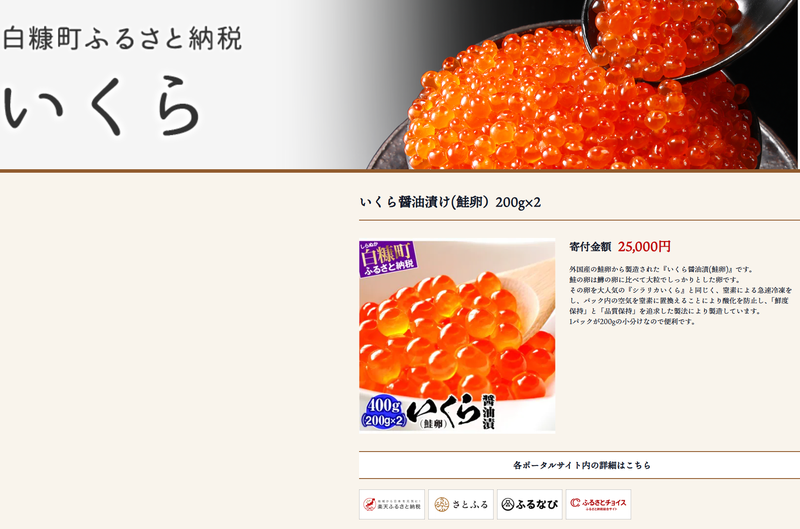
Known for salmon roe and salmon, Shiranuka Town attracted 22.3 billion yen in fiscal 2025, ranking second nationwide. That amount is close to its fiscal 2026 general account budget of 26.2 billion yen. Donations, which stood at 160 million yen in fiscal 2015, have increased more than 100-fold in just 10 years.
Since 2006, Shiranuka Town has operated a direct sales shop on Rakuten Ichiba, building up retail experience. It has used donation revenue to develop new seafood products and introduce fishing equipment such as underwater drones. Its reserve fund also exceeded 24 billion yen at the end of fiscal 2024, more than triple the level five years earlier.
By contrast, Kawasaki, which is financially strong enough to forgo local allocation tax grants, is expected to see resident tax revenue fall by 17 billion yen in fiscal 2026. That is nearly three times the 6.6 billion yen recorded in fiscal 2020, and more than the city's annual garbage collection and disposal costs.
To offset the tax outflow, Kawasaki expanded its gift offerings from 400 items in fiscal 2022 to 1,200 in fiscal 2025 by adding Kao household goods and Toshiba appliances. Donation revenue also rose from 300 million yen to 4.3 billion yen. The result is a vicious cycle in which even major cities that lose tax revenue are forced into a gift-item race to win it back.
A Kawasaki official pointed out that "the system has changed into something like online shopping because of the gift items." Tokyo Governor Yuriko Koike also called for a review of the system in April, saying, "Money that should be used for schools, welfare, and road construction is disappearing into meat and scallops."
Namiko Numao, a professor at Toyo University, said that "tax money meant for public services is flowing into specialty product costs and brokerage fees." She added that "the system should be gradually scaled back, taking into account the impact on local economies."
Meanwhile, South Korea introduced the Hometown Love Donation Program in 2023, taking a cue from Japan's Hometown Tax Program. Last year's fundraising total reached 151.456 billion won, 2.3 times the amount in the program's first year. Although 92.2% of the total went to non-capital regions, areas with famous tourist attractions, specialty products, and large numbers of former residents have an advantage in fundraising, making regional disparities a key challenge.
[email protected] Seo Hyejin Reporter