KPAA and KIND Join Forces to Eliminate IP Blind Spots in Overseas Infrastructure Projects
- Input
- 2026-08-26 15:06:12
- Updated
- 2026-08-26 15:06:12
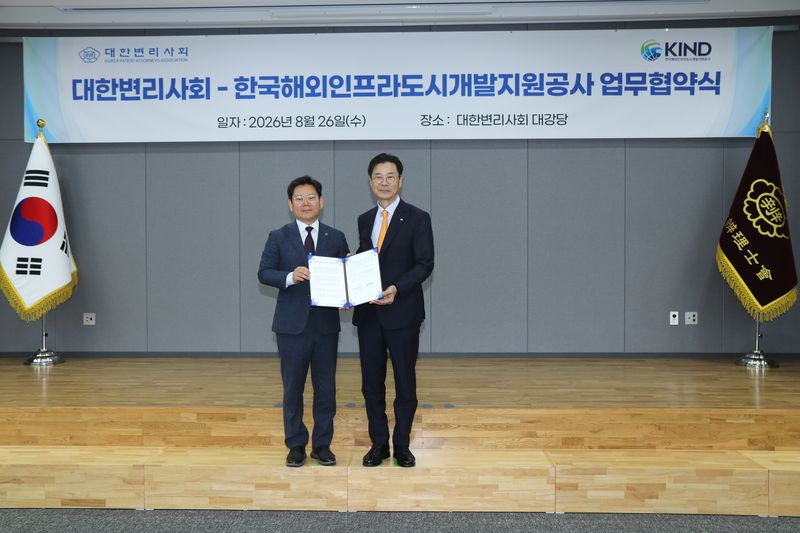
[Financial News] Support will be expanded for intellectual property (IP) risks that may arise in overseas infrastructure and plant projects, including patents, trademarks and technology contracts. As the importance of IP management grows alongside technical competitiveness in large-scale overseas projects, the move is also expected to help small and mid-sized companies, which often struggle to secure in-house specialists, expand abroad.
■ Overseas projects involving multinational firms: patents and technology contracts emerge as a hidden challenge
KPAA and KIND said on the 26th that they signed an MOU at the KPAA building in Seocho-gu, Seoul, to strengthen the competitiveness of Korean companies in overseas infrastructure exports.The agreement was designed to help domestic companies entering overseas infrastructure projects review IP-related risks from the early stages of a project and build a support system that can respond professionally to disputes that may arise later.
As the government pushes advanced industry development and stronger export competitiveness as key growth strategies, the importance of overseas infrastructure and plant markets is also rising. In particular, large-scale overseas infrastructure projects involve not only design and construction technologies but also a wide range of IP issues, including patents, trademarks, technology contracts and trade secrets.
Because overseas projects involve companies from multiple countries in design, procurement and construction, unexpected IP issues can affect not only the construction schedule but also project profitability. That has increased the need to identify related risks proactively from the bidding and project development stages.
Under the agreement, the two organizations will cooperate in four areas: IP advisory and dispute response for overseas investment and development projects; IP consulting for companies expanding abroad together with Korean partners; support for IP creation, commercialization and monetization; and joint seminars and training programs.
The partnership is expected to provide stronger support for small and mid-sized companies that have difficulty securing their own IP specialists. The plan is to review patents, trademarks and technology contracts from the early stages of overseas projects and provide expert advice to reduce the likelihood of future disputes.
■ Combining overseas networks with patent attorney expertise
KPAA, founded in 1946, is the only statutory organization for patent attorneys in Korea and has expertise in IP fields such as patents and trademarks.KIND, a specialized agency under the Ministry of Land, Infrastructure and Transport for overseas infrastructure and urban development investment projects, has approved 1.4 trillion won in direct investment across 38 overseas projects in 22 countries since its establishment in 2018. The overseas contracts won by Korean companies with its support have reached about 21 trillion won.
The two organizations plan to combine KIND's overseas project network with KPAA's IP expertise to build a more concrete cooperation framework so companies can receive the IP support they need at each stage of overseas projects.
Kim Bok-hwan, president of KIND, said, "As our companies expand their overseas businesses, the importance of professional responses to intellectual property issues is also growing." He added, "We will work to effectively connect KIND's overseas project network with KPAA's expertise so that Korean companies participating in overseas projects can receive timely IP advice and support when they need it."
Jeon Jong-hak, president of KPAA, said, "What ultimately completes the competitiveness of overseas exports is the ability to properly protect our technology and innovation." He stressed, "The larger the overseas infrastructure project, the more strategically patents, technology contracts and other IP issues must be managed from the very beginning."
He added, "Using KPAA's IP expertise, we will actively support Korean companies so they can review IP risks proactively from the early stages of overseas projects and enter the global market more stably."
[email protected] Lee Dong-hyeok Reporter