The KCCI says policy support for growth companies should be expanded... "It is time to break the Peter Pan Syndrome"
- Input
- 2026-08-26 15:06:49
- Updated
- 2026-08-26 15:06:49
[Financial News] There is growing support for strengthening policy assistance for companies that have already achieved growth or have strong growth potential, separate from support aimed at helping firms survive. To address the so-called "Peter Pan Syndrome," the proposal calls for patient capital that shares the risk of failure for startups and performance-linked incentives for large-scale investment companies.
On the 26th, the Korea Chamber of Commerce and Industry (KCCI) released a report titled "Case Studies and Implications of Performance-Based Support Policies in Major Countries." According to the report, when all corporate policy funds were classified by quartiles of return on assets (ROA), firms in the lowest quartile received 10.7% of government subsidies, while the second quartile received 12.0%, the third quartile 12.3%, the fourth quartile 12.0%, and the fifth quartile 11.4%. By contrast, the distribution of government funding dropped sharply for the 8th quartile (8.8%), 9th quartile (7.6%), and 10th quartile (5.1%).
ROA is an indicator that shows how efficiently assets are used to generate profits, suggesting that policy funds are concentrated on companies with low ROA. In response, KCCI emphasized that "policy support for protection and survival is important, but incentives for growth-oriented companies need to be strengthened," adding that this would be a way to "drive the creation of more added value."
The report also noted that "Korea already has growth-oriented support programs such as World Class Plus and the Global Hidden Champion 1000+ Project, but these programs need to be advanced through growth data management, post-evaluation, and tailored dedicated support." Specifically, it proposed patient capital for startups that shares failure risk, customized coaching for growth companies to help them overcome key growth hurdles, and success-linked incentives for large-scale investments.
For startup patient capital, the report said that subsidy support in the form of patient capital is needed for early-stage deep-tech, biotech, and advanced manufacturing companies that do not yet generate significant revenue but have high strategic value for the future, so that the government can share the risk of failure in new technology development.
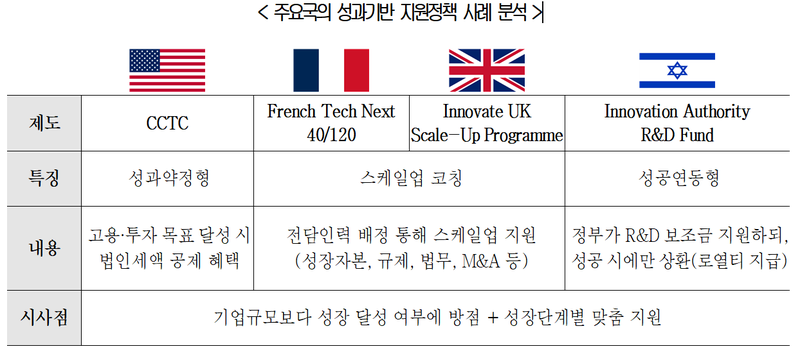
The report also called for customized coaching to help companies overcome growth hurdles. For firms that have grown to a certain size, it proposed providing dedicated managers who can help them navigate regulatory and globalization challenges. In France, 120 companies are selected for support based on recent revenue growth or equity investment raised, and the top 40 among them are then chosen again. The dedicated managers assigned to these firms help them respond smoothly to regulations, legal issues, internationalization, and social concerns, while also encouraging French public institutions and large companies to procure their solutions.
For mature companies, a performance-linked support model could be offered. In California, the United States, a "performance commitment" system is in place, under which support is provided only when a company meets the performance indicators it has proposed. After a company agrees with the state government on annual targets such as full-time jobs, wage levels, and investment plans, it can receive incentives such as tax credits only if those targets are achieved.
Lee Jong-myeong, head of the Industrial Growth Division at KCCI, said, "Support for struggling companies is important, but we must increase support for growth companies and efficient companies to promote growth." He added, "Just as the Miracle on the Han River was achieved through export milestones, now is the time to break the Peter Pan Syndrome that holds back growth and quickly create economic added value through corporate growth milestones."
[email protected] Lim Su-bin Reporter