"The K-culture economic impact created by TikTok will exceed 40 trillion won by 2030"
- Input
- 2026-08-26 13:56:11
- Updated
- 2026-08-26 13:56:11
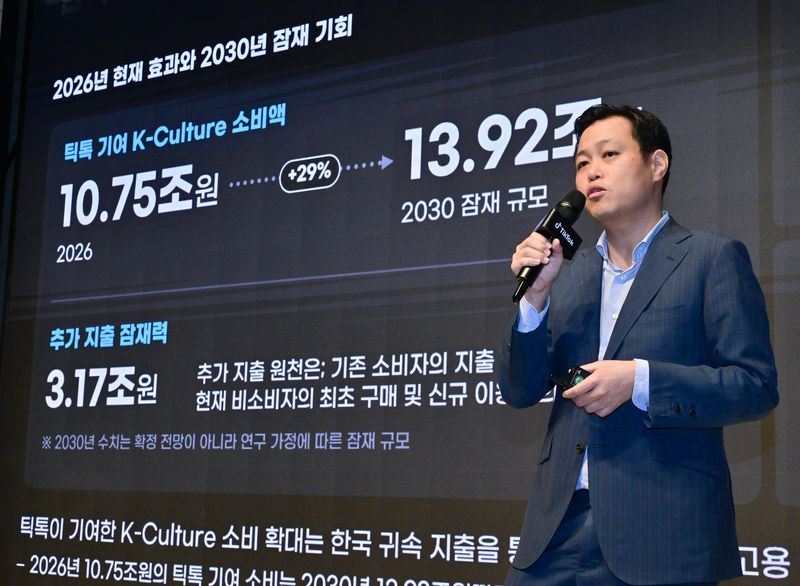
[Financial News] "The economic impact of TikTok's contribution to K-culture will rise from 31.37 trillion won this year to 40.64 trillion won in 2030."
At the press briefing for 'K-culture on TikTok' held at Hotel Eliena in Seoul on the 26th, Jeong Tae-hwan, associate partner at Kearney Korea LLC, projected that TikTok-generated economic effects tied to K-culture would grow to that level.
TikTok also released the report 'K-culture on TikTok: Driving Global Economic Impact' jointly researched with global management consulting firm Kearney. The report analyzes how interest in Korean culture, sparked through TikTok, affects domestic industries and the broader economy. The survey covered 3,300 consumers aged 16 to 49 in 10 countries, including the United States, the United Kingdom, the Philippines, Saudi Arabia, Brazil and Japan. The analysis covered six areas: K-pop, K-media and intellectual property rights (IPR), K-beauty, K-food, K-fashion and K-tourism.
Jeong said, "K-culture has moved beyond 1.0, which was centered on TV broadcasts, and 2.0, which was driven by fandom through social networking services, and 3.0, the stage of mainstream adoption through global over-the-top media services (OTT) and streaming, and has now entered 4.0." He added, "In 4.0, K-culture's influence expands beyond content into consumption more broadly through short-form platforms such as TikTok and user-generated content (UGC)."
This expansion appears to be driven by a process in which users discover content on TikTok, develop preferences, engage with related content, and then consume actual products and services. The analysis suggests that even without searching directly or following an account, users encounter new content through recommended feeds and increase their purchase intent for related products through creator content.
In fact, 89% of respondents said TikTok helps them discover K-culture. Seventy percent said their preference for K-culture increased after using TikTok. Another 61% said that engaging with K-culture content on TikTok makes them more likely to consume related products and services, while 56% said they had actually spent money on related items after viewing such content. Jeong therefore analyzed that "the economic impact of TikTok's contribution to K-culture will increase by 29% from 31.37 trillion won this year to 40.64 trillion won in 2030," and that "consumer spending over the same period is expected to expand from 10.75 trillion won to 13.92 trillion won."
By 2030, the domestic production-inducing effect is estimated at 26.72 trillion won, while the employment-inducing effect is projected at 118,865 jobs. Jeong explained, "This is the scale of jobs generated when that level of spending occurs, based on employment-inducing coefficients by industry published by the Bank of Korea (BOK)." He added, "The figure includes jobs across product planning, manufacturing sites, hotels, travel agencies and tourist destinations."
By industry, K-beauty is expected to generate the largest direct economic impact in 2030, at 3.27 trillion won. K-tourism is forecast to grow 44% from this year, marking the highest growth rate among the six categories. Its employment-inducing effect is also expected to be the largest, at 30,384 jobs.
Jung Jae-hoon, head of operations at TikTok Korea, said, "We will continue to play our role as a partner that supports new growth opportunities created by K-culture together with creators, users, brands and the broader Korean industry."
[email protected] Choi Hye-rim Reporter