Daegu and North Gyeongsang Become One Living Zone as Daegu–Gyeongbuk Metropolitan Railroad Passes Feasibility Review
- Input
- 2026-08-26 13:57:51
- Updated
- 2026-08-26 13:57:51
[Financial News, Daegu and Andong = Reporter Kim Jang-wook] Daegu and North Gyeongsang will be connected within a 30-minute living zone.
The city of Daegu said that the Daegu–Gyeongbuk Metropolitan Railroad project, a key transportation network for the Daegu–Gyeongbuk Integrated New Airport and linked to the government’s Five Mega-Regions and Three Special Self-Governing Provinces Policy for balanced national development, passed the Preliminary Feasibility Study at the Fiscal Investment Review Committee meeting held on the 26th.
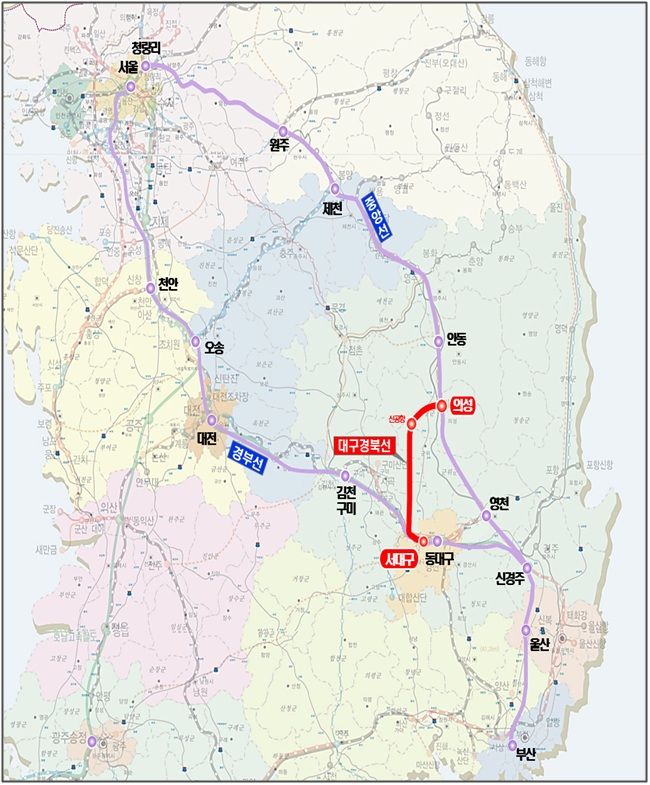
The Daegu–Gyeongbuk Metropolitan Railroad was included in the 4th National Railway Network Construction Plan in July 2021 as a leading metropolitan rail project outside the capital region. It is a large-scale SOC project worth 3.1813 trillion won, involving the construction of a double-track metropolitan railroad spanning 70.06 km from Seodaegu station to Donggumi, Gunwi County (Daegu–Gyeongbuk Integrated New Airport), and onward to Uiseong County on the Jungang Line.
Of the total route, 64.97 km will be newly built, and service will extend to Dongdaegu for 8.25 km.
Mayor Choo Kyung-ho said at the meeting, "This approval marks an important turning point in connecting Daegu and North Gyeongsang more closely as one living and economic zone." He added, "The Daegu–Gyeongbuk Metropolitan Railroad is more than just a railway construction project. It will play a key role in supporting the future growth of Daegu and North Gyeongsang and the era of the new airport."
He also said, "We will concentrate all administrative resources on pushing the project forward so that Daegu and North Gyeongsang can leap forward as a leading mega-regional economic bloc in Korea, and so that residents can feel the change as soon as possible."
Governor Lee Cheol-woo also said, "Daegu and North Gyeongsang came together to achieve the result of passing the difficult Preliminary Feasibility Study for this project." He added, "By expanding the rail network, we will do our utmost to lead balanced national development with the strength of the Daegu-North Gyeongsang region, going beyond economic integration and megacity building."
The biggest effect of the Daegu–Gyeongbuk Metropolitan Railroad project is that it will establish a metropolitan transportation network connecting major cities in Daegu and North Gyeongsang into a single living zone.
The line will use GTX-class trains with a top speed of 180 km/h. Once the route opens, travel from Daegu to the new airport will take about 30 minutes, creating a transportation network that provides rapid access to the airport and greatly contributes to its activation.
In particular, it will play an important role not only in improving transportation convenience but also as economic infrastructure linking the regional industrial structure. By connecting Daegu’s major industrial hubs, the Gumi National Industrial Complex, and planned advanced industrial complexes in Gunwi County by rail, it will become a key facility for creating a mega-regional economic zone centered on the new airport and forming a new axis of industry, logistics, and business.
The city plans to use this approval as an opportunity to work closely with the Ministry of Land, Infrastructure and Transport, the Gyeongsangbuk-do Provincial Government, and other related agencies so the project can move ahead quickly, while also securing strong government support and cooperation.
In particular, Mayor Choo is an expert in the economy and public finance who spent more than 30 years in key posts at economic ministries and later served as Deputy Prime Minister and Minister of Economy and Finance. Since taking office, he has focused the city’s administrative capabilities on securing approval for the Daegu–Gyeongbuk Metropolitan Railroad Preliminary Feasibility Study, drawing on his accumulated policy experience and expertise.
With this approval, the city has achieved a visible result that lays the groundwork for fully advancing a large-scale SOC project with a total cost of more than 3 trillion won.
Going forward, the project is expected to proceed in the second half of this year with a feasibility study by the Ministry of Land, Infrastructure and Transport and the establishment of a basic plan.
[email protected] Kim Jang-wook Reporter