250,000 babies born last year, the highest in four years; average mother’s age was 33.8
- Input
- 2026-08-26 12:00:00
- Updated
- 2026-08-26 12:00:00
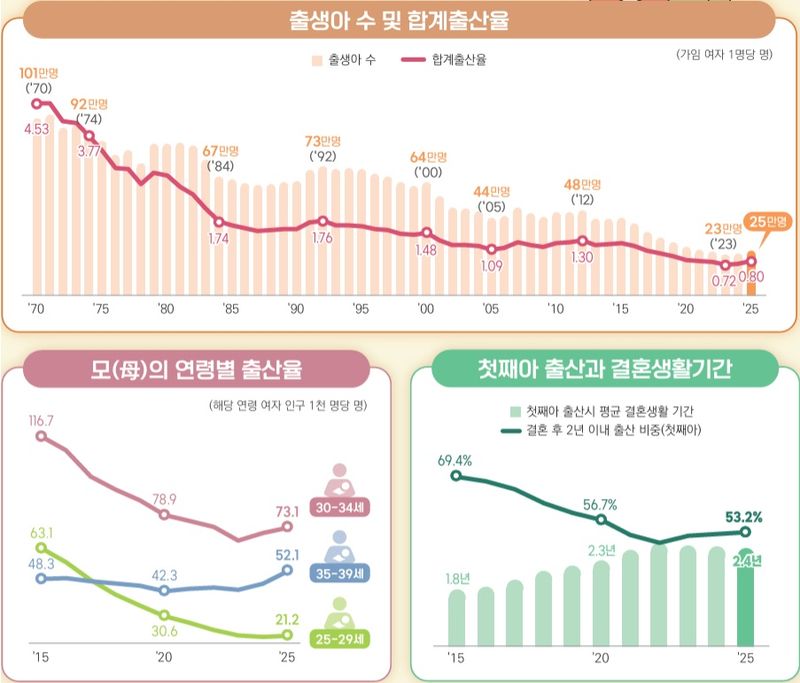
[Financial News] As the number of women in their 30s and marriages increased, the number of babies born last year climbed back above 250,000. After births fell into the 200,000 range in 2020, the decline had continued, but last year marked a rebound to the highest level since 2021. If this trend continues, the number of births this year is likely to recover to the 300,000 range seen in 2019. As women are having children much later, two out of five babies were born to mothers older than 35.
On the 26th, the Ministry of Data and Statistics released its 2025 birth statistics containing these findings.
According to the data, the number of births in 2025 was 254,300, up 16,000, or 6.7%, from the previous year.
The total fertility rate, the average number of children a woman is expected to have in her lifetime, was 0.80, while the crude birth rate, or the number of births per 1,000 people, was 5.0. Both rose from a year earlier, by 0.05 and 0.3, respectively.
Mothers are having children later. As marriage ages for both men and women rise, and women become more active in social and economic life, childbirth is naturally being delayed as well.
Park Hyeon-jeong, head of the Population Trends Division at the Ministry of Data and Statistics, explained, "The average age at childbirth for women rose by 0.2 years from a year earlier to 33.8," adding, "In particular, the share of births to mothers aged 35 or older increased by 1.4 percentage points from the previous year to 37.3%."
In particular, the average age at childbirth for mothers, 33.8, was 3.6 years higher than 20 years ago, when it stood at 30.2 in 2005.
By age group, the birth rate was highest among women in their early 30s at 73.1. Birth rates for women in their early and late 30s rose by 2.8, or 4.0%, and 6.0, or 13.1%, respectively, from a year earlier.
As of 2025, the average age at first birth was 33.2, 34.7 for a second child, and 35.8 for a third child. Compared with 2005, 20 years earlier, these figures were later by 4.1 years, 3.7 years, and 2.5 years, respectively.
The birth rate among women in their late 20s also rose by 0.5, or 2.6%, from a year earlier to 21.1. Compared with 10 years ago in 2015, when it stood at 63.1, it has fallen by 41.9.
The average age of fathers at the time of birth was 36.1, unchanged from the previous year. Compared with 2015, when it was 34.8, it has risen by 1.3 years.
By region, the total fertility rate was highest in Jeollanam-do at 1.09 and Sejong City at 1.06, both above 1.0. In contrast, major cities such as Seoul at 0.63, Busan at 0.74, Gwangju at 0.76, and Daegu at 0.81 posted low total fertility rates.
The share of couples who had their first child within two years of marriage was the largest at 53.2%.
[email protected] Jung Sang-gyun Reporter