Gangwon, which has endured 80 years of regulation, says the Han River basin fund is unfairly skewed; the government says it will improve the system
- Input
- 2026-08-26 11:00:42
- Updated
- 2026-08-26 11:00:42
【Financial News Chuncheon=Kim Gi-seop】Gangwon State in the upper Han River basin, which has endured decades of regulation to supply clean water to the Capital Region, is speaking with one voice in calling for a change to the unfair allocation structure of the Han River Basin Management Fund. As the government has also said it will revise the allocation method, attention is turning to whether long-standing discrimination will finally be corrected.
At a comprehensive policy questioning session of the Special Committee on Budget and Accounts of the National Assembly on the 24th, Climate, Energy and Environment Minister Kim Seong-hwan said the ministry also recognizes problems with whether the current compensation system for upstream residents is appropriate. Kim said, "We will change the budget allocation direction so that upstream residents, who have endured property restrictions and inconvenience to supply clean water downstream, can receive tangible benefits."
His remarks came in response to questions from Democratic Party of Korea lawmaker Heo Young, who represents Chuncheon A, about the sacrifices made by Gangwon residents in the upper Han River basin and the unfair treatment in fund distribution. He pointed out that since the construction of multipurpose dams, the region has been bound by regulations for 80 years and has failed to attract even a single factory that discharges wastewater, while Gangwon's population has been cut in half from 3 million to 1.5 million. Even so, residents are paying the nation's highest tap water rate at 1,104 won per cubic meter.
The core of the problem is that the burden borne by Gangwon State does not match what it receives in return. Since its introduction in 1999, the Han River Basin Management Fund has raised more than 10 trillion won, but most of the regulations to protect water sources are concentrated in upstream areas such as Gangwon State, meaning those areas effectively support the fund's foundation. In actual distribution, however, more money goes to the downstream Capital Region, where water use is higher. Last year, Gyeonggi Province received 203.4 billion won, while Gangwon State received only 126.4 billion won, illustrating this structure.
Funds that are supposed to compensate upstream areas are, in fact, shrinking further. Gangwon State's allocation for eco-friendly clean-up projects, which are intended to ease the damage caused by regulations, fell from 23.7 billion won in 2023 to 19.2 billion won in 2024, then to 12.4 billion won last year and 8.6 billion won this year, dropping to about one-third of its level in just three years. The water-use charge, which is the fund's main source of revenue, requires downstream residents to pay 170 won per ton of tap water, and it has not been raised since 2011. The Han River Basin Management Committee recently decided to freeze it again through 2027 and 2028. With the fee locked in place and revenues unable to grow, cities and counties in the upper Han River basin are being forced into annual competition to secure project funding.
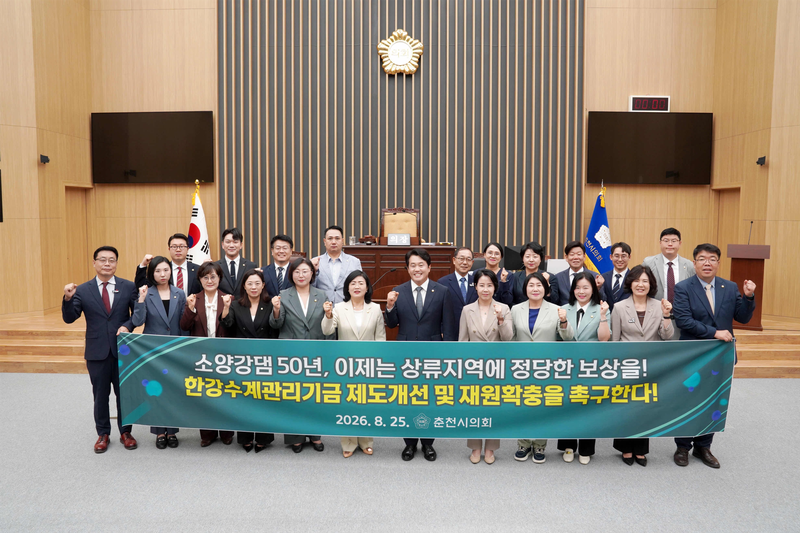
Calls for reforming the fund are also spreading to local councils. On the 25th, at the first plenary session of its 352nd regular meeting, the Chuncheon City Council unanimously adopted a resolution calling for reforms to the Han River Basin Management Fund system and expanded support for upstream areas, introduced by Culture and Welfare Committee Chair Kim Bo-geon. The council urged the government and the National Assembly to establish a reasonable allocation standard so that upstream regulations and actual damage are fully reflected in fund distribution, and to improve rules that excessively restrict residents' daily lives and the local economy. It also called for a special support system for areas around national water management facilities such as Soyang River Dam.
[email protected] Kim Gi-seop Reporter