"We’ll even rename the lake" ... Canada, angered by Trump, hits back with $20 billion in tariffs
- Input
- 2026-08-26 10:57:16
- Updated
- 2026-08-26 10:57:16
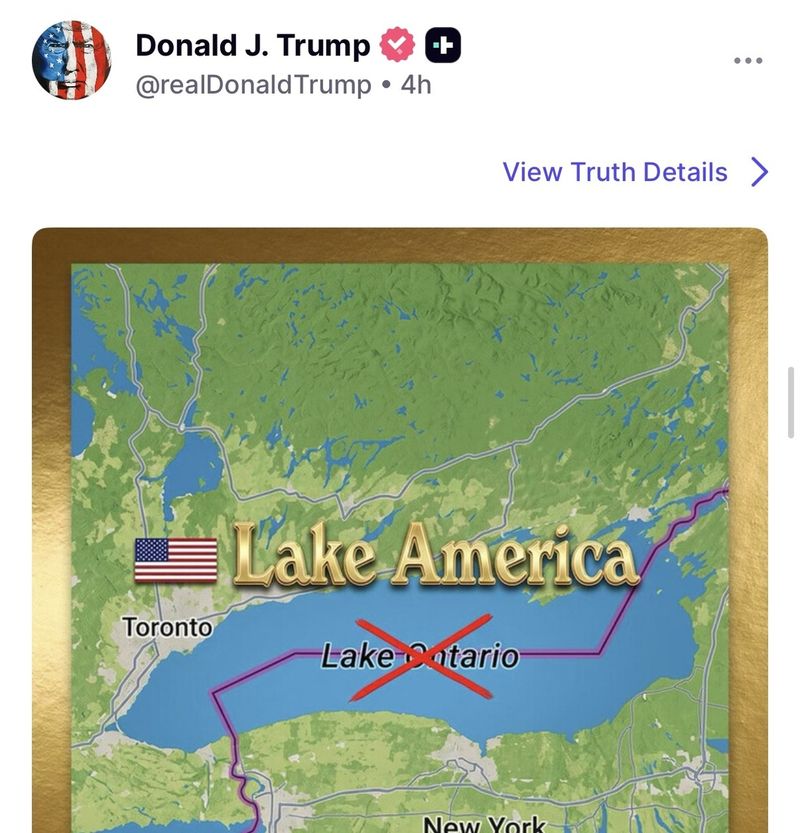
[Financial News] After the United States imposed 50% tariffs on Canadian products, Canada responded with retaliatory duties of up to 50% on $20 billion worth of U.S. goods. The trade dispute has also escalated into a personal feud, with Donald Trump threatening to rename Lake Ontario, which lies on the border between the two countries, as Lake America.
According to Canada’s Finance Ministry on the 25th local time, Canada will impose retaliatory tariffs of 15% to 50% on about 700 categories of U.S. goods. The measures cover imports worth 27.6 billion Canadian dollars, or about $20 billion, and will take effect on the 8th of next month.
The move is a countermeasure to the United States’ 50% tariffs on roughly $20 billion worth of Canadian products, which took effect on the 22nd. Canada said it was applying a so-called 'dollar-for-dollar, rate-for-rate' approach to match Washington’s tariff measures in both scope and rate.
Some U.S. steel, aluminum, furniture and clothing will face the highest rate of 50%. Household appliances, dairy products such as cheese, fish and seafood, and some steel and aluminum derivative products will be subject to 25%, while industrial tools and other items will be hit with 15%.
François-Philippe Champagne, Canada’s finance minister, said, "We did not choose this conflict, but when economic integration is used as a weapon rather than a foundation for mutual prosperity, we must stand up to it." The Canadian government also said it would provide 7.5 billion Canadian dollars in support for companies and workers hurt by the tariff war.
Because the two countries’ supply chains are tightly intertwined, the tariff shock is expected to spread across industries. The cosmetics sector has also been drawn into the dispute. The United States has imposed 50% tariffs on Canadian cosmetics, and Canada will retaliate with the same rate on some U.S. cosmetics starting next month on the 8th. Last year, Canada was the second-largest exporter to the U.S. beauty and skincare market after South Korea. With global companies such as L'Oréal and Estée Lauder operating production facilities in Canada, prolonged tariffs could lead to price increases or a restructuring of production and distribution networks. As a result, Korean cosmetics companies that compete with Canadian products in the North American market are also watching closely for shifts in the market.
The trade dispute has also spilled over into a personal clash between the two leaders. On Truth Social, Trump said, "I don’t think we’ll be doing much more business with Ontario," and added that he was "seriously considering changing the name of Lake Ontario to Lake America." Lake Ontario is one of the Great Lakes, located between Ontario, Canada, and the State of New York in the United States.
Trump also released an image showing Lake Ontario marked with a red X and labeled as Lake America. It appears to have been a provocation aimed at Doug Ford, the premier of Ontario, who has strongly opposed Washington’s tariff policy. Ford has repeatedly criticized Trump, saying that former President Ronald Wilson Reagan, a symbol of the U.S. conservative movement, would be turning in his grave.
Canada’s French-language policy has also become another point of friction. Prime Minister Mark Carney claimed that the U.S. negotiating team raised objections to Quebec’s policy of protecting the French language. Trump responded, saying, "I will never stop Canadians from speaking French," and called Carney’s claim "a lie made up to gain political support."
Trump also claimed that "the United States has lost an average of $60 billion a year over the past decade" and said Canada has been "ripping off the United States for decades." He has already warned that he will impose 50% tariffs on Canadian automobiles and auto parts starting next year.
After trade talks collapsed last week, neither side has backed down, putting the economic relationship between the United States and Canada, which share the world’s longest border, to the test. What began as a dispute over goods tariffs has now spread beyond supply-chain issues in automobiles and cosmetics to arguments over language and place names, raising the possibility that the trade war between the two countries will drag on.
[email protected] Kim Kyung-min Reporter