Births in the First Half Surge 15.4%, Marking the Largest Increase on Record
- Input
- 2026-08-26 12:00:00
- Updated
- 2026-08-26 12:00:00
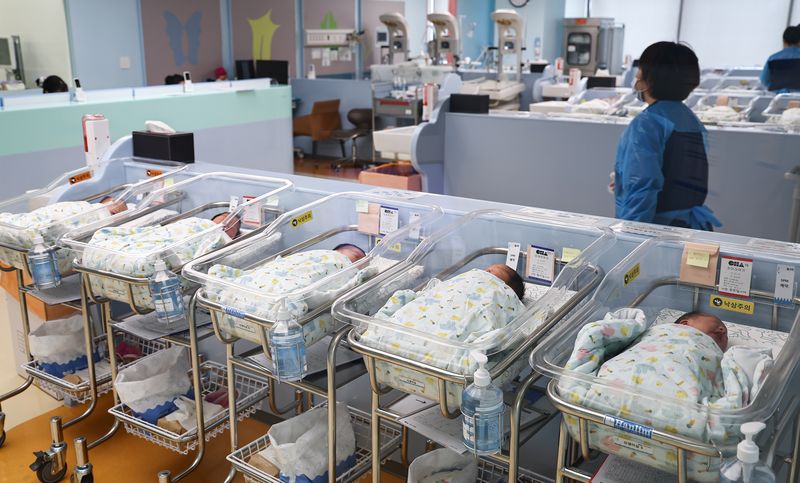
[Financial News] The number of babies born in the first half of this year rose by nearly 20,000, posting the largest increase on record. Births have increased year-on-year for nine consecutive quarters, and the pace of growth has now widened to its highest level ever, signaling a clearer recovery in childbirth. The number of marriages also reached its highest second-quarter level in eight years, supporting the upward trend in births.
According to the "Population Trends for June 2026" released by the Ministry of Data and Statistics on the 26th, births in the first half of this year totaled 145,804, up 19,430, or 15.4%, from a year earlier. Both the absolute increase and the growth rate were the largest ever for a first-half period.
Looking only at the second quarter, births came to 70,791, up 9,675, or 15.8%, from the same period last year. The growth rate was the highest ever for any second quarter, while the number of births was also the largest in seven years, since 2019. The total fertility rate stood at 0.88, up 0.11 from a year earlier.
The rise in births was driven by women in their 30s. The fertility rate by maternal age increased by 11 births per 1,000 women among those aged 30 to 34, and by 10.7 among those aged 35 to 39. It also rose by 0.7 among women aged 25 to 29. In particular, the fertility rate for women aged 35 to 39 was the highest since the second quarter of 2015.
The increase in marriages is also seen as a factor behind the rise in births. Marriages in the second quarter totaled 62,065, up 2,904, or 4.9%, from a year earlier. That was the highest figure in eight years, since 2018, and marked 10 straight quarters of growth since the first quarter of 2024.
Park Hyeon-jeong, head of population trends at the Ministry of Data and Statistics, explained, "The background to the increase in births includes the rise in marriages that has continued since May 2023, after the transition to the endemic phase, as well as the growing population of women in their 30s." She added, "Changes in attitudes toward childbirth, as shown in social surveys, also appear to have had a combined effect."
However, despite the increase in births, the natural population decline continued. Deaths in the second quarter totaled 85,772, up 1,254, or 1.5%, from a year earlier. The increase was driven by the ongoing aging of the population, which pushed up the number of deaths. As a result, natural increase fell by 14,981. This marks 27 consecutive quarters of natural decline since the fourth quarter of 2019.
The annual total fertility rate this year is increasingly likely to rise for a third consecutive year. Still, given the sharp increase in births in the first half, analysts say it remains to be seen whether the annual rate will climb back into the 0.9 range, and that the trend in the second half will need to be watched more closely.
Park said, "In the past, births in the first half were higher than in the second half, but since 2024 the number of births in the first and second halves has been similar, or the second half has even been higher." She added, "If that pattern continues this year, the upward trend in births is likely to continue, but we will need to watch this more closely."
[email protected] Kim Chan-mi Reporter