The Paradox of a Shrinking School-Age Population: Student Numbers Fell by 190,000, Yet 11 More High Schools Opened
- Input
- 2026-08-26 12:00:00
- Updated
- 2026-08-26 12:00:00
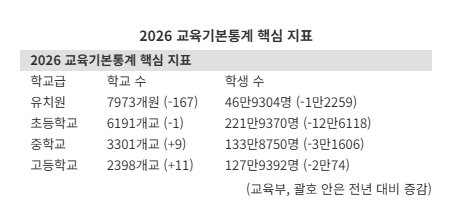
[Financial News] Although the number of students nationwide is falling rapidly due to the low birthrate, school demand is moving in different directions by region. Even though the number of high school students dropped by more than 20,000 this year, the number of high schools rose by 11, and 9 of the 12 newly opened high schools were in Gyeonggi Province. That is because population inflows into certain areas, driven by new town and residential development, are still creating demand for new schools.
According to the results of the 2026 Basic Education Statistics Survey released on the 26th by the Ministry of Education and KEDI, the number of students in kindergartens, elementary, middle and high schools nationwide stood at 5,362,281 this year, down 189,007, or 3.4%, from a year earlier. The number of high school students also fell to 1,279,392, down 20,074, or 1.5%, from a year ago.
However, the number of high schools rose by 11 from the previous year to 2,398. Of the 12 new high schools opened this year, 9 were in Gyeonggi Province, while one each was established in Seoul, Incheon and Gyeongnam. One school, Mupung High School in Muju County, North Jeolla Province, closed, leaving a net increase of 11 schools nationwide.
A ministry official explained, "School openings are subject to factors such as student-generation effects and investment review requirements." The official added, "As population inflows occurred in certain areas due to new town development and residential site projects, the number of people generating educational demand, including students, increased, and that led to more newly established schools." In other words, whether a school is built depends not on the nationwide decline in student numbers, but on regional population movement and development conditions. Even as the decline in the school-age population has begun in earnest, some developing areas may still see continued demand for new schools.
The changes also varied sharply by school level. The total number of kindergartens, elementary, middle and high schools fell by 140 from a year earlier to 20,233, but while kindergartens dropped by 167, middle schools and high schools increased by 9 and 11, respectively. Elementary schools declined by just one.
The ministry official said, "Kindergartens are the first stage to be hit directly by the decline in births," adding, "We believe the sharp drop in births has led to fewer kindergartens and children enrolled, as well as the closure of private kindergartens."
Because the number of teachers has barely fallen despite the steep drop in students, the number of students per teacher continued to decline. The total number of teachers in kindergartens, elementary, middle and high schools stood at 505,545, down just 594, or 0.1%, from a year earlier. In elementary schools, the number of students per teacher fell by 0.5 to 11.6 from 12.1 a year earlier.
The student body is also changing. The number of students with immigrant backgrounds, including those in special schools at the elementary and secondary levels, reached 210,838, up 8,630, or 4.3%, from a year earlier, accounting for 4.3% of all students.
The number of international students at higher education institutions, including universities, rose to 307,464, up 54,030, or 21.3%, from a year earlier. By country, Vietnamese students numbered 96,834, or 31.5%, surpassing Chinese students, who numbered 78,890, or 25.7%, to rank first for the first time.
[email protected] Kim Man-ki Reporter