Jeju has the nation's highest delinquency rate for household loans... expands its financial safety net
- Input
- 2026-08-26 10:21:26
- Updated
- 2026-08-26 10:21:26
[Financial News, Jeju = Reporter Jung Yong-bok] Jeju, which has the highest delinquency rate for household loans in the country, is moving to strengthen its financial safety net to block the flow into illegal private lending and help financially vulnerable households get back on their feet.
According to Jeju Special Self-Governing Province and the Jeju branch of the Bank of Korea on the 26th, the delinquency rate for household loans at deposit banks in Jeju stood at 1.24% at the end of May. That was down 0.07 percentage point from 1.31% in April, but it remained the highest in the country.
The delinquency rate for household loans refers to the share of household lending on which principal and interest have not been repaid for at least one month. Jeju's rate surged to 1.40% in January, setting an all-time high.
Loan volumes are also rising again. In May, household loans in Jeju increased by 145.4 billion won from a month earlier, more than four times the 33.7 billion won increase in April. Mortgage loans rose by 4.7 billion won, while other household loans, including credit loans, increased by 140.8 billion won.
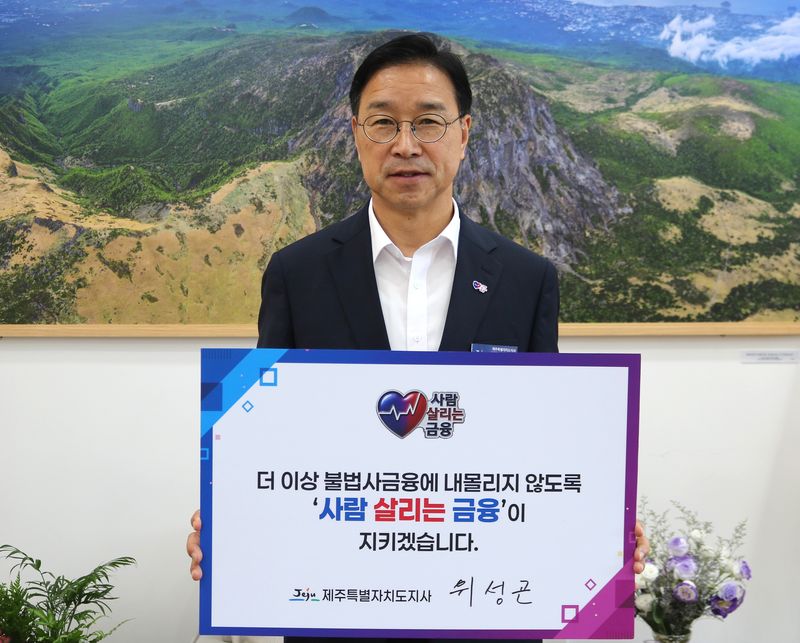
Against this backdrop, Governor Wi Seong-gon of Jeju Special Self-Governing Province joined the 'Finance That Saves Lives Relay Campaign' on the 25th to help prevent damage from illegal private lending.
The campaign, run by the Korea Inclusive Finance Agency, began on July 27 with Kim Eun-kyung, the agency's president, as the first participant. Wi joined after being nominated by Kim.
Wi said, "I will strengthen the financial safety net so that residents can avoid illegal private lending and use formal financial services to get back on their feet."
Jeju established an institutional foundation for supporting financially vulnerable groups earlier than other regions. In July 2023, it became the first local government in the country to enact the Ordinance on Support for Financial Inclusion in Jeju Special Self-Governing Province, and in December of that year it set up a financial inclusion fund. In March this year, a separate ordinance governing the establishment and operation of the fund took effect.
The province also operates interest support for policy-based microfinance through the financial inclusion fund, as well as 'Jejuhondi Loan,' an emergency loan program. Jejuhondi Loan is a small-loan program that helps financially marginalized people who have undergone debt adjustment or received approval for personal rehabilitation borrow emergency funds through formal financial channels.
The Jeju Financial Welfare Counseling Center, which opened in August last year, also plays a key role in the financial safety net. The center provides debt, financial and credit counseling, links to public and private debt adjustment programs, connections to jobs and welfare policies, financial education by life stage, and support for applications for credit recovery fees.
Jeju plans to further expand support for financially vulnerable groups under the 9th elected administration. It will launch new programs for asset-building and household loan support to prevent financial crises such as high-interest illegal private lending and to help residents achieve economic self-reliance.
Wi named Kim Young-jin, chair of the National Assembly Public Administration and Security Committee, lawmaker Park Sang-hyuk, and former lawmaker Je Yoon-kyung as the next participants in the campaign.
■ Guidelines for preventing damage from illegal private lending
If you are exposed to damage from illegal private lending, you can report it to the Financial Supervisory Service at 1332 to receive help. If you are struggling with excessive debt, you can also seek assistance from the Korea Inclusive Finance Agency at 1397 or the Credit Counseling and Recovery Service (CCRS) at 1600-5500.
※ Loan contracts with annual interest rates above 60% are invalid for both principal and interest.
[email protected] Jung Yong-bok Reporter