'Marine heatwaves' up 3.7-fold, and by century's end they could last more than 300 days a year
- Input
- 2026-08-26 11:00:00
- Updated
- 2026-08-26 11:00:00
[Financial News] The seas around Korea are warming rapidly. Over the past 10 years, the average sea surface temperature has risen 0.7 degrees Celsius above normal, and the number of days with marine heatwaves, often called "marine heatwaves," has increased 3.7-fold. If climate change continues, marine heatwaves could last for more than 300 days a year by the end of the 21st century, based on the high-temperature threshold from the past 20 years.
The Korean Meteorological Administration said on the 26th that, after analyzing sea surface temperatures and marine heatwaves in waters around Korea from 1991 to 2025, the average sea surface temperature over the past 10 years (2016 to 2025) was 18.1 degrees Celsius. That was 0.7 degrees higher than the normal level of 17.4 degrees for 1991 to 2020.
Since 1991, sea surface temperatures have risen by 0.3 degrees per decade. More recently, the pace has accelerated. From 1991 to 2015, there was no clear trend, with the rate at 0.0 degrees per decade. But over the past 10 years, the upward trend has reached 1.2 degrees per decade.
Records of high sea temperatures have also been concentrated in recent years. According to observations from the Korea Meteorological Administration's ocean weather buoys, the year with the highest average sea surface temperature was 2024, at 18.7 degrees Celsius. It was followed by 2025 at 18.0 degrees, and 2021 and 2023 at 17.9 degrees each. All of the top four warmest years came after 2021.
As the ocean warms, marine heatwaves have become more frequent. A marine heatwave is defined as a period when the daily average sea surface temperature stays above the threshold corresponding to the top 10 percent of the normal distribution for at least five consecutive days.
Under normal conditions, marine heatwaves occurred for an average of 22.6 days a year. Over the past 10 years, that figure rose to 83.3 days. In other words, the duration has lengthened from about 3.2 weeks a year to about 2.8 months. The intensity also increased by 0.2 degrees, from 1.9 degrees under normal conditions to 2.1 degrees over the past decade.
The East Sea showed the most pronounced changes. Over the past 10 years, its average sea surface temperature was 18.4 degrees Celsius, 0.8 degrees above normal. The number of marine heatwave days increased from an annual average of 23.5 to 96.1, while intensity rose from 1.9 degrees to 2.2 degrees. The scale of change was larger than in the Yellow Sea and Namhae County.
The rise in sea temperatures around Korea has been greater than the global average. Over the past 10 years, sea surface temperatures rose 0.3 degrees globally and 0.5 degrees in the Northwest Pacific, but they increased 0.7 degrees in waters around Korea.
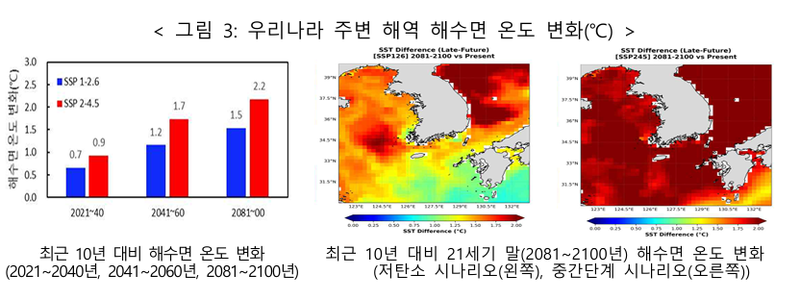
The increase is expected to become even larger in the future. Based on the IPCC Sixth Assessment Report, the Korean Meteorological Administration analyzed waters around Korea at a resolution of about 8 kilometers. It found that sea surface temperatures in 2081 to 2100, the end of the 21st century, are expected to be 1.5 degrees higher than the past 10 years under a low-carbon scenario, and 2.2 degrees higher under a mid-range scenario.
In the East Sea, temperatures are forecast to rise by 1.8 degrees and 2.5 degrees, respectively. The Yellow Sea is expected to warm by 1.6 degrees under the low-carbon scenario and 2.0 degrees under the mid-range scenario. In Namhae County, the increases are projected at 1.3 degrees and 2.0 degrees.
The number of marine heatwave days is also expected to rise sharply. By the end of the century, the annual average is projected to reach about 304 days under the low-carbon scenario and about 320 days under the mid-range scenario. That would equal about 83 percent and 88 percent of a year, respectively. Intensity is also expected to increase by 0.7 degrees and 0.9 degrees compared with the past 10 years.
However, the forecast of "more than 300 days a year" is based on the top 10 percent threshold, using the high-temperature standard from 1994 to 2013. The Korean Meteorological Administration explained that this figure shows how often and how strongly current high-temperature conditions could appear in the future.
In both scenarios, future sea surface temperatures, as well as the frequency and intensity of marine heatwaves, are expected to increase. The agency said ocean warming is likely to continue for a long time because of accumulated greenhouse gas emissions over the past, but the scale of change will differ depending on emission levels.
Administrator of the Korea Meteorological Administration Lee Mi-sun said, "The ocean climate crisis is becoming a reality, as sea surface temperatures around the world have recently remained at unusually high levels. In waters around Korea as well, climate change is clearly visible through rising sea surface temperatures and more frequent marine heatwaves." She added, "As one of the key components of the Earth system, the ocean interacts closely with the atmosphere and can have broad effects on daily life, including links to extreme weather events such as heat waves and heavy rain. We will do our utmost to closely monitor climate change in the ocean and provide highly reliable forecast information so that we can strengthen our advance response to the climate crisis."
[email protected] Lee Bo-mi Reporter