Jeju carrots to target new markets by growing smaller... 'Mini Hong' farm demonstration
- Input
- 2026-08-26 09:55:04
- Updated
- 2026-08-26 09:55:04
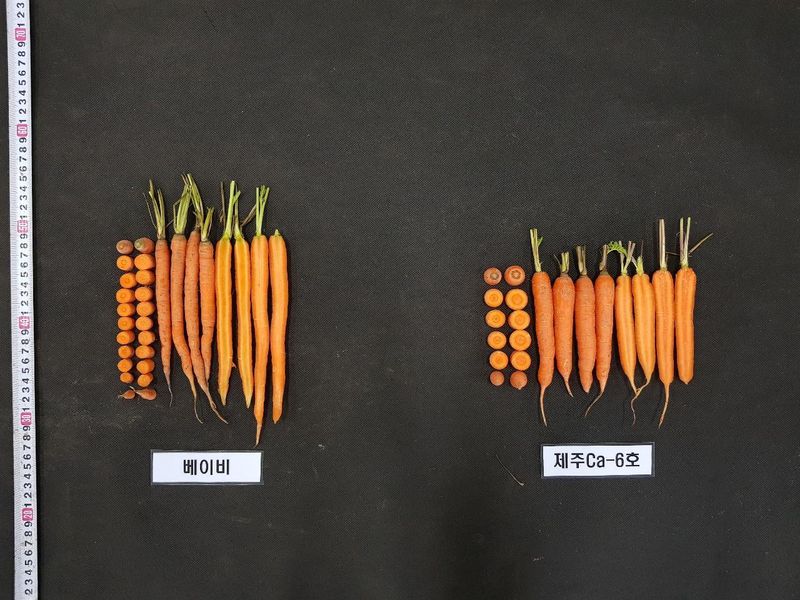
/Photo provided by the Jeju Special Self-Governing Province Agricultural Research & Extension Services 【Financial News Jeju = Reporter Jeong Yong-bok】 Jeju is beginning farm trials to cultivate small carrots, which are easy to eat in one sitting, as a new income crop. This is a stage to verify whether smaller carrots, produced in response to the increase in single-person households and the spread of salad and fresh-cut food consumption, can be stably produced in actual fields and accepted by the market.
2 hectares in the Gujwa area of Jeju City, a major carrot producing region. During the demonstration, 'Mini Hong' and the 'Baby' variety imported from France will be cultivated comparatively under the same conditions to investigate growth and yield characteristics.
Mini Hong is a small carrot for which the Agricultural Research & Extension Services filed a variety application in January 2024. Its growth period is approximately 80 days, and its root length is around 13 cm.
This is shorter than the 17 cm of the comparison variety, Baby. Its weight is about 50 g, which is about one-quarter the weight of a regular carrot.
The focus was on the fact that the small size makes it easy to eat in one sitting or to use in salads and convenience foods. This demonstration goes beyond merely confirming the variety's cultivation feasibility.
The Agricultural Research and Extension Services plans to conduct pilot sales of the produced Mini Hong starting this November to assess consumer response and actual marketability. Even if an agricultural product has high productivity, it is difficult for it to establish itself as a new source of income if it does not meet the size, shape, and usage preferences of consumers.
This is why the Agricultural Research and Extension Services is verifying both cultivation and sales simultaneously. Jeju carrots are one of the representative field crops cultivated primarily in the Gujwa region.
If small varieties differentiated from existing carrots secure marketability, it is significant in that it can expand the product range within the same crop category. If productivity and marketability are confirmed through demonstration results, the Agricultural Research and Extension Services plans to review the possibility of distributing Mini Hong to farms and establish a high-value-added production system to meet the demand for small vegetables.
Lee Gwang-ju, head of the Vegetable Research Team at the Jeju Agricultural Research and Extension Services, stated, "Agricultural products also need to change to meet the size and convenience of use desired by consumers," adding, "We will comprehensively review the productivity and marketability of Mini Hong to confirm its potential to become established as a new income crop for farmers.
"
On the left is 'Baby,' imported from France, and on the right is 'Mini Hong (Jeju Ca-6),' developed in Jeju. Mini Hong has a root length of around 13 cm, which is shorter than the Baby variety, and weighs about 50 g, which is about one-quarter the weight of a regular carrot.
On the left is 'Baby,' imported from France, and on the right is 'Mini Hong (Jeju Ca-6),' developed in Jeju. Mini Hong has a root length of around 13 cm, which is shorter than the Baby variety, and weighs about 50 g, which is about one-quarter the weight of a regular carrot.
[email protected] Jeong Yong-bok Reporter