Kim Min-seok says Jeju false case closure occurred while supplementary investigative authority was still in effect
- Input
- 2026-08-26 09:34:39
- Updated
- 2026-08-26 09:34:39
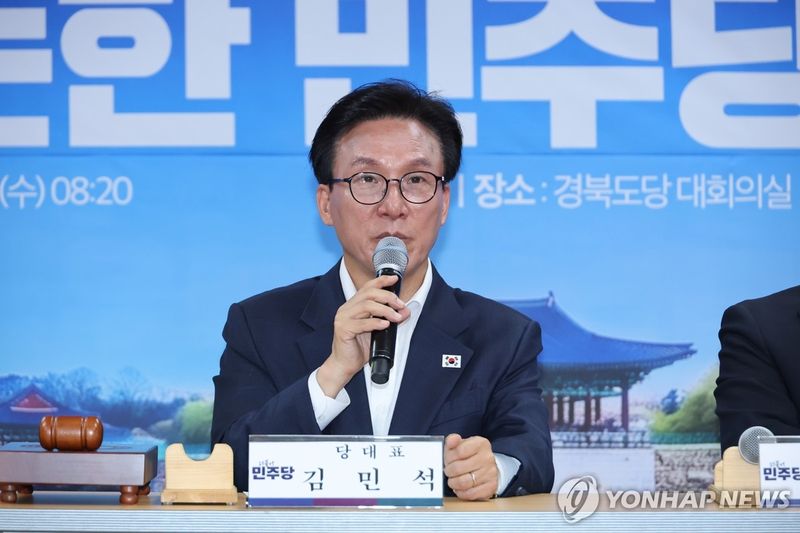
[Financial News] Kim Min-seok, leader of the Democratic Party of Korea, said on the 26th that the so-called "Jeju false case closure" incident "occurred while the Prosecution Service's current supplementary investigative authority was still in effect," rejecting claims that it was a side effect of prosecution reform, including the abolition of prosecutors' supplementary investigative authority.
At an on-site Supreme Council meeting held in Andong, North Gyeongsang Province, that day, Kim said, "When prosecution reform was already under way during my time as Prime Minister, I also thought police reform was a very important issue," adding, "Under the principle of popular sovereignty, we will strengthen democratic oversight of both the Prosecution Service and the National Police Agency."
The controversy over the National Police Agency's investigative capabilities and oversight mechanisms has grown after police closed the case of the late Jang Mi-ran, who had been reported missing in Jeju Province, and a body believed to be hers was later found. Some have also raised concerns that if prosecutors' supplementary investigative authority is fully abolished in the future, the checks on expanded police investigative powers could be weakened. Kim appeared to draw a line against those claims by stressing that this incident occurred while the current supplementary investigative authority of the Prosecution Service still existed.
Earlier, President Lee Jae-myung instructed officials to conduct a thorough fact-finding investigation into the case and to consider forming a police reform body. The Democratic Party of Korea also plans to launch a police reform task force with former police officers serving as advisers and to pursue legislation aimed at curbing poor investigations and abuse of police power.
As the direction of police reform, Kim stressed that "we must root out six major abuses, including protecting our own, burying cases, closing them without authorization, concealing or fabricating evidence, leaking investigative information, and violating personal information," adding, "We will protect investigations that safeguard the public, and firmly reform investigative power that infringes on people's rights and interests."
[email protected] Song Ji-won Reporter