Why do microplastics lighter than water sink to the seafloor?
- Input
- 2026-08-26 09:31:32
- Updated
- 2026-08-26 09:31:32
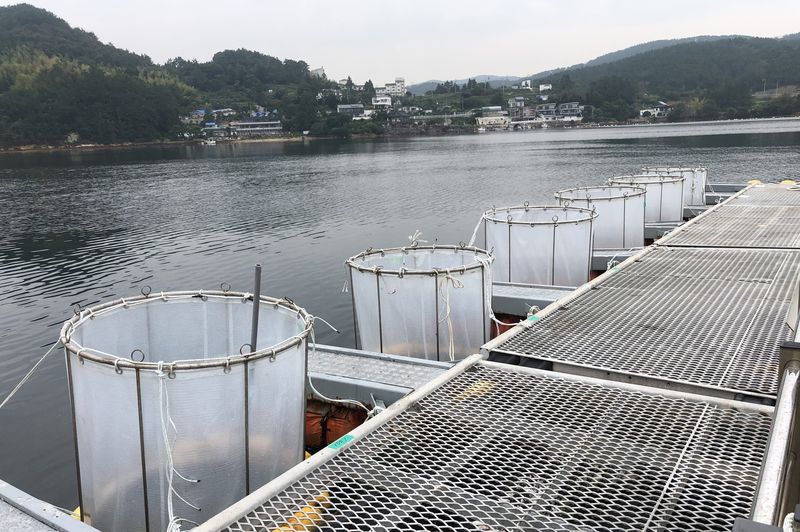
KIOST said on the 26th that Dr. Baek Seung Ho's team from the Ecological Risk Research Division conducted the study to resolve this question.
The study found that mucus released by phytoplankton gathers microplastics and causes them to sink into the ocean. In other words, the answer lay in phytoplankton, the tiny life forms of the sea.
Until now, most related studies have been conducted in laboratory settings using a single type of plankton. This study, however, was carried out using a mesocosm approach designed to recreate conditions similar to the real ocean and observe them in the field.
Dr. Baek's team installed five cylindrical tanks, each 1 meter in diameter and 2.5 meters deep, off Geoje Island in South Gyeongsang Province, and filled them with seawater and phytoplankton. They then added nutrients such as nitrogen and phosphorus at different concentrations to each tank, recreating natural conditions in which nutrient levels in estuaries and coastal waters change depending on rainfall.
Three days after the experiment began, diatoms rapidly increased in the nutrient-rich tanks, while growth was slower in the nutrient-poor tanks and the dominant species also differed. The team then added 30 million microplastics to each tank and measured how much had sunk to the bottom.
The researchers expected microplastics to sink more in tanks with more phytoplankton, but the results were not simply proportional to phytoplankton biomass. The reason lay in the type of phytoplankton. Tanks dominated by diatoms had more microplastics settled on the bottom, while tanks dominated by dinoflagellates had relatively fewer.
Dr. Baek said, "Until now, the movement of microplastics has been predicted mainly based on how heavy and small the particles are." He added, "Based on the results of this study, future efforts to predict the pathways of microplastics and develop management measures must also take into account biological community data by region. We will continue to examine how dominant species change by season and sea area to identify where microplastics move and where they accumulate."
[email protected] Byeon Ok-hwan Reporter