Toyota and Honda's 900,000-Unit Production Network Shaken by U.S.-Canada Tariff War
- Input
- 2026-08-26 09:34:43
- Updated
- 2026-08-26 09:34:43
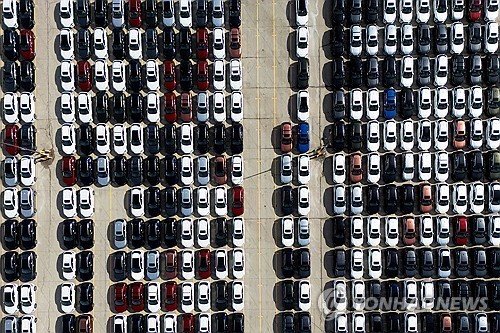
[Financial News, Tokyo = Reporter Seo Hye-jin] As the tariff war between the United States and Canada spreads to automobiles, Japanese automakers including Toyota Motor Corporation and Honda are closely watching the impact on their North American production networks. The two companies produce about 900,000 vehicles a year in Canada, and Honda exports roughly 80% of its local output to the United States. If a 50% tariff on Canadian cars and parts becomes reality, there are growing concerns that they may have to redesign their North American production and export strategy, which was built on the duty-free framework of the United States–Mexico–Canada Agreement (USMCA).
■USMCA cannot avoid tariffs either... business assumptions shaken
On the 26th, Japanese media reported that the tariff clash between the United States and Canada could affect not only Toyota Motor Corporation and Honda, but also local parts suppliers such as Denso Corporation and Aisin Corporation. Nihon Keizai Shimbun (The Nikkei) noted that "if a 50% tariff is imposed on cars exported to the United States, each company's business assumptions will change significantly." The Asahi Shimbun also reported that "if tariffs are imposed, the impact will be substantial and companies may be forced to review their supply chains."
Earlier, U.S. President Donald Trump said on his Truth Social account on the 24th that he would raise tariffs on Canadian cars, large and small trucks, auto parts, and steel to 50% starting January 1, 2027. The Government of Canada responded the next day, saying it would impose retaliatory tariffs of 15% to 50% on about 700 U.S. products starting on the 8th of next month. The affected imports are worth 27.6 billion Canadian dollars.
What Japanese automakers are paying close attention to is that the USMCA will not serve as a shield against the new tariffs.
The United States has so far exempted most Canadian imports that meet USMCA rules of origin from tariffs. However, the new 50% tariff imposed on more than 500 Canadian products from the 22nd applies regardless of whether they satisfy USMCA requirements.
■Toyota and Honda produce 900,000 vehicles a year in Canada
Japanese automakers have developed Canada into a production and export base for the U.S. market, relying on the North American free trade system.
Honda began vehicle production in Ontario in 1986 and expanded its production line in 1998. It can currently produce up to 400,000 units a year, including some gasoline versions of the sport utility vehicle Honda CR-V and the Honda Civic sedan. About 80% of that output is exported to the United States.
Toyota began production in Ontario in 1988 and started operating a second plant in the same province in 2008. It currently produces about 500,000 vehicles a year, including its flagship SUV, the Toyota RAV4, and the Lexus RX, a premium model. Combined, Honda and Toyota's production capacity in Canada reaches about 900,000 vehicles a year.
If a 50% tariff is imposed on Canadian cars, companies will either have to pass the burden on to consumers through higher prices or absorb it themselves. Passing it on would weaken price competitiveness in the U.S. market, while absorbing it would hurt profitability. Honda, which sends about 80% of its Canadian output to the United States, could be hit particularly hard.
The Yomiuri Shimbun analyzed that "Japanese automakers have used Canada as an export base for the U.S. market" and that "if tariffs on cars exported from Canada to the United States are sharply raised, business operations will also be significantly affected."
Parts suppliers could also be affected. Denso operates a subsidiary in Ontario that produces automotive air-conditioning products, while Aisin manufactures door frames and other components through its local affiliate. If a 50% tariff is applied to Canadian auto parts, it could also weigh on the price competitiveness and profitability of parts produced locally and supplied to the United States.
■A 30-year North American free trade system also faces a test
The background to Japanese companies' expansion of production in Canada lies in the North American free trade system. After the North American Free Trade Agreement (NAFTA) took effect in 1994, tariffs on automobiles and auto parts were gradually eliminated, prompting Japanese companies to expand local production capacity as well. NAFTA was replaced by the USMCA in 2020 during the first Trump administration.
Even after the United States raised its general auto tariff to 25% in 2025, the system that lowers tariffs under the USMCA based on the share of U.S.-made parts was maintained. The Yomiuri Shimbun predicted that "if tensions between the United States and Canada deepen, the USMCA framework itself could be reconsidered."
However, the specific method for imposing the 50% tariff on Canadian cars and parts has not yet been disclosed. It is also unclear whether the plan is to raise the existing 25% tariff on automobiles to 50%, or to add cars and parts to the 50% tariff measures launched on the 22nd.
The Nikkei reported that "the two countries are still seeking a path to continue negotiations."
[email protected] Seo Hye-jin Reporter