Will HD Hyundai Solve the LNG Cargo Tank Problem? World's First Commercialization of a Three-Tank LNG Carrier
- Input
- 2026-08-26 08:12:06
- Updated
- 2026-08-26 08:12:06
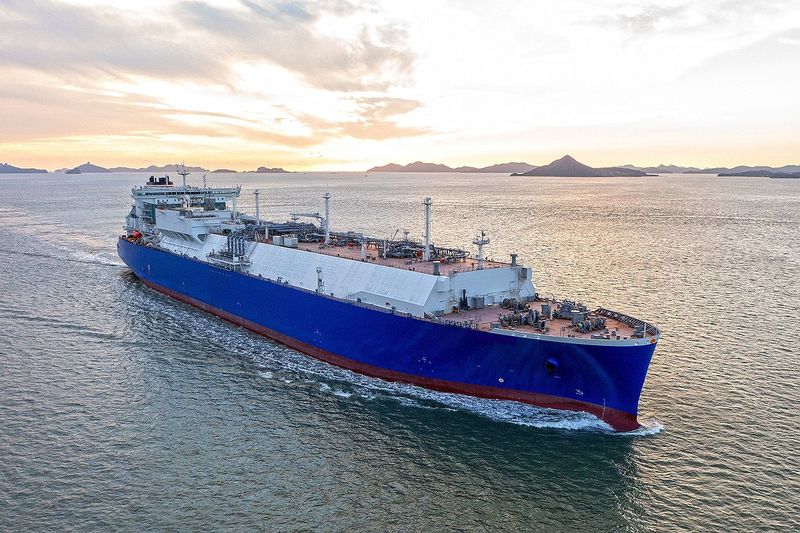
[Financial News] HD Hyundai Heavy Industries will commercialize the world's first next-generation design that increases cargo capacity by 3,000 cubic meters through an innovative cargo tank structure while keeping the hull size of the global standard 174,000-cubic-meter LNG carrier unchanged. The technology maximizes transport efficiency without running into terminal berthing constraints caused by larger ships, meeting shipping lines' demands for both profitability and environmental performance. By overcoming the cargo tank technology barrier, long constrained by dependence on core technology and the need to prove safety, through in-house engineering and global partnerships, expectations are rising that the company could help set the next global standard.
According to BW LNG's LinkedIn post on the 26th, HD Hyundai Heavy Industries will apply the jointly developed 177,000-cubic-meter three-tank design, created with Gaztransport & Technigaz (GTT) and BW LNG of Singapore, to vessels built by HD Hyundai Samho Co., Ltd. The design has already received approval from DNV for four ships ordered by BW LNG, and deliveries will be made sequentially from the fourth quarter of 2028 through the third quarter of 2029.
LNG cargo tanks are a highly demanding technology that must withstand temperatures as low as minus 163 degrees Celsius, and they have been one of the biggest challenges the Korean shipbuilding industry had to overcome. Because GTT held exclusive core patents, shipbuilders had to pay royalties of about 5% of a vessel's price, and independent development also faced a high barrier to commercialization due to concerns over sloshing defects during operation and the conservative stance of global shipowners.
HD Hyundai Heavy Industries chose a strategy of working with the original technology holder while bypassing and overcoming the limits through cargo tank structural innovation. It precisely analyzed the liquid dynamic loads created by larger tanks, proved structural safety, and optimized GTT's reinforced Mark III system.
By keeping the ship's external dimensions unchanged while reducing the number of cargo tanks from four to three, the company cut the space needed for insulation bulkheads and increased cargo capacity to 177,000 cubic meters. The lower surface-area ratio reduced the boil-off rate, while power consumption for boil-off gas and reliquefaction systems also fell, improving carbon intensity. The vessel also secured operational flexibility even under partial loading, fully preserving terminal compatibility.
An HD Hyundai Heavy Industries official said, "We plan to solidify our leadership in the next-generation LNG carrier market with a design that maximizes efficiency while preserving compatibility with proven hull forms."
[email protected] Kim Dong-ho Reporter