Foot Locker Parent's Outlook Cut, Sending Shares Tumbling... A Sign of a U.S. Consumer Collapse?
- Input
- 2026-08-26 03:06:13
- Updated
- 2026-08-26 03:06:13
DICK'S Sporting Goods, the parent company of the leading U.S. shoe retailer Foot Locker, lowered its full-year sales and profit outlook in its quarterly earnings report on the 25th (local time). Its stock plunged as much as 27% intraday.
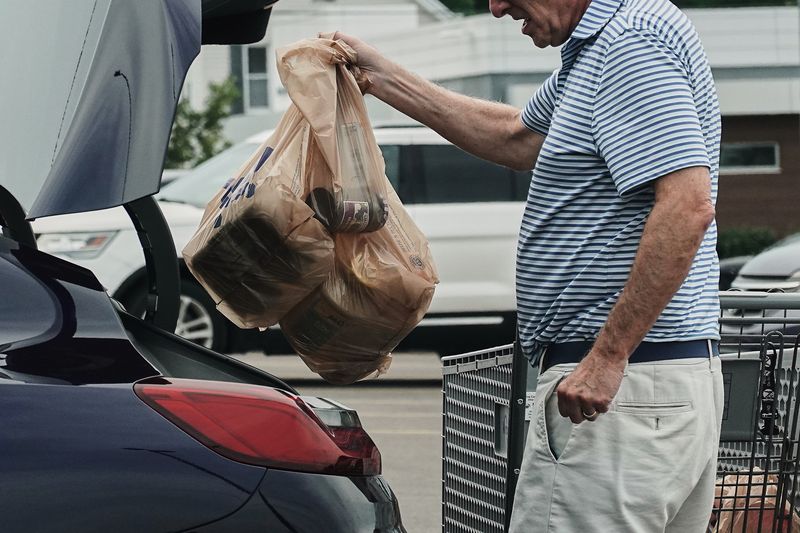
The weaker outlook for Foot Locker's sales and profit suggests that U.S. consumers are cutting back as household finances tighten. Concerns are growing that consumption, a key sector that accounts for more than three-quarters of the U.S. economy, may be starting to crack.
According to the Financial Times (FT), Edward W. Stack, CEO of DICK'S, said during a conference call with analysts that "there is too much inventory in the industry" as the stock price has fallen more than 40% from its June peak. Stack also added that consumers are becoming "more cautious than expected because of the geopolitical environment."
Although it had been expected that consumers would trim spending elsewhere as gasoline prices surged after the Iran war launched by President Donald Trump on February 28, the decline has far exceeded forecasts. Stack stressed that footwear products, especially sneakers, have been hit particularly hard.
Recent U.S. retail sales and consumer sentiment indicators show that many Americans are struggling with higher living costs caused by President Trump's tariffs and the Iran war. Discretionary spending, one of the first items consumers cut when budgets are tight, has been hit especially hard. As prices for essentials such as fuel rise, consumers are reducing spending on these nonessential items. As a result, the S&P 500 Consumer Discretionary Index on the New York Stock Exchange fell 5% last month.
U.S. consumer sentiment is also deteriorating.
The University of Michigan's consumer sentiment index for August, released on the 14th, came in at 51.0, down 7.6% from the previous month. Older adults and low-income households were hit especially hard psychologically as gasoline prices jumped. Oil prices have risen about 40% since the outbreak of the Iran war.
Susan Collins, president of the Federal Reserve Bank of Boston, told the Financial Times in a recent interview that the war has intensified cost-of-living pressures, making it "hard for poor U.S. consumers to put food on the table."
According to the U.S. Department of Commerce, retail sales in July fell 0.6% from the previous month, the largest drop in more than a year. Much of the decline was due to Amazon Prime Day being moved to June this year, but economists say a slowdown in U.S. consumption is unavoidable.
The slowdown at Walmart Inc., the world's largest brick-and-mortar retailer, is also showing that these concerns are becoming reality.
Walmart Inc.'s stock plunged last week after its quarterly earnings report showed that U.S. sales growth had slowed to its weakest pace in more than six years.
Meanwhile, DICK'S lowered its full-year net sales forecast from $22.1 billion-$22.4 billion to $21.9 billion-$22.2 billion. It also cut its operating profit outlook from $1.69 billion-$1.81 billion to $1.45 billion-$1.55 billion.
[email protected] Song Kyung-jae Reporter