A salt lake half the size of Seoul on the other side of the world... Lithium pours out when the brine is concentrated
- Input
- 2026-08-25 15:00:00
- Updated
- 2026-08-25 15:00:00
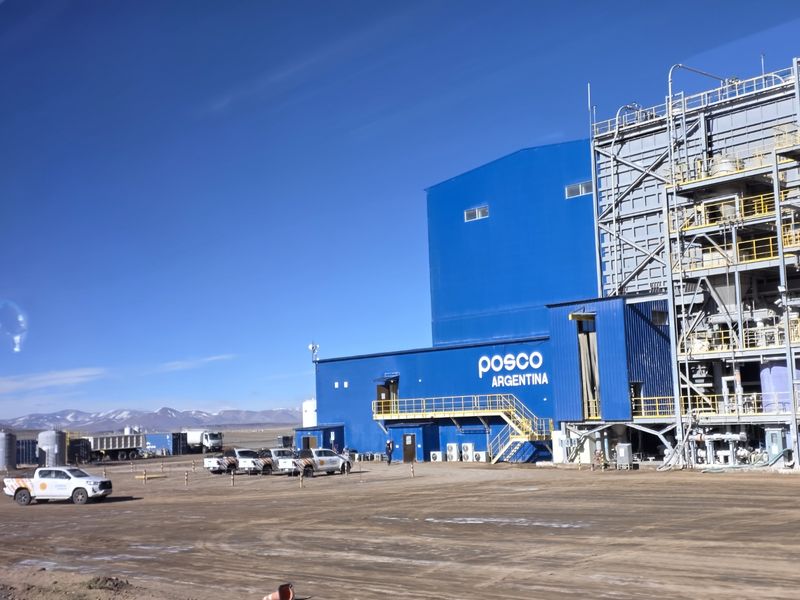
[Financial News, Salta (Argentina) = Kim Hak-jae] On the 19th local time, after traveling by plane for about two hours from Buenos Aires, Argentina's capital, to Salta, the provincial capital of Salta Province, and then taking a small plane for another 30 minutes, this reporter arrived at the Salar de Hombre Muerto area, a high-altitude salt lake region at 4,000 meters above sea level.
The weather was brutal from the start. In a place where yellow-brown land stretched endlessly, temperatures fell to minus 16 degrees Celsius and winds of more than 40 km/h blew across the barren terrain. The cold made the body shrink instinctively, but local workers repeated, "This is nothing."
Even in these harsh conditions, POSCO Argentina, a unit of POSCO Holdings Inc., was steadily extracting lithium, a key material for batteries, through its existing Argentina Brine Lithium Phase 1 Project and a second plant nearing completion. POSCO has now gone beyond simply mining lithium at a 4,000-meter-high plateau. By securing mining rights directly and building expertise in extraction and refining, it has created a competitive edge that can withstand price risks.
■ Lithium from a vast salt lake half the size of Seoul
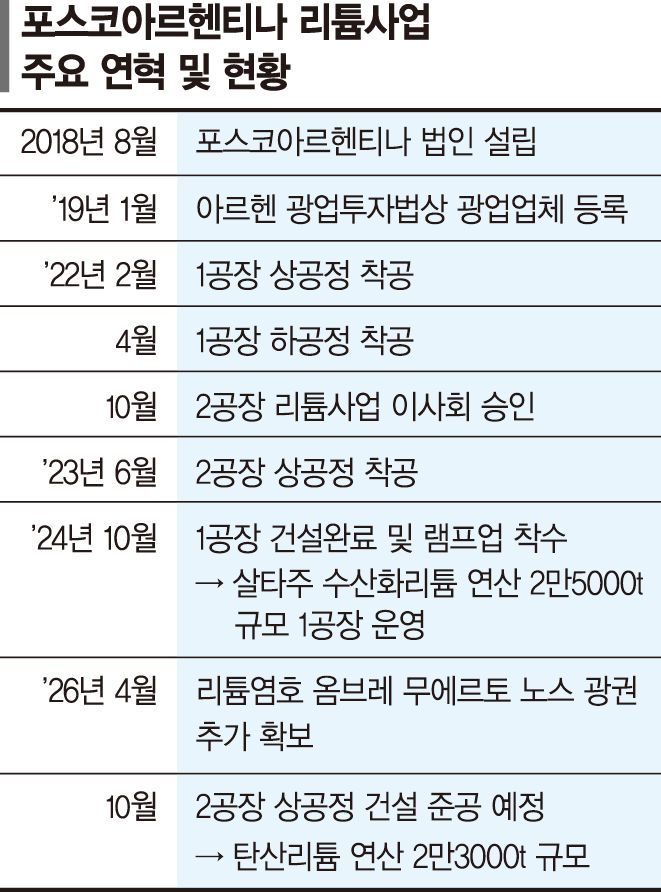
When POSCO Holdings Inc. acquired the mining rights to the Salar de Hombre Muerto in Salta Province in 2018 for about $280 million, the site was still a "land of possibility." There were ponds and pilot production facilities to pump up underground brine and raise the lithium concentration, but it was still unproven whether large-scale commercial production would succeed.
That has changed. Since completing the first plant, which handles the upstream process at 4,000 meters above sea level, the company has built a stable production system, and the second plant is set to be completed in October. POSCO has established an optimal process that achieves high purity and high recovery rates at low manufacturing costs, even with brine containing many impurities.
In April, POSCO Holdings Inc. additionally acquired the mining rights to the Hombre Muerto North Lithium Project held by Lithium South (LIS) in Canada, expanding its total lithium resources in the region to 15 million tons. The total area secured now stands at 287 square kilometers, or 86.81 million pyeong. That is about half the size of the Seoul Metropolitan Government area and 99 times the size of Yeouido. The pond area alone reaches 8.92 square kilometers, or 2.7 million pyeong, roughly three times Yeouido's size and equivalent to 1,250 soccer fields.
As a result, POSCO Holdings Inc. has secured an additional 1.5 million tons of lithium and space to expand future production capacity. With the resources it has already secured, the company can produce 100,000 tons of lithium a year for at least 30 years.
Park Hyun, head of POSCO Argentina, said, "One major advantage is that several facilities, including POSCO Argentina's first plant, are located near the acquired mining site." He added, "Beyond securing additional lithium by purchasing land where basic exploration has already been completed, it is also meaningful because we can secure more pond and plant sites in the future."
This kind of resource acquisition is being carried out in fierce competition, often described as a war without gunfire. But in Argentina alone, POSCO is the only Korean company competing with China, the United States, Canada and others for resources. As a result, calls are growing for stronger government support rather than leaving resource development and exploration entirely to companies.
■ "Higher efficiency than competitors"
The process of pumping lithium-rich brine from underground, storing it in ponds, drying it, and then refining the lithium through extraction may seem simple, but it requires advanced technology that leaves no room for impurities.
POSCO Argentina is regarded as having stronger local production stability than its Chinese rivals. At the first plant, the upstream process that turns concentrated brine moving through the facility's pipelines into lithium phosphate was operating stably. At the second plant, which is nearing completion, trial production of lithium carbonate is in its final stages. During the trial run, the plant was producing lithium carbonate "wet powder," a stage before it is refined into powder.
Seo Seok-jong, head of the construction and infrastructure division at POSCO Argentina, said, "A typical steel mill or general production plant stabilizes within six months to a year, but in the lithium business it often takes more than a year." He added, "We are applying the know-how gained from operating the first plant through all four seasons to the follow-up plants, so the process will continue to improve."
A drive of about 10 minutes from the plant led to a massive pond. It is a kind of salt flat where lithium-rich brine from underground is pumped up and concentrated, and the scale of each unit is equivalent to hundreds of soccer fields.
[email protected] Kim Hak-jae Reporter