After KOSPI Falls Below 2,000, Mechanical Selling Tops W36 Trillion Over Three Months... Interest Rates and Semiconductors Are Key [Program Selling Hits the Market]
- Input
- 2026-08-25 18:33:04
- Updated
- 2026-08-25 18:33:04
In the securities industry, many view the current situation as a "healing process" and say it will take time to watch whether interest rates rise and whether semiconductor stocks stabilize.
■Program trading deepens the decline... W36 trillion bomb after the KOSPI peak
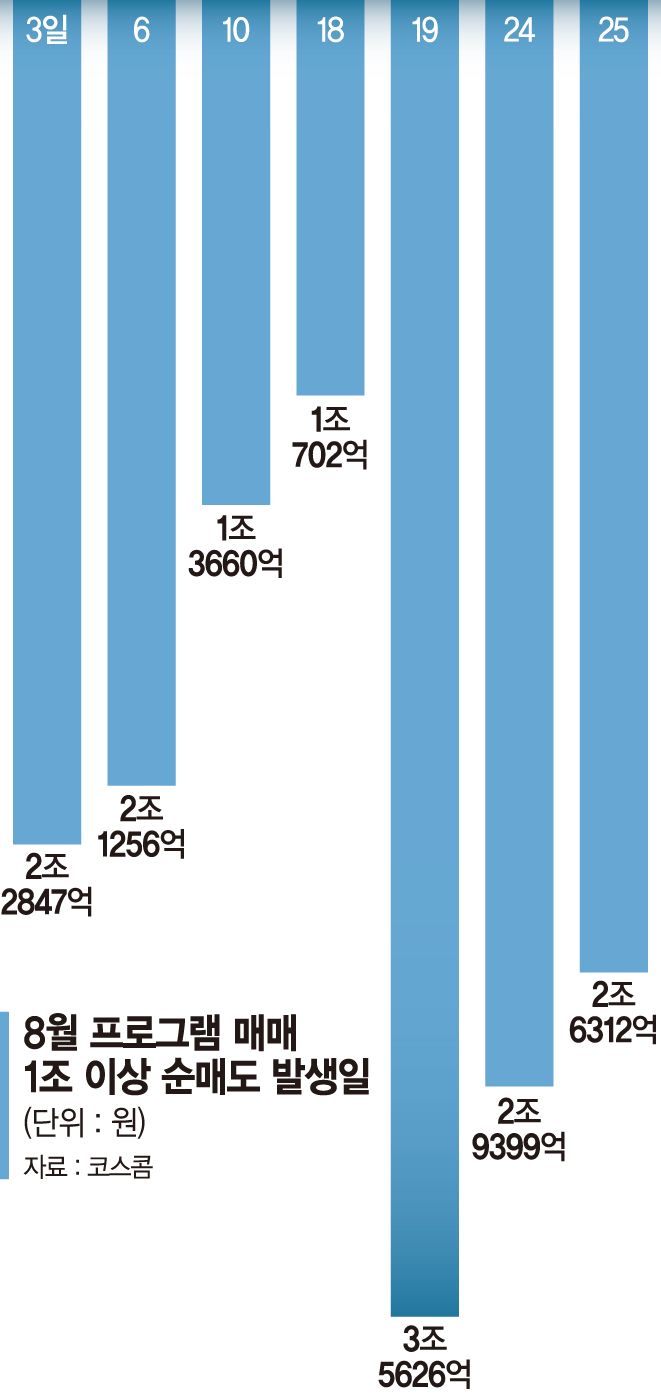
According to Koscom Corporation on the 25th, the KOSPI's losses widened this month whenever net program selling reached the trillion-won range. On the 19th, when the index posted its steepest drop of 5.8%, net program selling came to W356.26 billion, the largest amount this month.
The KOSPI also plunged on days when net selling reached the W200 billion range: on the 3rd, when net selling totaled W228.47 billion, the index fell 5.12%; on the 6th, with W212.56 billion in net selling, it dropped 4.58%; and on the 24th, with W293.99 billion, it slid 3.12%. On the 18th, when net selling reached W107.02 billion, it also closed down 1.55%.
Program selling began to surge on June 22, right after the KOSPI hit its peak and then lost momentum. From June 22 through the previous day, cumulative net program selling reached W36.0945 trillion. That works out to an average of W820.3 billion a day, far above the daily average of W744.9 billion from the start of the year through June 19.
In particular, selling intensified on June 22 with W254.99 billion, on the 23rd with W467.83 billion, on the 29th with W481.22 billion, and on the 30th with W270.85 billion. Last month, trillion-won net selling occurred on nine of the 22 trading days. On the 28th of last month, when the KOSPI fell 10.84%, selling reached W259.82 billion.
Although this kind of program-selling "bomb" has continued, the market funds that could absorb it have shrunk sharply after the correction phase. Investor Deposits, the cash waiting on the sidelines, fell by more than W33 trillion in just two months, from W136.8314 trillion on June 23 to W103.0137 trillion the previous day.
A source in the financial investment industry said, "After the sharp drop last month, market participants suffered heavy losses and are now highly reluctant to trade." The source added, "Retail funds that led the market in the first half were hit hard, and there are also many pending sell orders from investors who want to sell once prices recover."
■"A recovery in investor sentiment will not come quickly"
Although a recovery in liquidity is seen as the key to normalizing the market, the consensus in the securities industry is that a rebound to previous levels will be difficult for the time being. Investor sentiment has been damaged by the sharp fall in semiconductor stocks, while macroeconomic headwinds, including concerns over higher interest rates, have also piled up. For now, there is no clear catalyst to offset them.
Lee Sang-heon, a researcher at iM Securities, said, "Last month, deleveraging took place as leverage was reduced, and the sharp market plunge further dampened investors' trading activity. As a result, total trading value this month has been falling sharply." He added, "Even if trading value begins to recover next month, it will not be easy to return to the first-half level."
In the short term, the possibility that shareholder returns could trigger foreign profit-taking is also being cited as a burden.
Lee said, "There has recently been a trend of expanding treasury share buybacks and cancellations, especially among large-cap stocks, but paradoxically, this could lead to a much larger amount of foreign selling." He added, "Because foreign selling is expected to continue, a strong recovery in liquidity is unlikely."
Still, some expect that as the market is now in a phase of recovering investor sentiment, liquidity could improve over the long term depending on monetary policy and the stability of global semiconductor stocks.
One market source said, "The biggest burden on the market right now is interest rates." The source added, "For liquidity to recover, the current damage must heal, and we need to wait until interest rates and semiconductor stock momentum stabilize."
[email protected] Lim Sang-hyeok Reporter