Could Even the Kimchi at This Restaurant Be Chinese? Diners Say, "I Don't Want to Eat Chinese Food"
- Input
- 2026-08-25 18:31:33
- Updated
- 2026-08-25 18:31:33
As it was recently confirmed that some rural areas in China used formaldehyde, a Group 1 carcinogen, to keep cabbage fresher, a new wave of "Chinese kimchi phobia" is spreading across South Korea's restaurant industry. Consumer distrust appears to have deepened after another backlash in 2021 over so-called "naked kimchi" in China.
Imported kimchi is 99% Chinese... Restaurants worry about what comes next
Choi, who runs a restaurant in Jongno District, said, "More and more customers have been asking where the kimchi comes from." He added, "Once they hear it is Chinese, most of them say they do not want to eat it."
Formaldehyde is a hazardous substance classified by the International Agency for Research on Cancer (IARC), under the World Health Organization (WHO), as a Group 1 carcinogen. It is used in industrial applications, disinfection, and the preservation of biological tissue. Chinese authorities are conducting a special investigation after some rural areas were found to have used formaldehyde to preserve cabbage freshness.
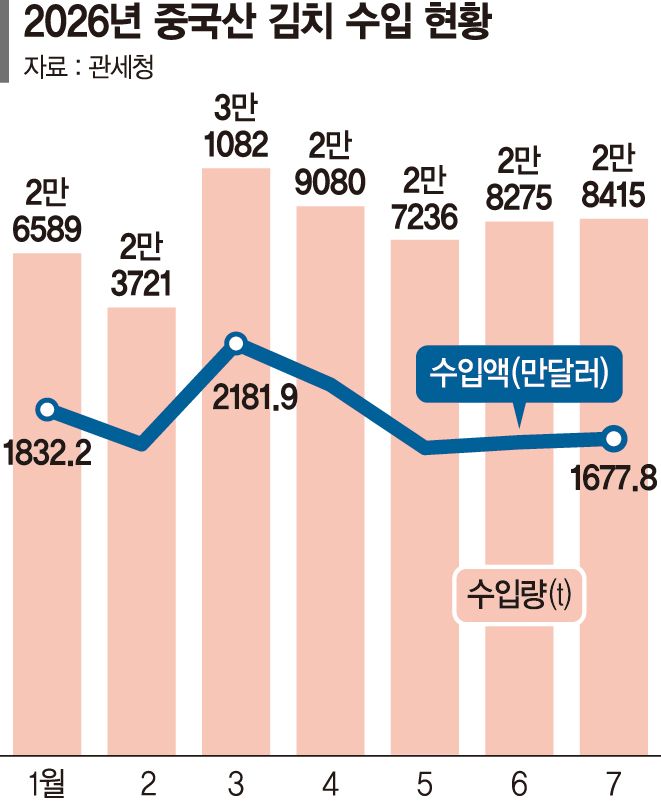
The problem is that the domestic restaurant industry is more dependent on Chinese kimchi than ever before.
According to trade statistics from the Korea Customs Service, kimchi imports from January to July this year totaled 194,400 tons, up 2.7% from a year earlier and the highest on record. Import value also rose 16.3% to $125.932 million. China accounts for 99% of all kimchi imported by South Korea.
Amid high inflation and rising labor costs, cheap Chinese kimchi has become virtually the only option for many self-employed business owners. According to KREI's "2025 Kimchi Industry Survey Report," 44.1% of restaurant businesses use imported kimchi as a side dish.
Group meals also face concerns... MFDS launches emergency testing
The Chinese kimchi controversy is also heightening anxiety in the group meal sector.
A nutritionist surnamed Ji, who works at a hospital in Gyeonggi Province, said, "The average unit price for 10 kilograms of Chinese kimchi is 15,000 to 22,000 won, while domestic kimchi costs around 38,000 to 53,000 won. Because Korean-made kimchi is much more expensive, we have no choice but to use Chinese kimchi to keep costs down."
MFDS has begun emergency collection and testing to determine whether cabbage treated with the carcinogenic substance, or kimchi made from that cabbage, entered South Korea. Although the detailed investigation results have not yet been released, consumer anxiety is already spreading across the restaurant industry.
An industry official stressed, "In addition to swift and thorough import clearance inspections by MFDS, comprehensive support measures are urgently needed to restore trust in ingredients used by the restaurant industry." The official added, "To prevent food safety concerns from deepening the downturn in the dining sector, thorough on-site inspections and transparent information disclosure are necessary."
[email protected] Kim Seo-yeon Reporter