WM Business Model Obsessed With Fee Competition Raises Risk of Mis-Selling [Survival Race in the Non-Interest Income Sector of the Financial Industry (Part 2)]
- Input
- 2026-08-25 18:22:08
- Updated
- 2026-08-25 18:22:08
■ Sales pressure to 'sell no matter what'
According to the financial industry on the 25th, banks are seeking to increase fee income by selling financial products such as ETFs in order to expand non-interest income. The strategy is aimed at diversifying revenue and reducing reliance on interest income.
This revenue diversification strategy is translating into stronger pressure to sell products at branches. Banks need to expand financial product sales to increase fee income, and because related results are reflected in key performance indicators (KPI), employees on the ground say the burden is difficult to avoid. Even without official individual sales quotas, branch-level targets and comparisons of performance across branches are said to be putting pressure on staff.
An employee at a commercial bank branch said, "Each bank focuses on different products, but there are many cases where customers are encouraged to buy Productive Finance ISA and Individual Retirement Pension (IRP) products." The employee added, "There is a system that rewards staff with strong sales results, but on the ground, the pressure felt by employees with weak sales is even greater." The employee continued, "There is an atmosphere that each branch must sell at least one product over a certain period, so from an employee's perspective, there is no choice but to feel sales pressure every day."
In March, the labor union at Shinhan Bank also expressed concern in an internal statement over company-wide pressure to sell ETFs.
■ Sales competition fuels mis-selling risks
As the burden of non-interest income product performance grows for bank employees, the risk of mis-selling may also rise. In the process of meeting sales targets, employees may fail to fully explain product risks and trust fee structures, or may recommend products that customers do not actually need.
Starting this month, the financial authorities have been conducting on-site inspections of ETF trust sales at major banks, beginning with KB Kookmin Bank, Woori Bank and Nonghyup Bank. The focus of the inspection is how the banks sold the products. ETF trusts are products in which a bank buys and sells ETFs on behalf of customers, so trust fees are charged unlike direct investment through securities firms. As the stock market has recently remained strong, ETF trusts that reached target returns early have seen repeated redemptions and re-subscriptions, resulting in repeated upfront fees. Regulators are therefore focusing on whether investors were sufficiently informed about the fee structure and the repeated operation method.
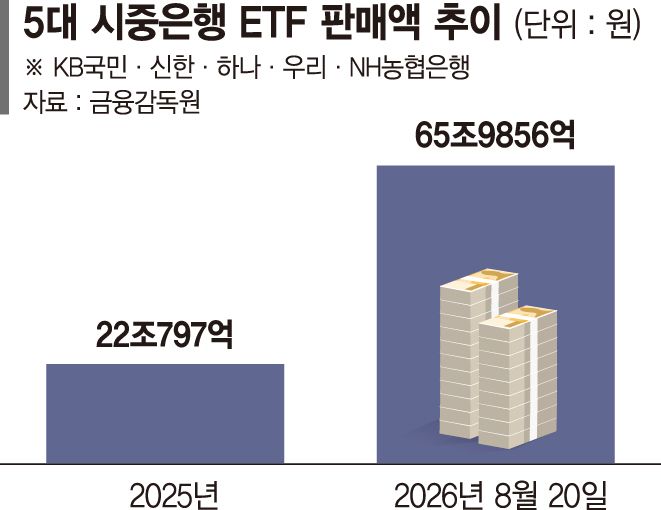
According to the Financial Supervisory Service, the six major banks — KB Kookmin, Shinhan, Hana, Woori, Nonghyup and Standard Chartered Bank Korea Limited — sold ETF products worth 64 trillion won and recorded 1.03 million transactions from last year through May this year. Sales in May alone came to 10.8 trillion won, up 8.8 times from 1.2 trillion won in December last year. As of May, banks' ETF trust fee income reached 103.6 billion won, a 10.2-fold increase from 10.2 billion won in December last year. The five major commercial banks handled ETF sales worth 65.9856 trillion won from January this year through the 20th of this month, nearly three times last year's annual sales of 22.0797 trillion won.
However, industry officials say consumer protection procedures such as sufficient explanations and call recordings are already in place during product sales, and internal controls have also been strengthened since the Hong Kong H-index linked securities (ELS) incident.
A banking industry official said, "Each bank has set conditions and procedures for each product, and because employees explain the product structure and risks to customers before recording the call, it takes a considerable amount of time before a product is sold." The official added, "We cannot completely rule out the possibility that some employees may bypass procedures under sales pressure, but at the bank level we are managing compliance with the relevant procedures."
There are also calls for banks to shift their business model toward managing customer assets over the long term and securing sustainable non-interest income, rather than focusing on short-term sales commissions, in order to reduce the risk of mis-selling. In a report titled "Measures to Expand Non-Interest Income at Domestic Banks: International Comparison and Implications," senior research fellow Kim Woo-jin of the Korea Institute of Finance (KIF) pointed out that "the existing asset management service is a sales commission-centered business model that encourages short-term sales competition and marketing-oriented sales practices." He added, "Rather than expanding short-term product sales commissions, banks should shift to a wealth management (WM) business model that earns fees by managing customers' assets over a long period of time."
[email protected] Lee Hyun-jung Reporter