Competition Disappears in Redevelopment Projects... 9 of 10 in the 'Apyeomokseong' Areas Win Unopposed
- Input
- 2026-08-26 15:59:25
- Updated
- 2026-08-26 15:59:25

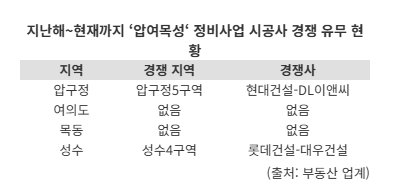
■ Only 2 of 15 'Apyeomokseong' projects won through competition
Financial News analyzed all of the Apyeomokseong project sites that had selected contractors or were close to doing so from late last year through now, and found that only two of the 15 projects were awarded through competitive bidding.
Apgujeong and Seongsu-dong are the most notable examples. In Apgujeong, Hyundai Engineering and Construction and DL E&C faced off in District 5, while in Seongsu-dong, LOTTE Engineering & Construction and Daewoo Engineering & Construction competed in District 4. Hyundai Engineering and Construction won in Apgujeong, and LOTTE Engineering & Construction prevailed in Seongsu-dong.
Mokdong and Yeouido have yet to see any competitive awards. In Mokdong, complexes 6, 10, 12, and 13 have either already selected a contractor or are preparing to do so. Among them, Complex 6 was quickly taken by DL E&C, and Hyundai Engineering and Construction is widely expected to win Complex 10. Hyundai Engineering and Construction was the sole bidder in the first main tender on the 10th, which led to one failed bid, and it was also the only participant at the second site briefing on the 19th. In redevelopment projects, companies must usually attend the earlier site briefing in order to qualify to bid.
Yeouido, where contractor selection is now in full swing, is seeing a similar atmosphere. At Yeouido Sibum Apartments, where bidding closed on the 25th, Samsung C&T was the only participant, automatically causing the tender to fail. At least two construction companies must take part for a competitive bid to be established. If competition is still not achieved by the second round, the project can switch to a negotiated contract.
Nearby Mokhwa Apartments also saw Samsung C&T participate alone in the site briefing for a rebid on the 20th, following the first tender on the 9th of last month. With the rebid also failing, the project can now move to a negotiated contract. The industry expects Samsung C&T to win the project.
■ "Nothing like 10 years ago"... Here's why
The sudden decline in competition for contractor selection, which was active in the 2010s, is being attributed to a worsening construction market and the heavy losses that can follow a failed bid. An official from a major construction company said, "The costs involved are greater than the benefits gained through the bidding process." He added, "Bid bonds, sales staff retention, and marketing expenses all add up, and if you lose, they become sunk costs."
The downturn in the construction market has also pushed companies to become more conservative. As a result, they are said to be entering only the projects where they can maximize gains after weighing the pros and cons of each site. Another construction industry official said, "These days, if a major builder with strong appeal among union members, such as Samsung C&T or Hyundai Engineering and Construction, signals interest, other companies tend to step back from the race early." He added, "Unless it is a project they absolutely must secure, they seem to avoid competition."
For union members, this is bad news. Some complain that construction companies are already deciding in advance where they will enter before taking part in the bidding. They say competition is necessary to lower prices and secure better terms, but in negotiated contracts, it is difficult to make demands too early. A redevelopment union chief in Seoul said, "Most union members want competitive bidding," adding, "But we cannot force companies to bid."
[email protected] Kwon Jun-ho Reporter