SK hynix to buy back KRW 40 trillion in treasury shares, reducing share count by 28%
- Input
- 2026-08-25 16:23:29
- Updated
- 2026-08-25 16:23:29
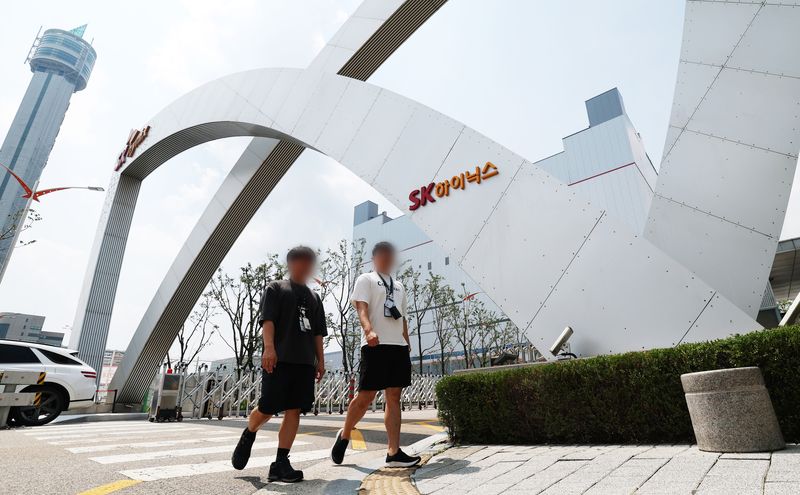
[Financial News] Analysts said that if SK hynix maintains its current shareholder return policy for an extended period, the number of shares in circulation will fall by about 28% by 2030. They also forecast that earnings per share (EPS) growth will far exceed market expectations, helped by the reduction in share count from treasury share buybacks and cancellations.
According to Mirae Asset Securities on the 25th, treasury share buybacks by KOSPI-listed companies have reached KRW 77 trillion so far this year through the 24th. The figure includes SK hynix's recently announced KRW 40 trillion buyback and cancellation plan. KOSPI treasury share purchases have surged this year from KRW 16 trillion in 2024 and KRW 19 trillion last year.
Youmyoung Gan, an analyst at Mirae Asset Securities, said, "What matters is not the short-term reaction to individual announcements, but the process of shareholder returns becoming a repeated structure." He added, "To narrow the discount in the Korean stock market, we need to take a medium- to long-term view."
Mirae Asset Securities estimated that if SK hynix's current policy continues, the number of shares in circulation will decline by 13.5% in 2027 from 2026 levels and by 28.3% in 2030. Based on that, EPS growth in 2027 is projected at 30.9%, well above the current consensus of 20.5%. The average annual EPS growth rate through 2030 is also expected to reach 15.5%, roughly twice the current forecast of 7.9%.
Samsung Electronics and SK hynix also differ in how they return capital to shareholders. Samsung Electronics uses 50% of cumulative free cash flow (FCF) from 2024 to 2026 for shareholder returns and places greater emphasis on dividends. SK hynix, meanwhile, plans to return more than 50% of cumulative FCF from 2025 to 2027, with a stronger focus on treasury share buybacks and cancellations. Based on existing measures, the ratio of dividends to treasury shares is 7-to-3 for Samsung Electronics and 1-to-9 for SK hynix.
Gan said, "Shareholder returns in the domestic stock market are still lower than in the United States, but there is plenty of room to expand." He added, "Korea's shareholder return ratio relative to net profit stands at 30%, less than half of the U.S. level of 75%. However, as corporate earnings and cash holdings increase, the resources available for returns are also growing."
He also highlighted companies that are actively buying back shares as names to watch in the current expansion phase of shareholder returns. This year, Daishin Securities posted the highest treasury share buyback ratio at 9.5%, followed by HYUNDAI G.F. HOLDINGS CO., LTD. at 4.8%, Meritz Financial Group Inc. at 4.7%, Krafton Inc. at 3.9%, KB Financial Group at 3.3%, and SK hynix at 3.2%.
[email protected] Choi Doo-sun Reporter