Competition for Group Loans Shows Signs of Overheating...What About Homebuyers Seeking Mortgages?
- Input
- 2026-08-26 16:13:01
- Updated
- 2026-08-26 16:13:01

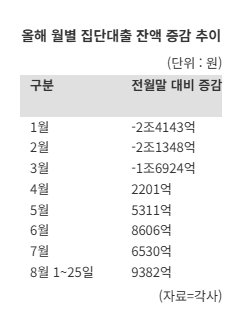
According to the banking sector on the 26th, household loans at the five major commercial banks — KB Kookmin Bank, Shinhan Financial Group, Hana, Woori Bank and NH NongHyup — rose by 1.9263 trillion won, from 778.9791 trillion won at the end of last month to 780.9054 trillion won on the 25th of this month. At the current pace, household loans are expected to increase by more than 2 trillion won this month.
In particular, outstanding group loans increased by 938.2 billion won this month, accounting for 48.7% of the total rise in household loans. In other words, group loans made up nearly half of the increase.
The sharp rise in group loans is believed to reflect banks' allocation of additional lending limits to large new apartment complexes where loan shortages have emerged, such as Maegyo Station Pallucid in Suwon, Gyeonggi. In the case of The H Bangbae in Seocho-gu, Seoul, which is set to welcome residents next month, competition among banks is becoming even fiercer. The five major banks have more than tripled the complex's remaining balance loan limit, raising it from an initial 500 billion won to 1.55 trillion won. Competition over lending rates for new large-scale apartment complexes is also now in full swing.
The pace of growth in group loans has accelerated further since the 13th, when the measures that separately manage housing-supply-related loans were announced. In fact, household loans at the five major banks increased by 1.0101 trillion won over the 12 days from 779.8952 trillion won on the 13th to 780.9054 trillion won on the 25th. Over the same period, group loans rose by 557.2 billion won, from 148.6235 trillion won to 149.1807 trillion won. After the policy announcement, group loans accounted for 55.2% of the increase in household loans. Before the announcement, from the end of last month to the 13th of this month, the share stood at 41.6%.
Banks are actively pursuing group loans for new large apartment complexes because they can secure a large volume of high-quality loan assets with strong collateral value and liquidity. The financial authorities' decision to manage housing-supply-related loans, including moving expenses, interim payments and balance loans, separately from each financial institution's total lending target has also fueled the competition.
By contrast, the bar for ordinary mortgages remains high. Banks are still maintaining their own limits and restrictions on new applications for home-purchase mortgages. Since revised lending quotas by institution have not yet been finalized, banks appear reluctant to expand ordinary mortgage lending too quickly.
This trend is expected to continue for the time being. The financial authorities are pushing to classify high-value mortgages, high Debt Service Ratio (DSR) mortgages and high-value homes with high Loan-to-Value ratio (LTV) mortgages as high-risk loans and raise their risk weights. From the banks' perspective, the incentive is growing to selectively expand large group loans for apartment complexes, where collateral is more secure and borrowers' repayment capacity is easier to assess, rather than broadly increasing ordinary mortgages.
A banking official said, "Group loans allow us to secure a large number of solid borrowers at once, and because they are managed separately as housing-supply-related loans, the trend is toward increases centered on high-quality projects." The official added, "Ordinary mortgages require banks to consider detailed targets and soundness burdens at the same time, so supply conditions are likely to be adjusted gradually."
[email protected] Ye Byung-jeong Reporter