"Drones and AI will plant trees on steep slopes"...Baekdudaegan National Arboretum demonstrates 'smart forest restoration'
- Input
- 2026-08-25 16:15:58
- Updated
- 2026-08-25 16:15:58
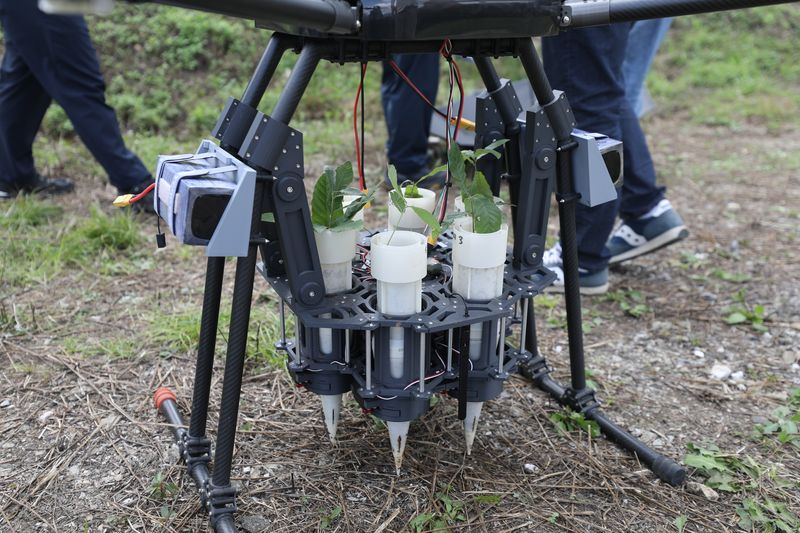
KAGI said on the 25th that it carried out a two-day demonstration of AI-based unmanned automated planting at Baekdudaegan National Arboretum on the 24th and 25th, and verified smart forest conservation and restoration technology.
The demonstration was launched to efficiently restore high-altitude conifer species, including Korean fir, which are gradually disappearing due to climate change. KAGI built a public-private-academic partnership with Oregon State University (OSU) and DR1, and planted 120 trees in an ex situ conservation area at Baekdudaegan National Arboretum, including 90 Korean fir trees and 30 Oriental cork oak trees, using unmanned methods.
The planting work was carried out based on advanced data technology. Using LiDAR equipment and high-resolution drone imagery, the team built a precise three-dimensional (3D) map of the site and analyzed soil and terrain conditions in detail. An AI algorithm then automatically selected the best locations for the trees to grow, and the drone moved to the designated spots to plant them autonomously.
This drone- and AI-based unmanned planting technology is expected to sharply reduce the risk of worker safety accidents, which has been one of the biggest challenges in restoring forests in high-altitude areas. Until now, planting in rugged mountain terrain has required workers to carry seedlings and materials up the slopes themselves, making the work physically demanding and exposing them to serious accident risks such as falls.
It is also drawing attention as an alternative to address severe labor shortages and aging in the forestry sector. With drones, precise planting is possible even on inaccessible cut slopes or areas at risk of collapse, raising expectations that the technology could later be expanded to large-scale forest disaster recovery sites, such as wildfire damage restoration and landslide prevention projects.
After the demonstration, KAGI plans to compare and analyze tree survival rates, growth conditions, work time and efficiency with conventional manual planting methods to establish a smart forest conservation and restoration standard model tailored to steep slopes and high-altitude regions.
Lee Gyu-myeong, director of Baekdudaegan National Arboretum, said, "Drone- and AI-based unmanned planting is an innovative attempt that could change the paradigm of forest ecosystem restoration in the era of climate crisis." He added, "Based on the results of this demonstration, we will further advance the technology and spread it as a standard model to forest restoration sites."
[email protected] Kim Won-joon Reporter