As the Earth Warms by 1.5 Degrees, Fewer Ways Remain to Adapt: IPCC Lead Author Warns
- Input
- 2026-08-25 15:58:49
- Updated
- 2026-08-25 15:58:49
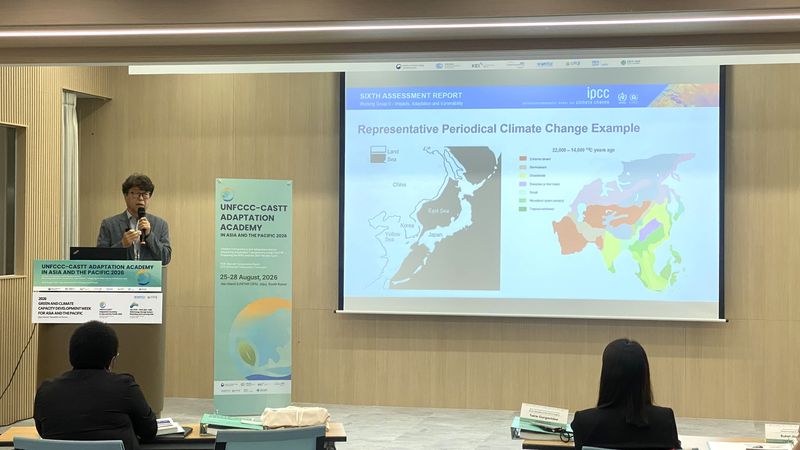
[Financial News, Jeju = Jeong Yong-bok] If the global average temperature rises 1.5 degrees Celsius above preindustrial levels, the options for responding to the climate crisis will steadily shrink. As warming intensifies, the limits of adaptation in water, food and ecosystems grow wider, and a single shock such as a heat wave or drought can more easily cascade into health, income and food problems, a warning from Jeju said.
At the "2026 UNFCCC-CASTT Asia-Pacific Climate Adaptation Academy" held on the 25th at UNITAR CIFAL Jeju in Jeju Province, Jeong Tae-seong, team leader at MOIS's NDMI, presented these findings under the theme "Climate Change Adaptation: Global Context and National Response."
Jeong currently serves as a chapter lead author for Chapter 2 of the IPCC Seventh Assessment Report (AR7). Working Group II assesses the impacts of climate change on people and nature, as well as adaptation and vulnerability.
The main risk outlook Jeong presented on the day was based on the already finalized IPCC Sixth Assessment Report (AR6). AR7 is now being written.
According to the IPCC assessment, about 3.3 billion to 3.6 billion people worldwide live in areas highly vulnerable to climate change. The risks rise with every incremental increase in the global average temperature.
Climate disasters do not stop at one sector. When heat waves intensify, the health of outdoor workers worsens and labor productivity falls. Drought can reduce crop yields and push up food prices, while also compounding income and health problems.
Jeong described this as a "compound and cascading risk" in which individual disasters interact and magnify damage. He introduced the IPCC's latest risk assessment framework, which shows how heat waves, wildfires, droughts and floods can combine with food, water, health and urban infrastructure to intensify losses.
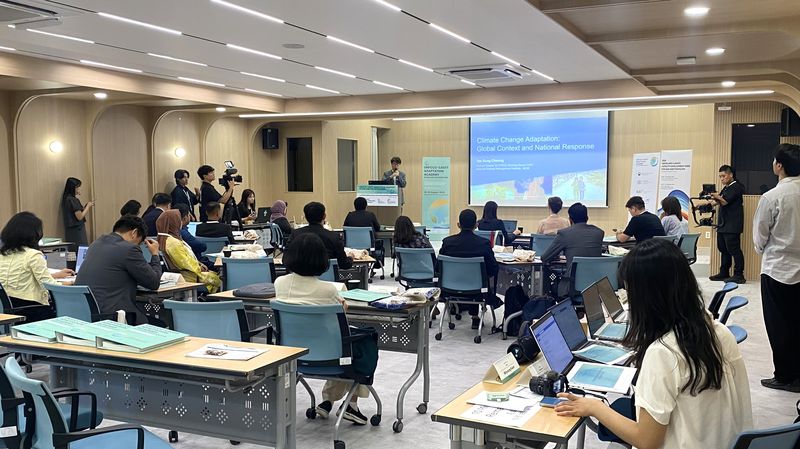
The bigger problem is that the more severe warming becomes, the fewer ways there are to adapt. If the rise in the global average temperature exceeds 1.5 degrees Celsius above preindustrial levels, some nature-based adaptation measures may become less effective. In small island states and regions that depend on glacier- or snowmelt-fed water, a shortage of freshwater could even make adaptation itself difficult.
At 2 degrees Celsius, it may become difficult to continue growing several key crops in many major agricultural regions. The IPCC also says the options for "climate-resilient development" - maintaining economic and social systems while withstanding climate change - are likely to narrow rapidly after 1.5 degrees.
Jeong explained that adaptation policy does not always produce positive outcomes. Facilities or policies designed to respond to the climate crisis can create new risks or shift damage onto other regions and social groups, leading to "maladaptation." Economically and socially vulnerable groups are more likely to bear the brunt of those side effects.
Financing is another challenge. Global climate finance is still insufficient to meet the cost of needed adaptation, and a large share is still concentrated on greenhouse gas reduction. The gap between what is actually needed for adaptation and what is currently being implemented is also wider in low-income countries and among vulnerable populations.
The solution lies in not pursuing adaptation, emissions reduction, biodiversity conservation and sustainable development separately. Because climate disasters are interconnected, policy must also be designed to address water, food, cities, health and ecosystems together.
The IPCC's core message, as Jeong presented it, is ultimately about time. As temperatures rise further, response costs increase and the available adaptation tools diminish. In other words, today's policies and investments will determine the range of responses available in the future.
The IPCC's message on climate-resilient development that Jeong highlighted points in the same direction. It is a warning that each policy decision made now will shape the scope of climate adaptation society can choose from later.
Meanwhile, the academy is hosted by the Ministry of Climate, Energy and Environment and co-organized by the UNFCCC secretariat, the National Institute of Environmental Research's National Climate Crisis Adaptation Center, UNITAR CIFAL Jeju and the UNEP Copenhagen Climate Centre. Government officials and experts from Asia-Pacific developing countries will focus through the 28th on climate adaptation, the Paris Agreement's enhanced transparency framework and the preparation of biennial transparency reports.
[email protected] Jeong Yong-bok Reporter