Massive Investment, Including a Future Fund, in a Super Budget... Opposition Says, "Spending Semiconductor Windfall for Show"
- Input
- 2026-08-25 15:36:52
- Updated
- 2026-08-25 15:36:52
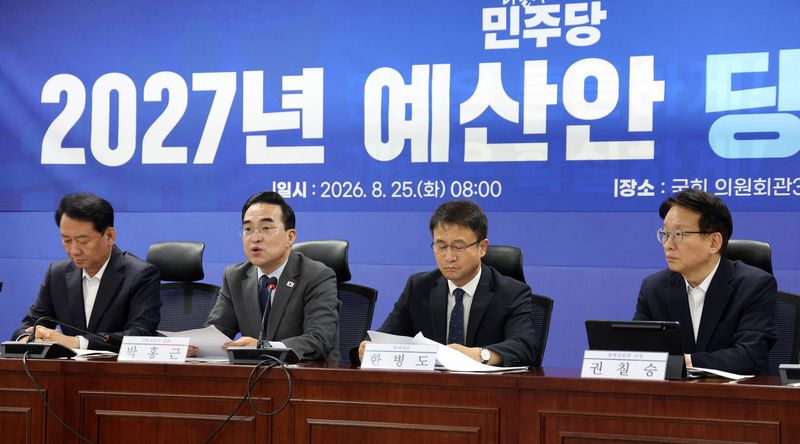
[Financial News] The Lee Jae-myung administration and the Democratic Party of Korea will launch a super budget of more than 800 trillion won and create a Future Response Fund worth more than 100 trillion won to make large-scale investments in advanced industries such as AI semiconductors. The main opposition People Power Party voiced concern, saying the government should not spend excessive tax revenue generated by the semiconductor boom.
At the policy meeting on next year's budget bill on the 25th, the ruling party and the government decided to focus on investment and support for advanced industries.
Key measures include the creation of a special semiconductor account and capital injections into Korea Electric Power Corp. and Korea Water Resources Corp. The plan is to back fiscal support for semiconductor investment, including the 600 trillion won Yongin Semiconductor Cluster and an additional 800 trillion won project in Honam. Fiscal resources are also expected to go into industrial site rental land supply and infrastructure development.
The budget will also include support for the development of Physical AI that reflects manufacturing know-how. The idea is to turn tacit manufacturing knowledge into data, provide the necessary robots and equipment, and deliver AI solutions. In this regard, the Democratic Party has proposed bills to support the Ministry of Trade and Industry-led manufacturing AX (AI transformation) industry-academia-research alliance, the M.AX Alliance, and to deploy young AI engineers to mid-sized and small companies.
Park Hong-keun said, "We will focus support on production bases, core technologies and talent development for the three major mega-projects in semiconductors, Physical AI and AI Data Centers (AIDC)." He added, "We will also invest generously to quickly build the infrastructure needed, including power, water and industrial complexes."
Investment in the 'NEXT 10 sectors,' which include electric vehicles and other key industries, will also be pursued. The package includes the largest-ever expansion of EV subsidies to support the energy transition, more pilot zones and support for autonomous vehicles, moon landing R&D support through 2030, and expanded scale-up financing for venture firms.
This broad-based investment drive will be backed not only by the budget but also by the Future Response Fund, which will be built up to more than 100 trillion won. Some of the additional tax revenue generated by the semiconductor boom will be set aside in the fund, with the goal of supporting core industries across the board, including semiconductors. Under the National Finance Act, the government can change fund management plans at its discretion within a 20 percent range, allowing for a swift and proactive fiscal response.
The pro-business People Power Party did not oppose large-scale support for companies, but it raised concerns about excessive fiscal expansion. In particular, it pointed out that the Future Response Fund would be partly outside parliamentary control and could have a negative impact on local finances.
Bae Jun-young, the opposition secretary on the National Assembly Planning and Finance Committee, said on the day, "Because semiconductors are making money, the Lee Jae-myung administration is trying to use that money to make a show of things without principles." He added, "Instead of first distributing funds to local governments and paying down debt under the National Finance Act, they want to create a bank account called the Future Response Fund."
Funds are usually limited to spending for a specified purpose. But because the Future Response Fund covers such broad goals as growth engines, youth, regional development and talent, it is effectively close to the general account. That is why criticism has emerged not only from the People Power Party but also from the RKP, which says the fund is being created like an overdraft account to avoid parliamentary budget review. The issue of strengthening parliamentary control is expected to become a key point during the National Assembly's review of the Future Response Fund bill.
Bae also pointed to problems for local finances. He said, "The government calculates additional tax revenue by first subtracting the amount it plans to take into the fund, based on revenue growth that exceeds the average annual increase in domestic taxes over the past 10 years, and then applies the 19.24 percent local transfer tax rate to the remainder." He added, "That means local governments will get a smaller share, and although the central government says it will help, there is no timetable."
The government and the ruling party say that bold fiscal investment to raise the potential growth rate will ultimately lead to higher tax revenue and help maintain fiscal soundness. Park said, "At a time when structural low growth is becoming entrenched, we must drive a trend-based rebound in the potential growth rate." He added, "To avoid using increased tax revenue for temporary spending, we will use the Future Response Fund as a strategic investment platform that supports a rebound in the potential growth rate and as a tool to smooth tax revenue volatility."
[email protected] Kim Yoon-ho, Song Ji-won Reporter