Selling a Factory Can Still Swing Operating Profit... The 'Operating Profit Formula' IFRS 18 Will Change
- Input
- 2026-08-25 15:52:30
- Updated
- 2026-08-25 15:52:30
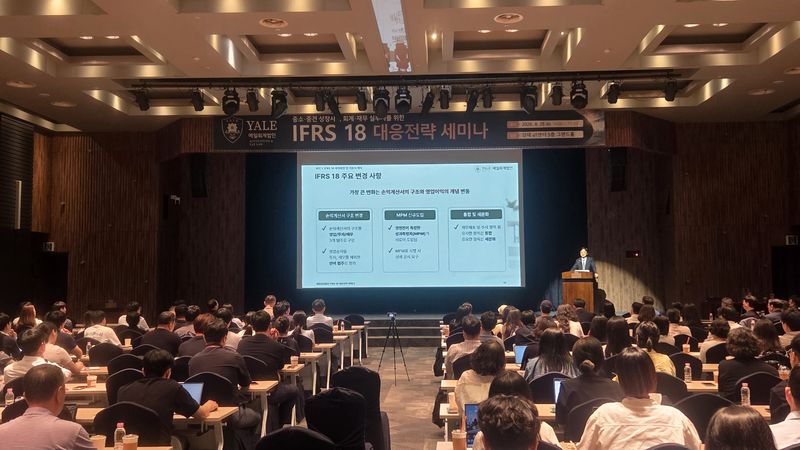
Lee Seung-jae, managing director at YALE Accounting Corporation, said at the 'IFRS 18 Response Strategy Seminar' held on the afternoon of the 25th at Grand Hall in the aT Center in Yangjae, Seoul, "IFRS 18 is not intended to improve the concept of operating profit, but to standardize the presentation of the income statement in line with global standards."
K-IFRS No. 1118, 'Presentation and Disclosure of Financial Statements,' will take effect on Jan. 1 next year. It reflects IFRS 18 issued by the International Accounting Standards Board (IASB) and replaces the existing K-IFRS No. 1001, 'Presentation of Financial Statements.' The key point is to classify revenue and expenses into operating, investing, and financing categories, while presenting operating profit and profit before financing and income taxes as mandatory subtotals.
The biggest practical change for companies is the expansion of the operating category. Under IFRS 18 Presentation and Disclosure in Financial Statements, items of income and expense are first classified into investing and financing categories, and the remainder is generally placed in the operating category. Lee explained, "This is a structure in which revenue and expenses that do not fall under the investing or financing categories are included in the operating category," adding that "the core of this change is that many non-recurring gains and losses that used to sit in non-operating items will move up into operating profit."
For example, if a manufacturing company sells an aging factory and records a disposal gain, that gain was usually treated as a non-operating item. Under IFRS 18 Presentation and Disclosure in Financial Statements, however, it may be included in operating profit. On the other hand, if demand falls and the value of production equipment declines, leading to a large impairment loss, that too could directly drag down operating profit. In other words, operating profit may fluctuate even if the company's core product sales volume and margins do not change, depending on asset disposals and impairments.
Companies with a high share of exports and imports will also be affected. For instance, if an exporter sells products and foreign exchange movements create gains or losses on trade receivables before payment is received, those items may fall into the operating category. The same applies to foreign exchange gains and losses related to trade payables incurred when raw materials are purchased in foreign currency. This means some exchange-rate effects that investors previously checked below operating profit may now affect operating profit itself.
Changes may also appear after business combinations. If certain gains and losses that are not classified as investing or financing items, such as goodwill impairment from an acquired business, are included in the operating category, companies that have carried out large mergers and acquisitions (M&A) could see greater volatility in operating profit. In particular, manufacturing companies with large factories and equipment and a high share of overseas sales may see asset impairments and foreign exchange gains and losses affect operating profit at the same time, so caution is needed when comparing results with the previous year.
The same transaction can be presented differently depending on a company's 'main business activities.' For a general manufacturing company, rental income from leasing surplus real estate would, in principle, fall under the investing category. But if real estate leasing is the company's main business activity, it may be classified as operating. Lee said, "The starting point for applying IFRS 18 is determining whether activities in the investing or financing categories are our company's main business activities," adding, "It is not enough for the company to simply claim so; it must be substantiated through quantitative and qualitative factors such as revenue and asset size, segment disclosures, and IR materials."
However, a change in accounting standards does not alter the actual cash a company earns. It simply changes the 'location within the income statement' of items that were previously shown as non-operating items and are now moved into operating items. Lee stressed, "If you compare the existing income statement with the one prepared under IFRS 18 Presentation and Disclosure in Financial Statements, the final net income will be the same," adding, "What changes is not net income, but the categories and composition of profit and loss, and that is something to keep in mind."
The burden on companies to prepare for the change is also expected to be significant. They will need to remap numerous profit and loss accounts into operating, investing, and financing categories, and examine whether the same transaction is classified differently in separate and consolidated financial statements. In particular, as the meaning of 'operating profit' seen by investors will change next year, companies are expected to need not only system upgrades but also explanations during Investor Relations (IR) efforts about the difference between the old operating profit measure and operating profit under IFRS 18 Presentation and Disclosure in Financial Statements.
[email protected] Kim Hyun-jung Reporter