Lee Jae Myung: "Police Will Become the Most Powerful Institution Going Forward... Public Concern Is High"; Orders Review of Police Reform Body
- Input
- 2026-08-25 16:16:01
- Updated
- 2026-08-25 16:16:01
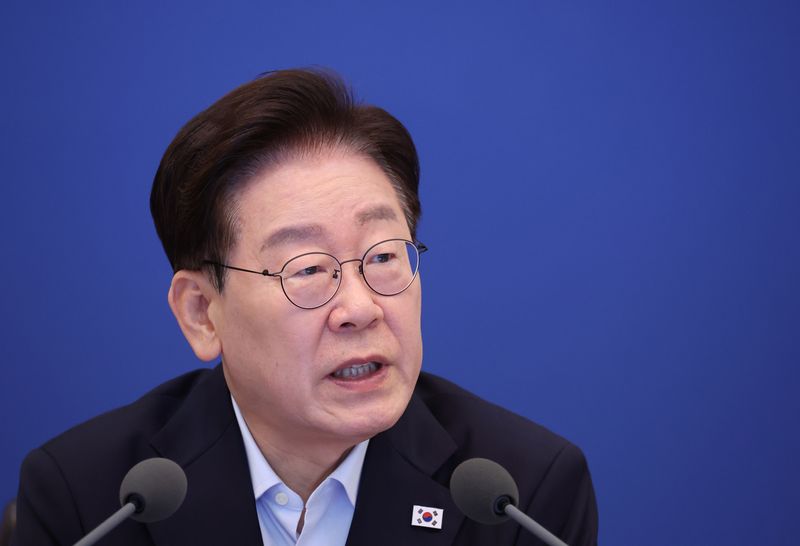
[Financial News] President Lee Jae Myung said on the 25th that "the police will probably exercise the greatest power among state institutions going forward. That is why responsibility must be strengthened in proportion to the size of that authority," and instructed officials to consider establishing a police reform body. With the complete abolition of prosecutors' investigative and command authority set for October, the move is intended to create accountability and oversight mechanisms that match the police's expanding powers, following a series of controversies including the botched investigation into the disappearance of Jeju resident Jang Miran.
At the Cabinet meeting he chaired at Cheong Wa Dae that day, Lee said, "Recently, serious concerns have emerged over police discipline and irresponsibility in public safety matters." He added, "Public concern is very high. Because there are doubts about whether such great power is being exercised with sufficient responsibility, I ask you to think about how the police should be reformed and to consider a police reform body."
He then told Prime Minister Han Seong-suk, "Please take the lead from the Prime Minister's Office and first come up with a plan through broad public consultation on how this should be carried out," adding that "power always creates bigger problems when it is concentrated."
Lee said, "In fact, the problems facing the police are nothing new. Because the force is so large, trouble can arise in many places, like a tree with too many branches that never escapes the wind." He added, "Efforts to minimize those problems must continue without end, and we also need to improve the system to address them."
He continued, "The police are a very important state institution built on a strict chain of command, and command responsibility is extremely important. If frontline officers make mistakes, should everything end with disciplining only those officers? Then what is the point of having a command structure?" He went on to say, "There is authority to command, but at the same time, responsibility corresponding to that authority must of course be borne." The remarks were interpreted as a signal that the police leadership will also be held accountable for its expanded powers.
The ruling party has also moved to push police reform. The Democratic Party of Korea (DPK) announced the lineup for its police reform task force on the day. Lawmaker Kim Nam-hee, a lawyer by training, will head the group, while lawmakers with police backgrounds will serve as advisers. Party leadership is also reportedly discussing the creation of a special police reform committee directly under DPK leader Kim Min-seok. Floor leader Han Byung-do also said at a strategy meeting that "the police must strengthen investigative capability, high accountability, transparency in procedures, and democratic oversight in line with their expanded authority," adding that the party would prepare a comprehensive overhaul of the police organization.
Lee also commented on lowering the age threshold for criminal minors, saying, "It seems to have been delayed for too long, so I hope we can reach a quick conclusion." He added, "We should lower it by about one or two years for serious repeat offenses. After once again reviewing public opinion on this point, I hope we can settle it early and move it into legislation."
In the closed-door session, after receiving a report from the Ministry of Health and Welfare (MOHW) on the current status of foreign nationals making back payments to the National Pension Service (NPS) and possible improvements, Lee criticized the fact that short-term foreign residents in Korea are eligible for such back payments at all, calling it contradictory. Senior presidential spokesperson Kang said Lee also urged the health minister to view the issue from the public's perspective and to urgently strengthen eligibility requirements by examining factors such as actual residence in Korea.
Meanwhile, there had been speculation that a second round of public institution relocations would be placed on the agenda for the Cabinet meeting, but it was ultimately not included. The meeting reviewed and approved four bills, 15 presidential decrees, 38 general agenda items and one report item.
The Cabinet also approved exemptions from preliminary feasibility studies for the rapid implementation of the three major mega-projects for a great leap forward for the Republic of Korea. The government will speed up key projects, including the Honam semiconductor industrial complex, an AI data center (AIDC), and the establishment of regional medical schools, by exempting them from preliminary feasibility reviews.
For the Honam semiconductor industrial complex, the government will invest a total of 6 trillion won from 2027 to 2030 to support infrastructure and the development of an industrial ecosystem. For the semiconductor industrial complex, both the power and water infrastructure will be exempted from preliminary feasibility studies, and even the separate feasibility review will be skipped. AI-related projects, including the AI data center (AIDC) cluster, K-AI semiconductor full stack, and the manufacturing data library, will also be fast-tracked through the exemption.
[email protected] By Choi Jong-geun, Seong Seok-woo and Song Ji-won Reporter