Jeju Province Becomes Asia-Pacific Climate Adaptation Training Hub as UNFCCC Academy Opens
- Input
- 2026-08-25 15:34:54
- Updated
- 2026-08-25 15:34:54
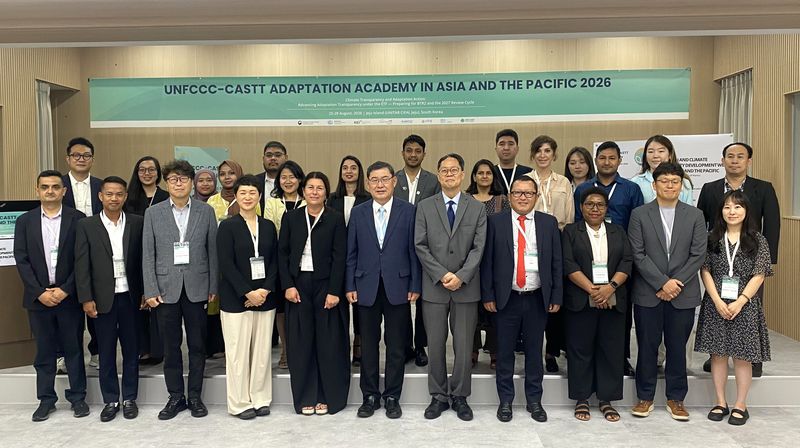
[Financial News, Jeju = Reporter Jung Yong-bok] Government officials and experts in charge of climate change from developing countries in Asia and the Pacific have gathered in Jeju Province to intensively learn the reporting skills needed for climate adaptation under the Paris Agreement. The program covers practical topics ranging from drafting the second Biennial Transparency Report (BTR2) that each country must submit to the international community, to organizing data with artificial intelligence (AI) and measuring and reviewing climate adaptation outcomes.
According to the UNITAR Jeju International Training Center on the 25th, the 2026 UNFCCC-CASTT Adaptation Academy in Asia and the Pacific opened in Jeju Province that morning and will run for four days through the 28th.
The academy was jointly organized by the Ministry of Climate, Energy and Environment, the secretariat of the United Nations Framework Convention on Climate Change (UNFCCC), the Korea Environment Institute (KEI) National Center for Climate Crisis Adaptation, the UNITAR Jeju International Training Center, and the United Nations Environment Programme (UNEP) Copenhagen Climate Centre.
The main theme is "climate transparency and adaptation action." In line with the Paris Agreement's Enhanced Transparency Framework (ETF), the program focuses on training participants to determine what data countries should use to measure their climate response and how they should report it to the international community.
The BTR is a national report that countries submit every two years to the international community on their implementation of the Paris Agreement, including greenhouse gas emissions and reductions, climate adaptation, and international support. This training centers on preparing BTR2, the second report, and on preparing for the 2027 review cycle.
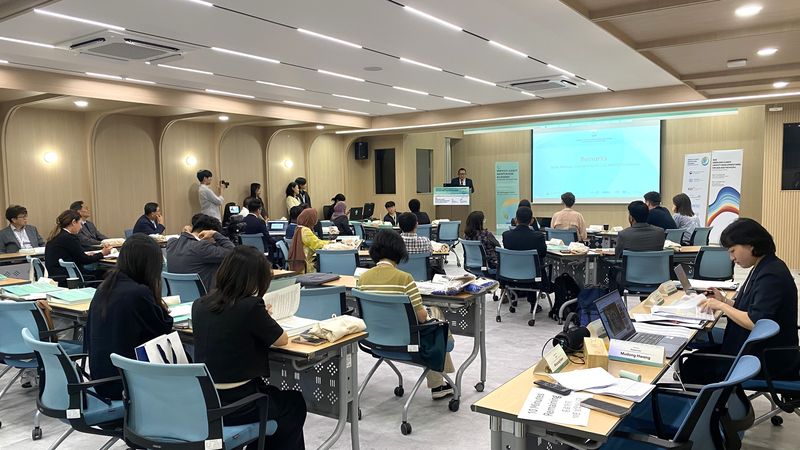
On the first day, the program covers global trends in climate change adaptation and national responses, followed by BTR drafting using AI and data, the structure of the Paris Agreement and the ETF, and how to write climate adaptation information in the BTR.
In particular, the training does not treat AI simply as a translation or document-writing tool. It also teaches how to classify scattered field data and organize indicators so they can serve as verifiable reporting evidence. The program also includes a verification process in which people compare AI-generated results against source materials.
On the 26th, participants will examine how to include "loss and damage" caused by climate disasters in the BTR and share their own countries' drafting experiences. They will also discuss what evidence and indicators should be used to measure the results of climate adaptation policies, as well as how to efficiently connect multiple international reporting systems.
Another feature of this academy is that Jeju Province itself is being used as a training site. On the 27th, after reviewing South Korea's national climate crisis adaptation measures, the program will hold a separate session on "Jeju and climate change challenges." Participants are scheduled to visit the Jeju Research Institute's Jeju Carbon Neutrality Research Support Center, the Hallasan Research Division of the Jeju Special Self-Governing Province World Heritage Headquarters, and Manjanggul Cave to examine on-site examples of climate change impacts and natural heritage conservation.
On the final day, the 28th, participants will take part in a hands-on exercise to draft the climate adaptation section of the BTR themselves. After learning how to improve clarity and consistency in their writing and prepare for international review, they will share their country-specific tasks and future response plans.
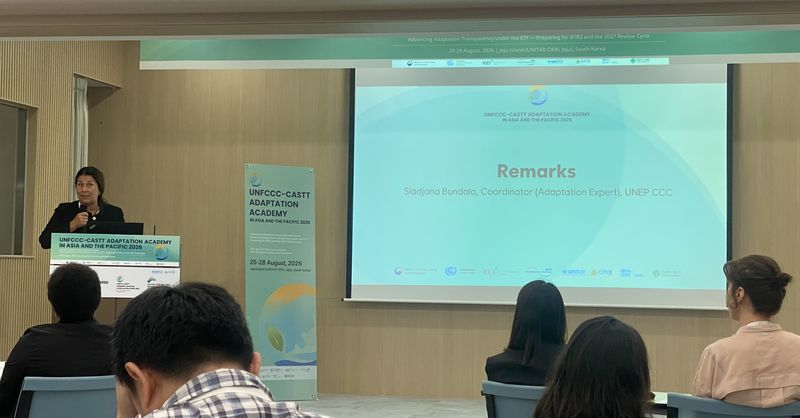
The opening ceremony was attended by Shin Seong-cheol, head of the UNITAR Jeju International Training Center; Park Jong-seok, Jeju Province's ambassador for international relations; Jigme, head of the transparency division at the UNFCCC secretariat; Shin Jiyoung, head of the KEI National Center for Climate Crisis Adaptation; and Sladjana Bundalo, adaptation expert and coordinator at the UNEP Copenhagen Climate Centre.
The program goes beyond simply drafting policies to respond to the climate crisis. It places greater emphasis on building the capacity to measure real outcomes and turn them into data that the international community can verify. In that sense, it connects the "implementation" and "reporting" of climate policy into a single system.
As the UNITAR Jeju International Training Center links UNFCCC, UNEP, and domestic expert institutions to provide practical training for developing countries in Asia and the Pacific, Jeju Province is increasingly being used as a venue for international climate cooperation and capacity building.
Shin Seong-cheol, head of the UNITAR Jeju International Training Center, said, "I hope this becomes a place where developing countries can build the capacity to respond effectively to the increasingly complex requirements for implementing international environmental agreements." He added, "I also hope that strengthening each country's response capacity will lead to a stronger international effort to address the climate crisis."
[email protected] Jung Yong-bok Reporter