Despite Four Straight Earnings Surprises, the Stock Fell... NVIDIA Rattles Samsung and SK hynix [Why the Market Moves]
- Input
- 2026-08-26 06:10:00
- Updated
- 2026-08-26 06:10:00
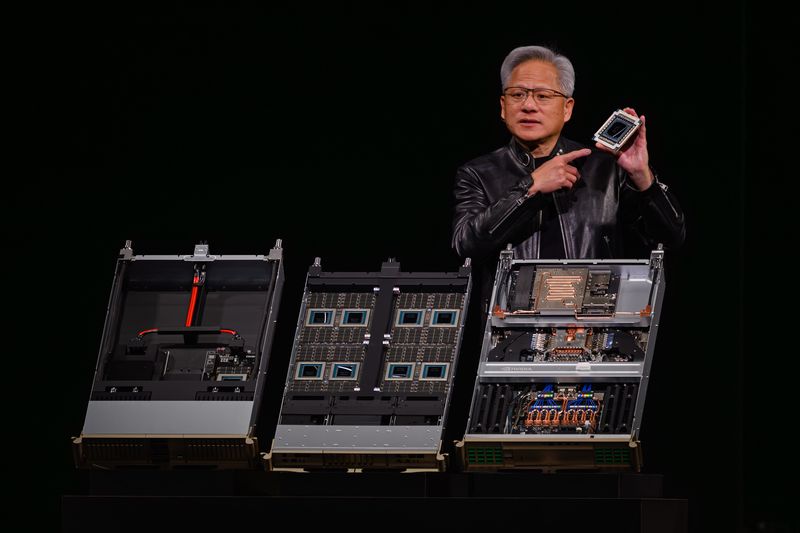
[Financial News] Volatility is rising for Samsung Electronics and SK hynix ahead of NVIDIA Corporation's earnings release. Even results that beat market expectations may not be enough to push NVIDIA's stock higher, and future AI investment and the outlook for next-generation products could also affect domestic memory demand, including high-bandwidth memory (HBM).■Samsung and SK hynix trim losses after a sharp drop... swings ahead of NVIDIA earningsAccording to the securities industry on the 26th, consensus revenue for NVIDIA Corporation's fiscal 2027 second quarter is expected to reach $91.64 billion, up 96.1% from a year earlier. Adjusted earnings per share (EPS) are also projected to rise 98.1% to $2.08. In other words, the market is already pricing in nearly doubled growth.
The problem is that strong results alone are no longer enough to satisfy investors. Since the AI boom accelerated in 2023, NVIDIA Corporation has consistently posted earnings above market expectations, but in the past four quarters its stock has fallen after earnings announcements, triggering a sell-off. In the previous quarter as well, revenue and EPS rose 85% and 130% from a year earlier, respectively, yet the stock still weakened.
That caution has also shown up in the Korean market. Samsung Electronics and SK hynix fell as much as 8.70% and 3.41%, respectively, on the 24th, and the following day they dropped by around 4% and 6% in early trading. They later recovered some of those losses as bargain hunting emerged, but intraday volatility remained high.
Brokerages say investors should focus less on revenue or net income in this earnings report and more on profitability and the outlook for future AI investment. NVIDIA Corporation's gross margin under U.S. generally accepted accounting principles (GAAP) in the previous quarter was 74.9%. The forecast for this quarter is 74.4% to 75.4%. As prices for memory and components such as HBM and server DRAM rise, NVIDIA Corporation has notified customers that it will raise the price of AI servers scheduled for shipment in early 2027 by more than 15%. The key question is whether it can maintain strong profitability while increasing product prices.
Kim Jae-seung, a researcher at Hyundai Motor Securities, said, "Even after four straight quarters of earnings surprises, a sell-off has appeared." He added, "For this earnings report, investors should pay more attention to Jensen Huang's remarks than to the results themselves."■How much memory will go into Vera Rubin? Samsung and SK hynix are watching closelyStarting in the second half of this year, NVIDIA Corporation has begun initial mass production and shipments of its next-generation AI platform, Vera Rubin. The market is watching whether product supply will expand as planned and whether capital expenditure (CAPEX) on AI facilities will continue to grow after 2027. Another key issue is whether the massive investment poured into data centers is actually translating into revenue and profit.
This is also an important issue for Samsung Electronics and SK hynix. As production of AI servers and next-generation graphics processing units (GPUs) increases, demand for HBM and server DRAM could also rise. On the other hand, if Vera Rubin production is delayed or if the amount of memory used in the product is smaller than expected, the outlook for domestic memory demand could come under pressure.
It is also necessary to confirm whether AI investment can continue. Recently, market expectations have risen over whether the huge sums being poured into AI companies can actually turn into profits. Skepticism about circular financing centered on NVIDIA Corporation is also seen as an issue that needs to be addressed.
It will also matter how much NVIDIA Corporation can expand beyond existing large AI companies and secure new sources of GPU demand. Park Jae-hwan, a researcher at Eugene Investment & Securities, said, "The open-weight camp, which would have difficulty building its own AI ecosystem, is likely to use NVIDIA Corporation's highly versatile GPUs and CUDA ecosystem." He added, "As a result, the 'lock-in' effect that keeps users on NVIDIA Corporation's products could become stronger."
Another point to watch is whether the expansion of the open-weight market will lead to growth at AI cloud companies such as CoreWeave and increase their GPU purchases. Park said, "In this earnings release, it is worth paying attention to any mention of the open-weight ecosystem and its synergies."
[email protected] Choi Du-seon Reporter