Argentina's congressional mining committee chair welcomes POSCO cooperation in other sectors, says South Korea and Argentina are long-term allies
- Input
- 2026-08-25 15:11:50
- Updated
- 2026-08-25 15:11:50
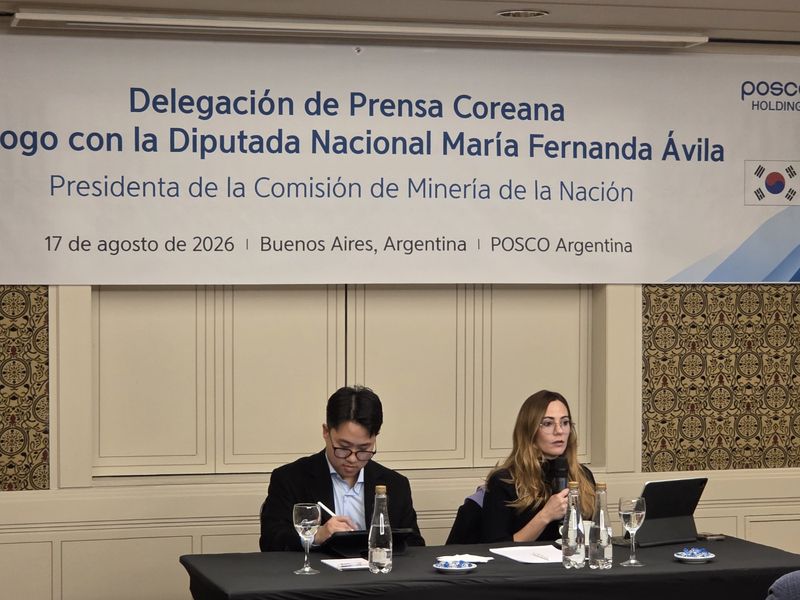
Fernanda Avila, chair of Argentina's federal congressional mining committee, made the remarks at a press briefing held at a local hotel in Buenos Aires on the 17th local time, referring to the relationship between South Korea and Argentina and POSCO Group's investment in the country.
Avila, who currently serves as a federal lawmaker representing Catamarca Province, is a local politician who supported POSCO's entry into Argentina from the sidelines while serving as national mining secretary, a vice minister-level post, and later as mining minister in Catamarca Province.
As Canada, the United States, China and Australia compete to secure resources in Argentina through investment, Avila assessed the strategic meaning of investment by Korean companies such as POSCO. "South Korea does not yet have the same scale of investment as some of the major historical players in Argentina's mining sector, but it has very significant strategic importance for us," she said.
Referring to POSCO Group's ongoing Sal de Oro project, which seeks lithium rights in large salt lakes in Salta Province and Catamarca Province, Avila said, "The relationship between the two countries is not limited to investment alone." She added, "We see South Korea as a particularly strategic partner. The two countries have clear mutual complementarity."
She explained that South Korea is an industrial and technological powerhouse that needs critical minerals for batteries, automobiles, steel and technology supply chains, while Argentina has resources but needs capital, technology and markets to develop them.
In the medium to long term, Argentina provides resources to South Korea, but receives even more investment from South Korea, Avila emphasized.
"In the case of POSCO's business in Argentina, its strategic location has greatly helped foster friendly relations between the two countries," Avila said. "This is my personal view, but during my time as mining vice minister and minister, the United States and China have maintained ties across various industries, but POSCO was the first to build a relationship with us in the mining sector."
Avila especially praised POSCO for contributing to local communities while cooperating not only with the Argentine government but also with provincial governments.
"It can be described as a friendly relationship in which the country provides resources and POSCO makes investments, but it cannot be seen as investment alone," she said. "I could feel that POSCO has maintained a long-standing relationship with provincial governments and plans to contribute to local communities for many years to come, while also valuing local talent, supplier creation and social aspects."
Avila added, "POSCO is no longer just an outside investor. It is a company that has put down roots in Catamarca and Salta and plans to remain for many years to come." She urged the company to create opportunities so that the growth of its investment increasingly aligns with local actors such as suppliers, workers and communities.
[email protected] Kim Hak-jae Reporter