"Why should Chinese nationals receive the National Pension Service in Korea?"... President Lee: "Prepare a swift alternative"
- Input
- 2026-08-25 15:38:06
- Updated
- 2026-08-25 15:38:06
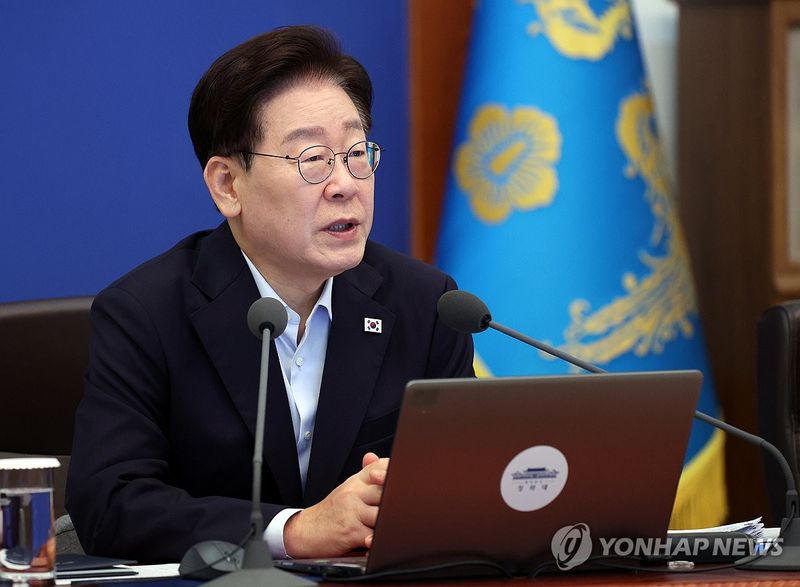
[Financial News] President Lee Jae Myung has ordered officials to quickly prepare an alternative in response to the controversy over foreign nationals receiving old-age pensions through retroactive contributions to the National Pension Service (NPS).
President Lee orders a fix for the controversy over the foreign retroactive contribution system
According to EDAILY on the 25th, President Lee raised the issue of the recent controversy over foreign nationals and the NPS during a State Council of South Korea meeting he chaired at Cheong Wa Dae that day, stressing that institutional loopholes must be addressed quickly.
President Lee said, "No system can be perfect, no matter how carefully it is designed, so gaps will always emerge." He added, "Efforts to eliminate those gaps are of course important, but when a gap is found, it must be filled as quickly as possible."
He also urged officials to "continuously examine problems in the process of implementation on the ground, because self-inspections alone cannot fully confirm whether a problem has occurred."
He went on to say, "This is not just an issue limited to one case. Problems can arise in every policy area. The real measure of capability is how quickly and thoroughly we correct those problems and come up with alternatives." He added, "I hope other policy areas will take this as a lesson."
Controversy over foreigners working for just one month and then paying 119 months of contributions to receive a pension for life
Earlier, controversy erupted as cases continued to emerge of foreign nationals who joined the NPS for only one month in Korea, paid 119 months' worth of contributions in a lump sum, and then received monthly old-age pensions for life.
Retroactive contributions are a system that allows subscribers who could not pay premiums because of unemployment or business suspension, or whose coverage was interrupted by marriage or childbirth, to pay them later.
Introduced in 1999, the system was expanded in November 2011 to allow payments of up to 119 months even for excluded periods, such as when a subscriber had a non-working spouse or was a basic livelihood recipient.
Recently, however, the number of foreigners using the system as a form of "pension investment" has reportedly been steadily increasing.
Foreign subscribers are also eligible for retroactive contributions during certain periods, and if they were registered as foreigners during those periods, they can apply to pay retroactively for up to less than 10 years.
As a result, many cases have been confirmed in which foreigners with residency statuses such as F-2, Overseas Korean (F-4) visa, Permanent Residence Visa, and F-6 visa, especially ethnic Koreans from China, made short-term contributions and then paid large retroactive premiums to meet the 120-month, or 10-year, requirement for pension eligibility.
Critics say such retroactive payments by foreigners do not align with the original purpose of the system, which was designed to protect pension eligibility for career-interrupted homemakers and low-income workers.
In addition, Article 126 of the National Pension Act states that foreigners cannot become voluntary subscribers, which creates a legal inconsistency with the current practice of allowing them to retroactively pay premiums for periods when they were non-working spouses.
As President Lee has called for countermeasures, attention is now focused on whether the system will be revised in a more refined way, including stricter rules on the minimum subscription period, eligible retroactive periods, and domestic residency and enrollment requirements for foreigners.
[email protected] An Ga-eul Reporter