U.S.-Iran Economic War Intensifies as China, Which Holds Iran’s Lifeline, Emerges as Key Variable
- Input
- 2026-08-25 15:15:27
- Updated
- 2026-08-25 15:15:27
[Financial News] As the United States moved to sanction even third countries that do business with Iran, Tehran retaliated by blacklisting vessels passing through the Strait of Hormuz. With the war dragging on for nearly six months, the conflict has widened into an economic battle in which the United States is trying to choke off Iran’s lifeline, while Iran is seeking to control the sea lane for global energy supplies. For U.S. sanctions to be effective, Washington must pressure China, Iran’s largest trading partner. But with a U.S.-China summit set for next month, the calculation over how hard to hit China has become more complicated.
U.S.: 'Cut off the lifeline' vs. Iran: 'Block the sea lane'
U.S. Treasury Secretary Scott Bessent said on the 24th local time that the United States was launching an 'economic isolation campaign' to cut Iran off from the international economy. After starting military operations on February 28, Washington has shifted to an economic blockade after failing to achieve its key goals of 'banning Iran’s nuclear program' and ensuring 'free passage through the Strait of Hormuz.'
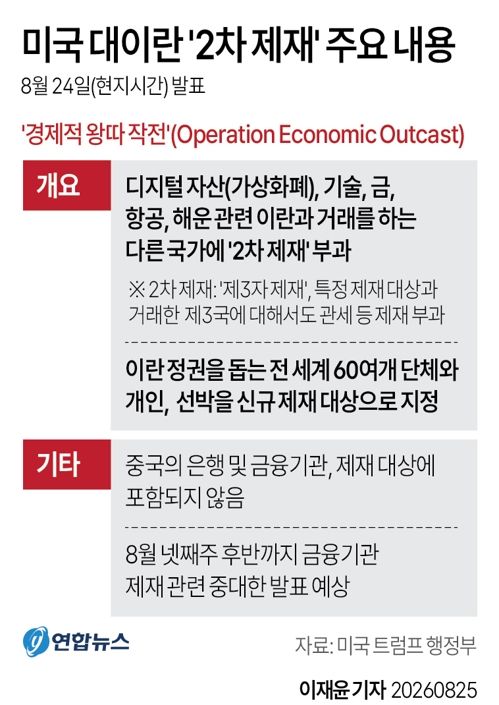
At the center of the effort is secondary sanctions targeting third countries that do business with Iran. The United States has decided to sanction countries and companies involved in transactions with Iran across five sectors: digital assets, technology, gold, aviation, and shipping. More than 60 organizations, individuals, and vessels around the world that support Iran’s nuclear and missile development and crude oil exports were also added to the new sanctions list.
Bessent unveiled a 'zero leakage' strategy aimed at blocking every network used for Iranian oil smuggling and sanctions evasion. He also warned that financial institutions helping Iran launder money would be cut off from the U.S. dollar system.
Iran responded through the Strait of Hormuz. The Persian Gulf Strait Authority said it had blacklisted 45 vessels, including oil tankers and liquefied natural gas (LNG) and liquefied petroleum gas (LPG) carriers, for violating transit rules. It also warned of fines, vessel detention, and cargo seizure. Five ships owned by Janggeum Maritime were included.
Iranian Economy Minister Ali Madanizadeh said, "We have prepared a two-year economic plan in anticipation of U.S. sanctions," adding, "They will not be able to cut our economic arteries." Mohammad Bagher Ghalibaf, speaker of Iran’s parliament, also dismissed the U.S. measures as bluff.
A bargaining chip ahead of the U.S.-China summit?
China is the biggest variable if Washington’s economic blockade is to have real impact. China is the key buyer, purchasing up to 90% of Iranian crude. To cut off oil sales, Iran’s main source of foreign currency, the United States would ultimately need to pressure not only Chinese refiners but also the financial institutions that facilitate the transactions.
However, the latest measures did not include direct sanctions on Chinese banks or financial institutions. When asked whether China would be targeted, Bessent only said, "No one can escape the reach of U.S. sanctions."
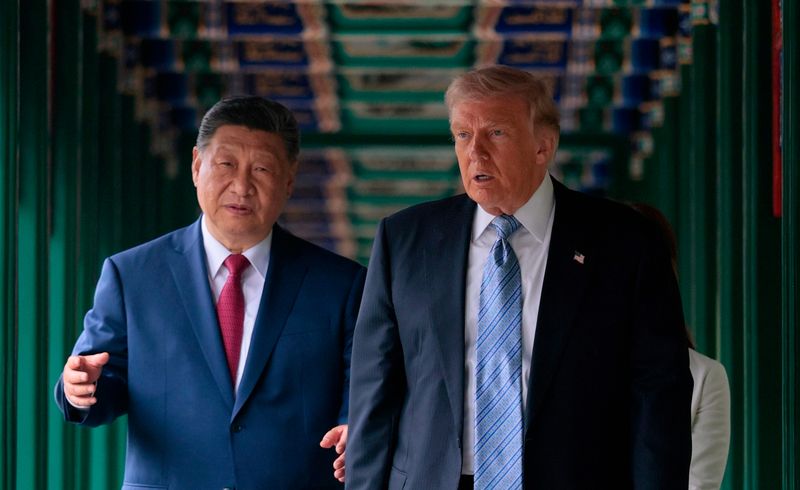
The upcoming summit between U.S. President Donald Trump and Chinese President Xi Jinping next month is a major obstacle. If China’s financial institutions are sanctioned while the two countries are maintaining a trade truce after last year’s tariff clash, the Iran issue could spill over into a broader U.S.-China confrontation. Some observers say Trump may hold off on direct sanctions against China for now and instead use them as leverage for the summit. In other words, he could keep the possibility of sanctions open and use it to pressure Xi Jinping.
Ahead of the summit, both sides appear to be working to manage the relationship. On the 25th in Beijing, a '1.5-track dialogue' involving current and former officials and experts from both countries was held to discuss cooperation in areas including the economy, trade, and artificial intelligence (AI). Wang Huning, who ranks fourth in China’s leadership hierarchy and serves as chairman of the CPPCC, also told the U.S. delegation that "we must respect each other’s core interests."
The United States is first seeking to persuade countries in private talks to cut ties with Iran. Bessent also signaled additional sanctions targeting major financial institutions within days or weeks. Whether Chinese financial institutions will be added to the list is now the key point to watch.
[email protected] Kim Kyung-min Reporter