"The chicken shop after retirement is a thing of the past"... Young entrepreneurs in their 20s and 30s are jumping into franchise startups
- Input
- 2026-08-27 15:09:30
- Updated
- 2026-08-27 15:09:30
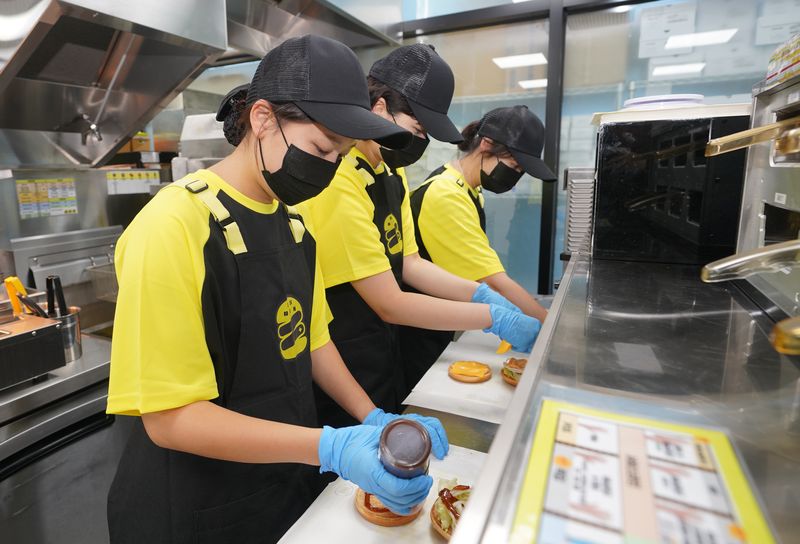
[Financial News] The old saying that people open a chicken shop after retirement is losing its relevance as more young people turn to franchise startups. With youth unemployment lingering, inquiries from young people looking for new opportunities through entrepreneurship have continued to rise. In response, the franchise industry is rolling out takeout stores and joint-investment models to make it possible to start a business with less capital and attract young entrepreneurs.
According to the franchise industry on the 27th, the share of franchise owners in their 20s and 30s at major restaurant brands had risen above 30% on average as of the end of last month. Genesis BBQ Group had the highest share of young franchisees, at 51.1%, meaning roughly one in two owners was in that age group. It was followed by Paik's Coffee, the cafe brand operated by The BORN Korea, at 36%, bhc Chicken at 31%, Kyochon Chicken and No Brand Burger at 25% each, and EDIYA COFFEE at 24%.
Until now, franchise startups were often associated with middle-aged and older people who had the financial means to open a chicken shop after retirement and start a business to support themselves. But as job hunting has become even more difficult, more young people are choosing entrepreneurship instead of looking for a job. Analysts also say changing values have played a role, as younger generations increasingly prefer independent economic activity over being tied to a workplace.
Industry sources say the share of young franchise owners, which stood at around 20% during the COVID-19 period, has surged to 30%. The expansion of the delivery and takeout markets has given young people, who are familiar with platform-based environments, an advantage in starting a business.
An industry official said, "When starting a business these days, there are more than five delivery apps to install, and there is a lot to learn, including company apps and rider dispatch systems." The official added, "You also have to learn payment systems such as Kakao, Naver and Toss, so young people who are familiar with platforms now have an advantage in entrepreneurship."
Lower initial investment costs have also contributed to the rise in young entrepreneurs. Franchise headquarters are expanding compact and takeout stores that can be opened with less than 100 million won to support startups by people in their 20s and 30s. No Brand Burger, operated by SHINSEGAE FOOD, runs compact stores that are smaller than standard outlets but optimize kitchen flow and space efficiency, allowing a startup investment of just over 90 million won for a store of about 50 square meters, or 15 pyeong. At the same time, low-cost coffee shops centered on takeout are rapidly increasing, and the food service industry is also expanding delivery-focused stores, creating more low-capital business models.
In addition, joint-investment models in which franchise headquarters share part of the lease deposit and other costs are also becoming more common. Under this model, the franchisor covers part of the initial costs, such as key money, deposits and franchise fees, and later takes a larger share of profits. It is seen as a suitable option for young entrepreneurs with limited upfront capital.
A franchise industry official said, "It is true that more young people are asking about starting a business." The official added, "Because the initial cost burden is heavy for younger generations, franchise headquarters are also considering training and financial support measures to reduce that burden."
[email protected] Park Kyung-ho Reporter