"Sales of 61.7 Billion Won, Profitable for Four Straight Years" ... Yet Facing Delisting Risk as a Penny Stock, the Paradox of Tougher Delisting Rules [Delisting Storm, Part 2]
- Input
- 2026-08-26 08:09:05
- Updated
- 2026-08-26 08:09:05
[Financial News] "Even this kind of blue-chip stock is being designated as a monitored stock? What exactly are the standards? I came in because it was profitable, but I still do not feel safe.""The financial authorities are making adjustments so that profitable companies will be exempt. Do not worry. It is the loss-making, distressed companies that will be pushed out, not profitable ones."These are posts that individual investors in KOSDAQ-listed Fashion Platform Co., Ltd. wrote on online communities. Fashion Platform is neither a so-called penny stock nor a loss-making company or one with capital impairment.
However, on the 13th, Fashion Platform was designated as a KOSDAQ monitored stock because its market capitalization fell short of the requirement. Contrary to the government’s explanation that the delisting standards were tightened to weed out distressed companies, market confusion is deepening as even firms that Korea Exchange classifies as "blue-chip" are being included among monitored stocks.
Corporate backlash is also growing stronger. In court recently, the first hearing was held on a preliminary injunction filed by companies that objected to the exchange’s decision to raise the market-cap threshold for delisting six months earlier than originally planned.
Designated as a monitored stock despite four straight years of profit
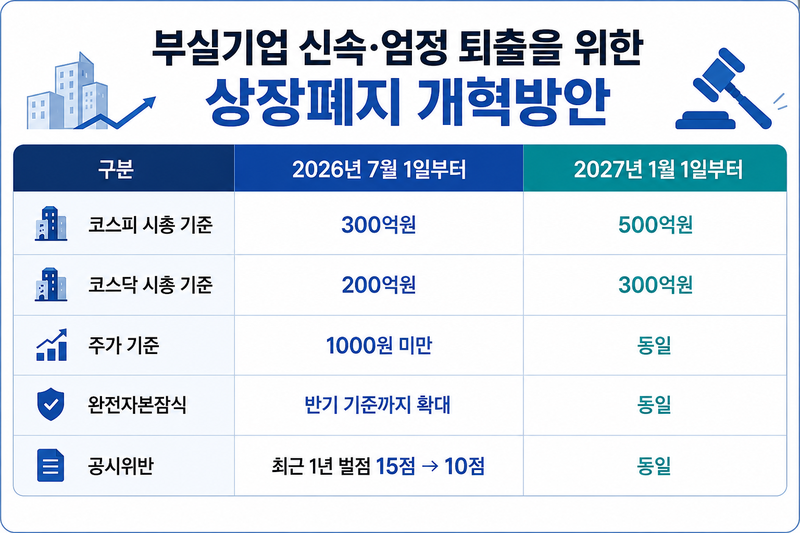
The government strengthened the delisting system to prevent so-called zombie companies from lingering on the stock market for years and repeatedly harming investors. The aim is to stop marginal firms that have been unable to cover interest expenses with operating profit for more than three years from using listed-company status to raise capital repeatedly or to abuse the market through stock manipulation, while directing funds toward more competitive companies.
Kim Gwang-jung, a lawyer at law firm Hankyul, said, "There are cases where marginal companies that have not been delisted are used for stock manipulation or attract new investors through capital increases, only to create fresh damage again." He added, "From a policy standpoint, there is a need to tighten delisting standards because such companies cannot simply be left alone forever."
According to Segye Ilbo on the 13th, 88 KOSDAQ-listed companies were at risk of being designated as monitored stocks after the delisting standards were tightened, due to market capitalization below 20 billion won or share prices under 1,000 won. On the 12th alone, 27 KOSDAQ stocks newly met the criteria for monitored-stock designation under the revised rules, and more cases have followed since then.
What stands out is that 11 of those companies were classified by the exchange, after separate screening and review, as either blue-chip firms or venture companies. Fashion Platform, which posted sales of 57.3 billion won and operating profit of 7.3 billion won in the first half of this year, is a profitable company and belongs to the blue-chip category.
In other words, even companies that the exchange has classified as blue-chip, or firms that post profits every year, can still be designated as monitored stocks if they fail to meet the share-price or market-cap requirements.
Jeongmoon Information is not in the blue-chip category, but it still recorded sales of 61.7 billion won in the first half of this year. That was up 49.8% from a year earlier, and it also posted operating profit, marking four consecutive years of profit.
One problem raised in this process is that a company’s operating performance and its share price do not necessarily move in the same direction. In Korea’s stock market, money is concentrated in a few large-cap names such as semiconductors, while KOSDAQ and small and mid-cap stocks are relatively neglected. As a result, many stocks fail to see their share prices rise even when their earnings improve.
Kim said, "If the KOSDAQ market itself cannot rise significantly, share prices are less likely to go up, and the risk of falling into penny-stock territory becomes greater." He added, "There are unavoidable aspects to the policy direction, but the issue is how to take individual companies’ circumstances into account when applying a uniform standard."
He also said, "There may be cases where individual companies are treated unfairly." He continued, "It is important to strike a balance between the public interest in removing distressed companies and the protection of existing investors."
"Like adding insult to injury" ... concerns over abuse of intentional delisting
There are also concerns that tougher delisting standards could be exploited in unexpected ways.
An official from the Korean Corporate Governance Forum (KCGF) said, "We agree with the purpose of clearing out listed companies that are merely occupying space in a distressed state and bringing in innovative companies and startups to revitalize the market." However, the official also noted that "some companies may actually be able to use the delisting requirements to the advantage of controlling shareholders," pointing out that the system is not necessarily unfavorable to them.
If controlling shareholders allow share prices to remain low or deliberately avoid raising corporate value, the tougher delisting standards could instead provide them with an exit.
The official explained, "If some controlling shareholders who do not want share prices to rise try to exploit the delisting requirements and pursue intentional delisting, it could become a case of 'like adding insult to injury.'" The official added, "If share prices plunge during the liquidation trading process, there is also concern that controlling shareholders could buy up minority shareholders’ stakes at bargain prices."
The official went on to say, "We need to consider whether delisting is truly a penalty for controlling shareholders." The official added, "In fact, innocent minority shareholders may suffer the greatest damage."
Delisting standards go to court ... corporate backlash intensifies
The controversy has spilled into legal disputes.
On the 21st, the Seoul Southern District Court held the first hearing on a preliminary injunction filed by two KOSPI-listed companies and one KOSDAQ-listed company against Korea Exchange. The companies argued that the exchange’s revised rule, which advanced the timing of the tougher market-cap requirement for delisting ahead of the original schedule, was invalid and asked the court to block their designation as monitored stocks.
Choi Cho-rong, a lawyer at law firm Chambers representing the companies, said, "Because the court must decide on the injunction on the premise that the listing rules themselves are invalid, it indicated that time for deliberation and sufficient grounds for judgment are needed." He added, "From the companies’ perspective, being designated as a monitored stock alone already causes many practical disadvantages."
The core issue raised by the applicant companies is the reasonableness of the market-cap standard.
Choi said, "The applicants argue that there is not enough rational explanation for why companies with a market capitalization below 50 billion won should be removed, or why companies with low market capitalization should be regarded as distressed firms." She added, "In particular, they believe there is no clear basis for why the threshold should be 50 billion won."
She also challenged the investor-protection logic cited by the exchange.
Choi said, "The argument is that if market capitalization is low, liquidity is small and volatility is high, making such stocks more likely to be abused for price manipulation. But separate delisting rules already exist for companies with low liquidity."
She also raised concerns about the unfairness of moving up the implementation date.
[email protected] Seo Yoon-kyung Kim Hee-sun Reporter