"Stock Market Correction and High Prices"... Consumer Sentiment Tumbles for the First Time in Four Months
- Input
- 2026-08-25 15:41:57
- Updated
- 2026-08-25 15:41:57
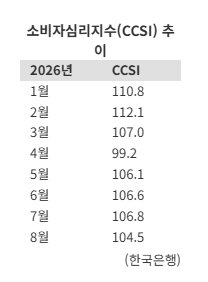
According to the results of the August 2026 Consumer Sentiment Survey released by the Bank of Korea (BOK) on the 25th, the Composite Consumer Sentiment Index (CCSI) stood at 104.5 in August. That was down 2.3 points from the previous month’s 106.8, ending the three-month uptrend that began in May.
Still, it remained above the long-term average of 100, based on the benchmark period from January 2023 to December 2025, suggesting a relatively optimistic reading.
The CCSI is a sentiment indicator calculated using six major indices from the Consumer Sentiment Index (CSI). The CSI is compiled by surveying 2,500 urban households nationwide on their perceptions of economic conditions and expectations for future consumer spending.
Kim Se-yong, head of the Economic Tendency Survey Team at the BOK’s Economic Statistics Department 1, explained that "despite a solid real economy, perceived conditions weakened due to the correction in the domestic stock market and accumulated price increases." Park Yong-min, head of the Economic Tendency Survey Team, also interpreted the data by saying that "although consumer prices fell from 3.2% in July to 2.8%, the result reflects the cumulative effect of sustained increases above 3% in living costs and other items."
Looking at perceptions of household finances, the Current Household Financial Situation CSI and the Household Financial Outlook CSI both fell by 1 point from the previous month to 92 and 97, respectively. The Household Income Outlook CSI, at 100, and the Consumer Spending Outlook CSI, at 109, also each declined by 1 point.
Sentiment on both current and future economic conditions was pessimistic. The Current Economic Conditions CSI fell 5 points to 79, while the Future Economic Outlook CSI dropped 3 points to 89.
The Employment Opportunities Outlook CSI and the Interest Rate Outlook CSI stood at 86 and 125, down 3 points and 1 point from the previous month, respectively. The latter had been revised upward every month since last October, when it rose from 93 to 95, before turning slightly lower in May. It then rebounded sharply in June and held that level through July.
In perceptions of household savings and debt conditions, the Current Household Savings CSI fell 3 points to 94, while the Household Savings Outlook CSI remained unchanged at 100. The former is the lowest level in one year and three months, since May last year, when it stood at 93. Park noted that "because the measure includes not only bank deposits and savings but also stocks and funds, the decline in share prices had a negative impact."
The Current Household Debt CSI was unchanged from the previous month at 100, while the Household Debt Outlook CSI fell 1 point to 97.
In perceptions of price conditions, the Price Outlook CSI remained unchanged from the previous month at 149. The Housing Price Outlook CSI fell 2 points to 125, ending a four-month streak of gains.
The Wage Outlook CSI edged down 1 point from the previous month to 123.
Perceptions of consumer price inflation over the past year were unchanged from the previous month at 3.0%. Expected inflation for the next 1 year also remained at 2.7%. For both the 3-year and 5-year outlooks, the figure was unchanged at 2.6%. Across all time horizons, the share of respondents citing inflation in the 2% to 3% range was the highest, at 31.6%, 31.5%, and 30.4%, respectively.
When asked which items would have the biggest impact on consumer price increases over the next year, respondents cited petroleum products first at 50.2%, followed by agricultural, livestock and fishery products at 42.0%, and public utility charges at 33.3%. Compared with the previous month, those figures were down 7.3 points, up 7.9 points, and down 0.3 points, respectively.
[email protected] Kim Tae-il Reporter